

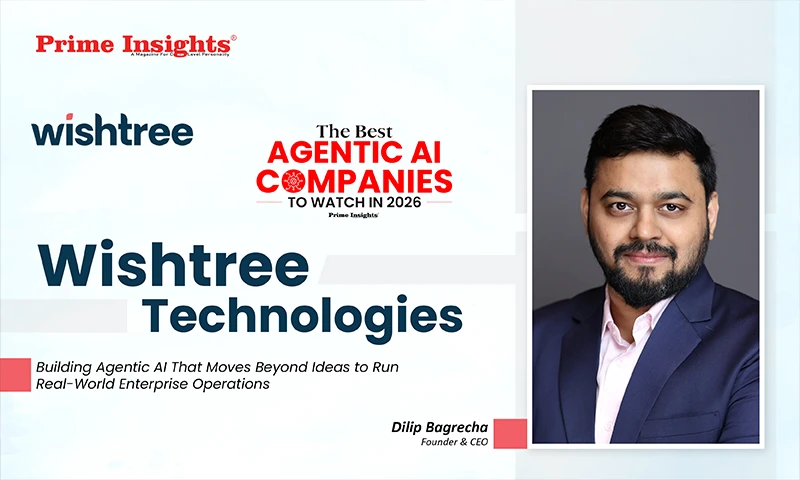
Wishtree Technologies
Did you know that by the end of 2026, the average office worker will likely spend more time “managing” AI agents than they do managing their own email inboxes? We have officially moved past the era where AI was just a fancy search engine or a chatbot that gave occasional “creative” answers. In today’s hyper-competitive landscape, the industry has shifted toward Agentic AI—autonomous systems that don’t just talk about work, but actually get it done. The competition is no longer about who has the smartest software but who can deploy a digital workforce capable of solving multi-step problems without constant hand-holding. For businesses, the stakes are simple: evolve into an AI-augmented powerhouse or get left behind by those who do.
At the forefront of this transformation is Wishtree Technologies, an AI-native product engineering powerhouse founded in 2010. Led by Dilip Bagrecha, Founder & CEO, the company was born from a vision to democratize top-tier digital services and has since grown into a 150+ member team of “doers.”
Bagrecha is an entrepreneur who built Wishtree on openness, ambition, and honesty. A career spanning Infosys, RBS, and UBS instilled in him a discipline for large-scale, mission-critical engineering. This path led him to build a company that is now a trusted technology partner for global enterprises and innovative startups. His message to the industry is clear: the future belongs to those who turn advanced concepts into dependable, everyday operations.
Wishtree’s approach is defined by “practical execution.” Rather than providing generic AI wrappers, they design closed-loop, autonomous systems that integrate seamlessly with existing enterprise tech stacks. Supported by a leadership team including Sumeet Shetty (DevOps), Suketu Naik (Technical Architect), Abhay Chopra (Project Management), and Business Development managers Amit Majithiya and Nasir Shaikh, the firm specializes in creating “goal-oriented intelligence.” Whether it is automating patient scheduling in healthcare or building complex quoting engines for the HVACR industry, Wishtree utilizes multi-agent architectures and robust data pipelines to ensure that AI doesn’t just suggest—it acts, learns, and delivers measurable financial impact.
In the spotlight is Dilip Bagrecha, Founder & CEO, in an interview for our prestigious “The Best Agentic AI Companies To Watch In 2026” edition. Learn from his insights and valuable lessons as an entrepreneur to excel and make your organization the best it can be. Stay tuned and know his tale of success.
Prime Insights: Can you introduce your company and explain its core focus in the field of agentic AI?
Wishtree Technologies is an AI-native product engineering services firm with over 15 years of experience. We build and scale complex software systems. We design and implement autonomous systems that run real business workflows across industries like SaaS, fintech, healthcare, wholesale distribution, and supply chain. Our strength lies in turning advanced agentic concepts into dependable systems that work inside day-to-day operations, not demos.
Our core focus in agentic AI is practical execution. We work closely with our clients to deeply understand their business and pain points and then implement agentic AI solutions that deliver clear, measurable ROI.
Prime Insights: What inspired your move into building autonomous or semi-autonomous AI agents, and how has your journey evolved so far?
We saw many AI initiatives fail, not because the models were weak, but because they never fit into real operations. That gap pushed us toward agentic systems. Our journey evolved from traditional product engineering to building closed-loop systems where AI can act, learn, and escalate when needed.
Today, our agents handle everything from inventory procurement to patient scheduling.
Prime Insights: How do you define agentic AI, and what differentiates your solutions from traditional AI or automation platforms?
We like to think of it as goal-oriented intelligence. Traditional automation follows a preset path. Agentic AI is given an objective and determines its own path to achieve it. We differentiate by being platform-agnostic orchestrators. We implement the best-fit agentic system, like Syllable for healthcare, and ensure it communicates seamlessly with a company’s entire tech stack.
Prime Insights: What key problems or use cases do your AI agents solve across industries?
Our implemented agents take over complex, multi-step workflows. For instance, we have automated patient triage for one healthcare leader and a quoting engine for an HVACR giant that consolidates data from dozens of suppliers—turning days of work into hours.
Prime Insights: How do your agentic systems balance autonomy, human oversight, and decision accountability?
Autonomy does not mean loss of control.
We architect precise human-in-the-loop triggers into the workflow. The agent operates independently but is hardwired to escalate decisions that fall outside defined parameters of cost, risk, or complexity.
Prime Insights: What role do large language models, reinforcement learning, or multi-agent architectures play in your technology stack?
LLMs provide the cognitive layer, and our core contribution is the orchestration and integration layer. We design multi-agent systems in which specialized agents collaborate. We build robust, secure data pipelines using tools such as AWS SageMaker to enable these agents to operate within an enterprise environment.
Prime Insights: How do you ensure safety, reliability, and alignment of AI agents in real-world deployments?
From the first architecture session, we implement guardrails, comprehensive audit trails, and zero-trust data principles to ensure reliability and alignment are built into the system’s core.
Prime Insights: Can you share a success story where your agentic AI solution delivered measurable business impact?
We implemented an agentic system for an HVACR client that automated a complicated, manual quote-to-order process. They got a 35% increase in win rates and over $1.5M in annual operational savings because errors and rework could be eliminated.
Additionally, for a multi-specialty healthcare provider, we deployed an AI scheduling agent that analyzes EHR data and provider calendars to autonomously manage appointments. This reduced patient no-shows by 28% and recovered over $800K in annual revenue.
Prime Insights: How do you address data privacy, security, and regulatory compliance in autonomous AI environments?
We treat data privacy as a non-negotiable system requirement. Our implementations are designed on a zero-trust framework. Client data never trains our models but flows through encrypted, compliant pipelines within their own approved cloud environment. And of course, they meet standards like HIPAA and GDPR by architecture.
Prime Insights: What industries or functions (enterprise operations, customer support, software engineering, healthcare, finance, etc.) are seeing the highest adoption of your agentic AI solutions?
We see the fastest adoption in healthcare, HVACR, and fintech. These are sectors where processes are data-heavy, compliance-critical, and have a direct, measurable cost of delay—making the ROI of a well-implemented agentic system immediately obvious.
Prime Insights: How do you measure the performance, learning efficiency, and ROI of deployed AI agents?
We measure the performance of the process the agent owns—reduction in cycle time, improvement in data accuracy, decrease in operational cost, and increase in conversion rate or customer satisfaction.
Prime Insights: What ethical principles guide your development and deployment of agentic AI systems?
We believe in deploying agentic AI that amplifies human expertise and judgment. Our ethical framework prioritizes transparency, auditability, and ensuring humans remain firmly in the loop for high-stakes decisions.
Prime Insights: How do you see agentic AI transforming the future of work and decision-making by 2026 and beyond?
By 2026, we will stop talking about AI tools and start managing AI teams. Human work will evolve from execution to strategy, oversight, and nurturing the AI systems that handle operational complexity.
Also, as a member of HARDI, we are specifically focused on bringing this vision to the HVACR distribution sector, where the move from manual to agentic can redefine market leadership in 2026.
Prime Insights: What are your company’s roadmap and innovation priorities for scaling agentic AI capabilities globally?
We are scaling our implementation frameworks and deep partner ecosystem (with leaders like Syllable) to help global enterprises transition from experimental pilots to production-grade, AI-driven operations.
Prime Insights: What advice would you give to enterprises considering the adoption of agentic AI and to startups building in this emerging space?
For enterprises, prioritize finding an implementation partner with deep engineering expertise over chasing the latest model. Brilliant agentic AI is useless if it remains stuck in the lab because it cannot talk to your database.
For startups, build for composability. Your agent should be a best-in-class specialist that can be easily plugged into a broader operational symphony. Your success depends on playing well with others. Focus on a targeted agentic AI solution to deliver a quick, measurable win.
