

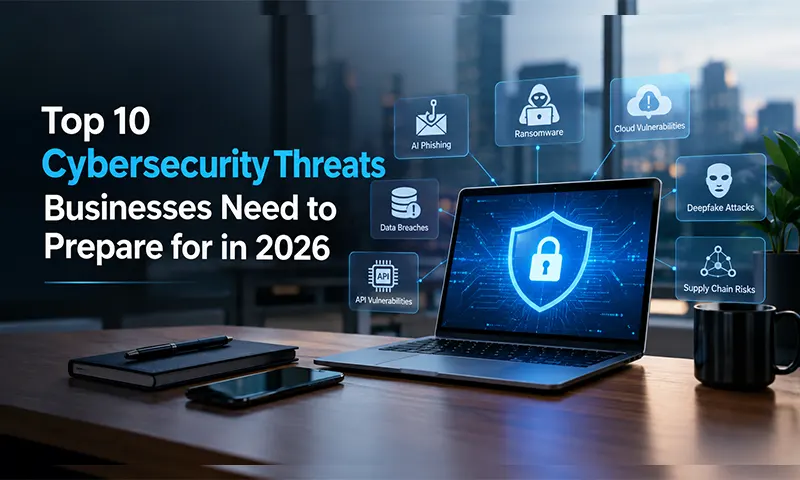
Cybersecurity Threats Businesses
The digital age is now hyper-connected, with a shifting corporate landscape. Simple computer viruses have evolved into potent cybersecurity threats for businesses. Understanding the basic nature of these cyber threats in 2026 is a matter of concern for every IT department. It is a fundamental step to be taken for any business foundation.
To safeguard intellectual property and ensure uninterrupted operational continuity with customer trust, leaders must stay ahead of emerging business cybersecurity risks. The cost of a breach is not financial loss but mental and social harassment as well. To avoid severe reputational damage, here are the top 10 cybersecurity threats for businesses:
AI-Driven Phishing and Social Engineering
AI has revolutionised many industries, but it has given access to many cyber criminals to breach data, get hold of companies’ credentials and steal legitimate information. AI-generated phishing emails cannot be distinguished since they are completely spelling-error-free. These sophisticated social engineering tactics represent one of the most pervasive cybersecurity threats for businesses and trick employees into revealing sensitive login information.
Ransomware 3.0 (Double and Triple Extortion)
Nowadays, ransomware is not just file encryption and demanding a direct payment for decryption. Hackers these days steal data first and threaten to leak it publicly by contacting a company’s clients if they don’t get the required ransom. This multi-layered extortion approach makes ransomware a critical cybersecurity threat for businesses with zero–trust network frameworks.
Supply Chain Vulnerabilities
Cyberthreat criminals generally target third-party vendors and software supply chians who are directly linked to an well-established enterprise. Attackers gain a backdoor by compromising a smaller, less secure vendor to access larger corporate networks. Managing these third-party business cybersecurity risks needs stringent vendor risk assessments, network monitoring, and access limitations.
Cloud Infrastructure Misconfigurations
Most organisations push their sensitive data into the cloud for storage, with poor identity and access controls and misconfigured storage buckets. This becomes a massive liability. Threat actors act on automated scripts to scan the net and get open doors to the company’s most private data. Thus, proper cloud security posture and configuration management are necessary for effective data breach prevention.
IoT and Smart Device Exploitation
Cyberattacks have exponentially increased through the Internet of Things (IoT). From internet-connected manufacturing equipment to smart thermostats and security cameras, many devices lack robust built-in security and also lack firmware updates. Unsecured IoT networks are becoming major cybersecurity threats for businesses.
Deepfake Technology and Executive Impersonation
To impersonate high-level executives, audio and video deepfakes are becoming common. In highly publicized cases, cyber threats in 2026 manipulate human trust by convincing people through voice memos or live video calls from their known CEOs requesting urgent sharing of confidential information and fund transfers.
API Vulnerabilities
Application Programming Interfaces (APIs) act as a bridge to hold the modern software ecosystem with integrations. In case of broken object-level authorisation and exposed APIs, attackers get the license to bypass traditional front-end security measures. They can also now access the backend database directly, posing significant cybersecurity threats for businesses.
Insider Threats (Intentional and Accidental)
Not all malicious activities originate outside the organisations. Simply negligent workers, employees seeking past revenge, or those who easily mishandle passwords can breach companies’ trade secrets and expose them to scammers. Thus, sharing improper data and causing a substantial loss. Organisations must work on user behaviour analytics and access controls to mitigate these internal business cybersecurity risks.
5G Network Interception
Adoption of 5G communication has increased the widespread use of the internet due to fast networking. Now, data transfers are easier, and new network routines are introduced with slicing vulnerabilities. This helps hackers access new ways to explore massive data volumes in transit across cellular networks, causing 5G to be a growing threat to mobile workforces.
State-Sponsored Cyber Espionage
So many geopolitical tensions continue to rise these days. Nation-state-funded Advanced Persistent Threats (APTs) target corporate intellectual property, trade secrets, and critical infrastructure. Therefore, defending against these highly sophisticated, well-funded cybersecurity threats for businesses needs enterprise-grade threat intelligence and planning of proper disaster management.
How to defend?
Taking proactive measures is necessary. Measurable steps include implementing cybersecurity best practices for businesses. Start with mandatory, regular employee training classes so that the staff recognises any attempts at AI phishing and deepfake scams. Across all internal and external platforms, implement Multi-Factor Authentication (MFA) and also adopt a Zero Trust architecture such that no device or user is trusted by default, regardless of their location. Leadership teams must focus on data breach prevention to encrypt sensitive information. There should be regular penetration testing and scanning to identify and patch API, cloud, and software vulnerabilities. Also, a robust, tested response plan must be in place so that, upon any breach, the IT teams can communicate well amongst themselves.
These steps are a guarantee against future vulnerabilities and potent threats. To avoid financial and reputational disaster, understand these top cybersecurity threats for businesses and actively deploy modern defense strategies to protect the bottom line of organisations.
