

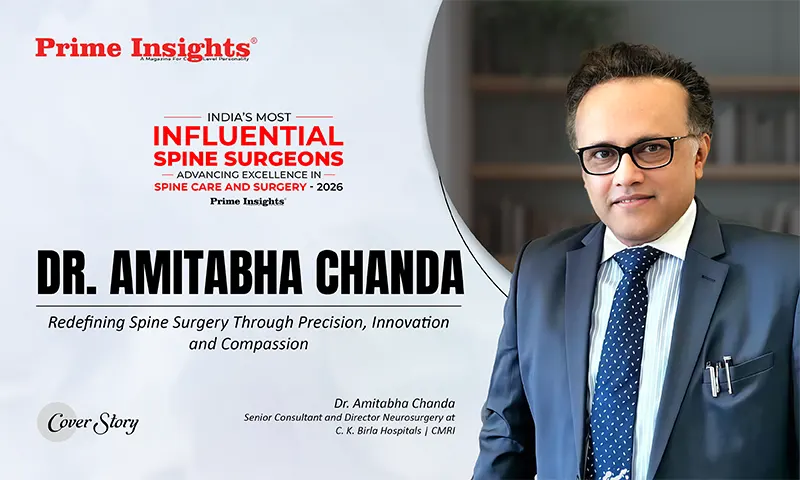
Dr. Amitabha Chanda | C. K. Birla Hospitals | CMRI
Few areas of modern medicine demand as much precision, patience and judgement as spine surgery. With spinal disorders becoming an increasingly important healthcare concern, the field has evolved rapidly, driven by minimally invasive techniques, advanced imaging, navigation, robotics and sophisticated instrumentation. Today, the challenge is no longer simply to perform a successful operation, but to achieve the desired outcome while preserving as much normal anatomy as possible and enabling patients to return to their lives sooner.
One name that reflects this journey is Dr. Amitabha Chanda, an internationally renowned neurosurgeon whose glittering academic career was followed by extensive advanced training across the US, Canada, Germany, Switzerland, Austria, Hong Kong and Korea. He stood first in Neurosurgery at PGIMER, Chandigarh, and has contributed extensively to neurosurgery through clinical work, research, publications and innovation. He is also the pioneer of Awake Brain Surgery for brain tumours in Eastern India and Bangladesh and has received several honours for his contribution to medical science and neurosurgery.
Currently Senior Consultant and Director of Neurosurgery at C. K. Birla Hospitals | CMRI, Dr. Chanda has devoted more than three decades to neurosurgery, with a significant part of his practice focused on complex spinal disorders. In 2008, he became the first surgeon in Kolkata to perform minimally invasive spine surgery. He has also developed a unique lateral approach for complex cervical dumb-bell tumours, reflecting his philosophy of achieving the surgical objective while preserving normal anatomy and spinal stability whenever possible.
In the spotlight is Dr. Amitabha Chanda in an interview featured in our prestigious “India’s Most Influential Spine Surgeons Advancing Excellence in Spine Care and Surgery 2026” edition. Through his insights and valuable lessons, he shares his journey as a surgeon, his approach to innovation and patient care, and his vision for the future of spine surgery. Stay tuned to discover his tale of excellence and the principles that continue to shape his remarkable journey.
Prime Insights: Could you introduce yourself and share your journey into spine surgery and your evolution as a spine specialist?
I did not set out to become a spine specialist. Spine surgery, in a sense, found me.
I began my career as a neurosurgeon with a fascination for cerebrovascular and skull-base surgery. But after returning to India following advanced training abroad, I realised that a very large proportion of patients seeking neurosurgical care were suffering from spinal disorders, many of whom required surgery. I understood that if I wanted to serve these patients comprehensively, I needed to expand beyond the spine surgery I had originally been taught.
I completed my MCh in Neurosurgery from PGIMER, Chandigarh, in 1996. Following this, I underwent advanced training in the United States and Canada, primarily in cerebrovascular and skull-base surgery. Those years taught me precision, patience and immense respect for anatomy. I learnt that the best surgical corridor is not necessarily the largest one; it is the one that reaches the pathology while disturbing the least amount of normal anatomy.
Back in India, I asked myself whether my MCh training alone was sufficient to address the entire spectrum of modern spinal pathology. My answer was no. I became a student again, undertaking training through AO Spine in instrumentation, fixation, reconstruction and newer operative techniques.
This also drew me towards minimally invasive spine surgery. In 2008, I became the first surgeon in Kolkata to perform minimally invasive spine surgery. For me, it was never merely about a smaller incision. Its real purpose is to minimise collateral tissue damage while accomplishing the surgical objective effectively and safely.
I later developed a unique lateral approach to the cervical spine for large dumb-bell tumours, allowing access while preserving the facet joint and, in selected cases, avoiding additional fixation.
My evolution has been driven by clinical necessity, continuous learning and an uncompromising respect for anatomy. After three decades, one conviction remains strong: a surgeon must remain a student throughout his professional life.
Prime Insights: What inspired you to specialize in spine care and surgery, and what continues to motivate you in this field?
Spine surgery emerged from the needs of my patients. The sheer volume and diversity of spinal disease I encountered made me realise that I had to continually expand my knowledge.
What continues to motivate me is not the complexity of an operation, but the life that can be restored afterwards. Every patient wants something simple—to return to work, hold a child, walk without pain or simply sleep through the night.
A spine surgeon is not defined by the complexity of the operation he performs, but by the life he restores afterwards. That pursuit, more than any title or milestone, continues to drive me every day.
Prime Insights: How have advancements in spine surgery and technology transformed patient outcomes and recovery over the years?
The transformation in spine surgery during my professional lifetime has been extraordinary. The spine surgery I learnt as a young trainee in the 1990s and the surgery I practise today almost seem to belong to two different eras.
Earlier, large exposures, considerable muscle dissection, greater blood loss, postoperative pain and longer hospitalisation were often accepted as inevitable. Today, the philosophy has fundamentally changed.
It is no longer enough merely to accomplish the operation; we must accomplish it with the least possible collateral damage.
Advances in imaging, microscopes, endoscopes, instrumentation, intraoperative imaging, navigation and neuromonitoring have dramatically improved precision and safety. Minimally invasive spine surgery has also transformed recovery. In appropriately selected patients, it can mean less muscle injury, less blood loss and postoperative pain, earlier mobilisation and a quicker return to normal life.
Technology has also expanded what we can safely attempt, including complex tumours, deformities, fractures and lesions close to critical neural and vascular structures.
Yet I remain cautious about our fascination with technology. Robotics, navigation and artificial intelligence will undoubtedly reshape the specialty, but no machine can replace clinical judgement, knowledge of anatomy or the experience of knowing when not to operate.
Technology can make a good surgeon better, but technology alone cannot make someone a good surgeon.
Prime Insights: What are the most common challenges you encounter while treating patients with complex spinal conditions?
In spine surgery, the most difficult operation is sometimes the one you decide not to perform.
The greater challenge is often judgement—whom to operate upon, when to operate, what operation to offer and when to leave well enough alone.
This is particularly evident in degenerative spine disease. An MRI may look frightening while the patient remains reasonably functional, while modest radiological changes may produce disabling symptoms. I firmly believe that we must treat the patient, not the MRI.
The therapeutic decision may involve medication, physiotherapy, intervention or surgery. If surgery is required, we must decide whether decompression alone is adequate, whether fixation is necessary, and whether a minimally invasive or open approach is safer.
Complex tumours, deformities, trauma and revision surgeries bring another challenge because we may be working within millimetres of the spinal cord, nerve roots or vertebral artery. The desire for radiological perfection must never override neurological safety.
Patients also need honest expectations. We may perform an excellent operation, but neurological recovery depends on the severity and duration of pre-existing damage.
A surgeon must offer hope, but never manufacture hope.
Prime Insights: How have minimally invasive, robotic-assisted, and navigation-guided procedures contributed to safer and more precise spine surgery?
When I began neurosurgery, the surgeon’s eyes, hands and knowledge of anatomy were our principal navigation systems. Today, technology allows us to see farther, plan better and operate with remarkable precision.
The real value of minimally invasive surgery, navigation and robotics lies in helping us accomplish what is necessary with greater precision, greater safety and less disruption of normal anatomy.
I started performing minimally invasive spine surgery in Kolkata in 2008. Its greatest advantage is not the cosmetic appeal of a smaller incision, but the ability to reach the pathology while minimising muscle disruption and preserving normal anatomy.
Navigation adds three-dimensional spatial accuracy, particularly during instrumentation, deformity surgery, revision procedures and minimally invasive operations. Robotics can assist in planning trajectories and executing certain precision-dependent steps.
But I remain pragmatic.
A robot does not make the decision to operate. Navigation does not decide how much decompression a patient needs.
These technologies are extensions of surgical judgement and skill, not substitutes for them. In India, their cost must also be justified by meaningful benefits to patients.
My philosophy is simple: use the most advanced technology when it genuinely improves safety, precision or recovery—but never use technology merely because it is available.
Prime Insights: What role does early diagnosis and timely intervention play in preventing the progression of spinal disorders and improving treatment outcomes?
In spinal disorders, time can sometimes be as important as the treatment itself.
Once the spinal cord or a nerve has suffered irreversible damage, even sophisticated surgery cannot turn the clock back. I have seen patients diagnosed and treated at the appropriate time and return to normal life, but I have also seen patients arrive after months of progressive weakness, difficulty walking or loss of hand function when the opportunity for complete recovery has diminished.
Early diagnosis, however, should never be confused with early surgery. Many degenerative conditions can be managed with medication, physiotherapy, lifestyle modification and observation.
Warning signs such as progressive weakness, increasing numbness, deterioration in walking or balance, loss of hand dexterity, bladder or bowel dysfunction, or rapidly worsening neurological symptoms should never be ignored.
This is particularly important in cervical myelopathy, spinal tumours, severe spinal canal stenosis, infections and spinal trauma.
The purpose of timely surgery is sometimes not merely to make you better—it is to prevent you from becoming worse.
Ultimately, timing is not about operating early. It is about not being late.
Prime Insights: How do you personalize treatment strategies for patients with varying spinal conditions, age groups, and levels of disease complexity?
Every MRI has a story that it cannot tell. The scan shows me the disease; the patient tells me what needs to be restored.
Two patients may have almost identical abnormalities on MRI and yet require entirely different treatment. Their age, health, profession, expectations and the impact of the condition on daily life all matter.
Before deciding on treatment, I try to understand one thing: what has this spinal problem taken away from this person’s life?
Many spinal conditions do not require surgery. When surgery is necessary, there are still choices: decompression or fixation, minimally invasive or open surgery, shorter procedures for elderly or medically fragile patients, and preservation of normal anatomy and mobility in younger patients.
With complex tumours, deformities, trauma and revision surgery, the temptation to perform the most extensive procedure must be tempered by one question: Will doing more actually give this patient a better life?
The best spine operation is not the biggest, newest or most sophisticated one. It is the operation that gives that particular patient what he or she genuinely needs, with the least possible risk and disruption.
Prime Insights: Could you share a memorable or challenging spine surgery case that had a significant impact on your career?
He came to me after spending nearly eighteen months in bed, unable to move three of his limbs and with only faint movement remaining in the fourth. He was a mason from Murshidabad whose livelihood depended entirely on the strength of his arms and legs.
His MRI revealed a large cervical dumb-bell tumour that had severely compressed and almost flattened the cervical spinal cord while extending through the neural foramen into the neck.
I had developed a lateral cervical approach for such lesions. By carefully identifying and mobilising the vertebral artery, I could reach the neural foramen while preserving the facet joint and access both the intraspinal and extraspinal components through the same corridor. This allowed removal of the tumour in a single stage without cervical fixation.
But I did not know whether, after eighteen months of severe spinal cord compression, he would ever walk again.
I had a long and candid discussion with him and his family. I explained the risks and, most importantly, the uncertainty of neurological recovery. I could promise my best effort, but never that he would walk again. They understood and wanted to take the chance.
I operated, and the tumour was removed through the lateral approach while preserving the facet.
The next morning, I noticed tiny flickers of movement in his limbs.
They meant hope.
His recovery surprised even me. Within about a week he began walking with a walker. At around six weeks, he was walking without support, and approximately three months after surgery, he returned to work as a mason.
Sometimes, the true success of spine surgery is not measured in millimetres of tumour removed or screws perfectly placed. Sometimes, it is measured simply by a man being able to stand on his own feet again.
Prime Insights: How does a multidisciplinary approach involving physiotherapists, neurologists, pain specialists, radiologists, and rehabilitation teams enhance spine care?
A spine surgeon may perform the operation, but restoring a patient to life is rarely the achievement of the surgeon alone.
A radiologist defines the pathology and its anatomical nuances; a neurologist helps distinguish spinal disease from other neurological disorders; pain specialists provide valuable non-operative interventions; and physiotherapists play a crucial role in restoring mobility, strength and confidence.
Rehabilitation is particularly important after spinal cord injury, severe myelopathy, major trauma and complex tumour surgery. An operation can decompress the spinal cord, but recovery does not end when the wound is closed.
The surgeon may remove the obstacle to recovery; the multidisciplinary team helps the patient reclaim function, confidence and independence.
I regard good spine care not as an individual performance, but as an orchestra. Every member has a different instrument, but the outcome depends upon how well we play together.
Prime Insights: What milestones, innovations, research contributions, or achievements best reflect your contribution to advancing spine surgery in India?
I would prefer my peers to judge the significance of my contribution, but certain milestones have been particularly meaningful to me.
One was my early adoption of minimally invasive spine surgery. In 2008, I became the first surgeon in Kolkata to perform MISS, when these techniques were still relatively unfamiliar in this part of India.
The other area particularly close to me is complex cervical dumb-bell tumours. I devised a lateral cervical approach that allows access to both the intraspinal and extraspinal components while preserving the facet joint. In selected patients, the entire tumour can be removed in a single stage without sacrificing spinal stability or requiring fixation.
What gives me particular satisfaction is the philosophy behind the technique: complexity of pathology need not automatically translate into complexity or destructiveness of the operation.
I regard these milestones not as destinations, but as part of a continuing journey of learning and reinvention.
Prime Insights: How do you incorporate emerging technologies such as artificial intelligence, robotics, advanced imaging, and computer-assisted navigation into your practice?
I look at new technology with two emotions—excitement and healthy scepticism. I believe a surgeon needs both.
Advanced imaging has transformed our ability to visualise complex spinal anatomy and plan procedures. Navigation adds three-dimensional spatial accuracy, while robotics can improve reproducibility in planned trajectories and certain precision-dependent components of surgery.
Artificial intelligence may ultimately prove even more transformative. Its ability to analyse large volumes of imaging and clinical data could assist diagnosis, risk stratification, outcome prediction, surgical planning and postoperative surveillance.
But adoption should be evidence-driven rather than fashion-driven. Particularly in India, we must ask whether an expensive technology produces a meaningful improvement that justifies the additional financial burden.
I embrace innovation when it solves a genuine clinical problem.
The future operating theatre will undoubtedly become more digital, intelligent and interconnected. But data can inform a decision; responsibility for that decision must ultimately remain with the surgeon.
Prime Insights: What are some of the most common misconceptions patients have about spine surgery, and how do you help them make informed treatment decisions?
Perhaps the sentence I hear most frequently is: “Doctor, somebody told me that if I undergo spine surgery, I may never walk again.”
Fear of paralysis remains deeply ingrained, and some patients postpone necessary treatment because of stories heard from relatives, neighbours or social media.
At the opposite extreme, some patients become frightened by an MRI report and assume that every disc bulge, degeneration or stenosis requires surgery. Many such conditions require nothing more than reassurance, exercise, physiotherapy or appropriate medical management.
There are also misconceptions that fixation inevitably causes permanent stiffness, laser surgery can cure virtually every spinal disorder, a smaller incision automatically means a better operation, or robotic surgery guarantees a superior result.
My approach is education rather than persuasion. I show patients their images and explain, in ordinary language, what is abnormal, what is important and what can safely be ignored. If there are several reasonable options, I discuss them.
Informed consent should never be reduced to obtaining a signature. It should leave the patient genuinely informed.
Prime Insights: What advice would you give to young surgeons aspiring to specialize in spine surgery and build a meaningful career in this evolving field?
Learn anatomy before technology, principles before procedures, and patience before ambition.
A young surgeon today enters an extraordinarily exciting world of navigation, robotics, endoscopy, minimally invasive surgery and sophisticated implants. Learn them, but do not allow them to become shortcuts around fundamental surgical training.
Remain a student throughout your career. I completed my MCh from PGIMER and subsequently trained in the United States and Canada, yet when I felt that contemporary spine surgery demanded additional expertise, I returned to structured learning through AO Spine.
There is no loss of stature in admitting that somebody else knows something you do not. Seek good mentors. Study your complications with greater attention than your successes, and never judge your progress simply by how quickly you can perform increasingly complex operations.
Most importantly, remember that technical brilliance may make you an impressive surgeon; integrity, compassion and judgement are what make you a trusted one.
Build your career around the people you treat rather than the procedures you perform.
Prime Insights: What do you believe are the biggest opportunities and challenges for the future of spine care and surgery in India?
India does not lack surgical talent. Our challenge is to make excellence available beyond islands of excellence.
We now have centres capable of performing spine surgery at the highest international level. Indian surgeons manage enormous clinical volumes, creating opportunities for training, innovation and meaningful research. Advanced imaging, minimally invasive surgery, navigation, robotics and modern rehabilitation are increasingly available.
India also has the potential to become an important international destination for complex spine care, combining clinical expertise with relative cost-effectiveness.
The challenge is disparity. What is routinely available in a metropolitan tertiary hospital may remain inaccessible to patients in smaller cities and rural areas. Delayed diagnosis, shortage of specialised rehabilitation, financial constraints and uneven access to advanced imaging remain genuine problems.
Another major opportunity lies in Indian clinical research. Our patient volumes are enormous. If we collect data systematically and develop high-quality registries, India can generate evidence particularly relevant to our own population.
We also need innovation suited to Indian realities—technology that is affordable, scalable and accessible.
The future of Indian spine surgery should not be measured by how many robots we acquire, but by how many people can benefit from world-class spine care irrespective of where they live or what they can afford.
Prime Insights: Finally, what message would you like to share with readers about spine health, prevention, early diagnosis, and seeking timely expert care?
Please do not be afraid of your spine, but do not neglect it either.
Most back and neck pain is not sinister, and most people with spinal pain will never require surgery. Regular physical activity, appropriate body weight, good muscle strength, sensible ergonomics and avoiding prolonged sedentary habits remain among the simplest ways of protecting spinal health.
At the same time, people should recognise when ordinary pain becomes something more. Progressive weakness, persistent numbness, increasing difficulty walking or maintaining balance, deterioration of hand function, or disturbance of bladder and bowel control deserve prompt medical evaluation.
What concerns me most are patients who continue living with progressive neurological symptoms because they are frightened of seeking a surgical opinion.
Consulting a spine surgeon does not mean consenting to spine surgery. It simply means understanding what is happening and what your options are.
Over more than three decades in neurosurgery, I have witnessed extraordinary recoveries. I have also met patients whose treatment came painfully late. Those encounters have taught me to respect time.
My message is simple: look after your spine, remain active, listen to genuine warning signs, and seek qualified advice before fear, misinformation or delay makes the decision for you.
Your spine carries you through an entire lifetime. It deserves attention before it demands attention
