

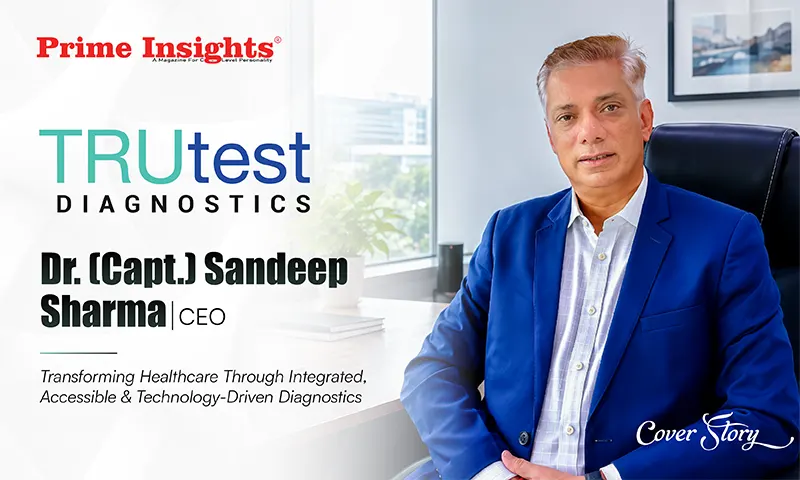
Dr. (Capt.) Sandeep Sharma | CEO
We are delighted to bring you an insightful conversation with a visionary leader working to reshape the way diagnostic healthcare is delivered across India.
In this exclusive interview, Dr. Sandeep takes us behind the journey of TRUtest Diagnostics—from its roots in serving communities through public-private partnerships to its vision of making advanced, integrated diagnostics accessible beyond metropolitan cities. He shares his perspective on bringing pathology, radiology, cardiology, genomics, and molecular diagnostics together to create a more connected and patient-centric healthcare experience.
He also delves into the role of technology, smart reporting, digital health, quality standards, and affordability in transforming diagnostics, while discussing the challenges facing the industry and his ambitious vision for expanding integrated diagnostic centres across India, particularly in Tier 2 and Tier 3 cities.
Join us as Dr. (Capt.) Sandeep Sharma shares the vision, leadership, and innovation driving the next chapter of India’s diagnostic healthcare ecosystem.
1. Can you introduce your organization and share its mission in advancing integrated diagnostics?
TRUtest Diagnostics, incubated by the Manipal Group, is India’s fastest-growing comprehensive diagnostics powerhouse — but I would describe us a diagnostics company and a movement to democratise quality, accessibility & affordability in healthcare. Our mission is audacious by design: to carry state-of-the-art, coordinated pathology, radiology and cardiology out of the metros and into the fringe and Tier 2/3 cities that have been waiting years for it, backed by a firm five-year commitment to fifty centres nationally. We are not chasing footprint for its own sake; we are closing a gap that India’s healthcare system has carried for far too long.
2. What inspired the establishment of your organization, and how has your journey evolved in the diagnostics and healthcare sector?
Our story did not begin in a boardroom — it began on the ground, running public-private partnerships across Haryana and Jharkhand, learning firsthand how fragile access to diagnostics still is outside India’s metros. That grassroots understanding evolved through the acquisitions of Medcis Pathlabs and iGenetic, an NCLT-approved merger in 2023, and years of institutional scale-building. TRUtest is the natural culmination of that journey — the moment we took everything we learned serving the masses through PPP and turned it outward, directly toward the consumer, as a brand built for every pin code in the country.
3. What range of diagnostic services and solutions do you offer, and what makes your integrated approach unique?
We offer over 3,500 tests and scans spanning pathology, radiology, cardiology, genomics and molecular diagnostics — but the menu is almost secondary to the philosophy behind it. What truly sets us apart is that TRUtest was conceived from day one on an equal, 50:50 foundation of pathology and radiology, at a time when most organised players in India remain skewed toward one or the other. We built for integration first, because we believe accurate diagnosis is never a single data point — it is a conversation between modalities, and that conversation cannot happen in isolated fragments.
4. How does your organization combine pathology, radiology, genomics, molecular diagnostics, and digital health to deliver comprehensive patient care?
We have engineered every layer of the patient journey to talk to every other layer, and we start from routine and go all the way to specialised and genomic based on the need of the patient & treating doctors’ recommendation. With a wide range of over 3,500 tests spanning pathology — including genomic, metabolic molecular diagnostics — alongside 300-plus radiology and cardiology studies, we are fusing predisposition testing with radiology under one roof. On top of this sits Smart Analytical & ABHA-integrated reporting, which — with the patient’s consent — digitises their report history so they are never burdened with carrying physical reports to every visit. The vision is simple but ambitious: a patient should never have to stitch together their own health story from disconnected reports. We do that stitching for them, in a single coordinated visit, so every modality — from routine to specialised to genomic — fuses together to deliver truly holistic patient outcomes.
5. What differentiates your diagnostic services in terms of accuracy, innovation, and patient outcomes?
Accuracy for us is table stakes — it is the entry ticket, delivered through NABL/NABH-accredited, scale-proven standards that have already served over 1.30 crore patients. Where we truly differentiate is in what happens after the result is generated. Our Smart Reporting ensures every report is interpreted by a doctor, with a complimentary counselling built in, so a number on a page becomes a conversation about a patient’s future. We are not in the business of producing reports; we are in the business of producing clarity and confidence.
6. How do you leverage advanced technologies such as AI, automation, and data analytics to enhance diagnostic precision?
Technology, for us, is not a back-office efficiency tool — it is how we keep a promise alive long after the patient has left the centre. For us, tech must make a report easier to understand, not just faster to produce. Our Smart Analytical Reporting format converts a patient’s results into a clear graphical summary rather than a page of numbers, with basic interpretive cues that help both the patient and the referring doctor see the inference at a glance. Layer that with ABHA-integrated digital reporting linking every result to India’s national health record, and Low-Dose CT screening for early lung and cardiac risk detection, and the technology stack works quietly toward one goal — making precision legible, not just accurate. What emerges is a diagnostics experience that anticipates a patient’s needs rather than simply reacting to them.
7. Can you highlight a major milestone or innovation that has significantly transformed your diagnostic capabilities?
The NCLT-approved merger in 2023, following our acquisitions of Medcis Pathlabs and iGenetic, was the single most transformative chapter in our journey. It did not just add scale — it fused routine pathology strength with radiology and added comprehensive diagnostic depth into our organisation with genuine end-to-end capability. That consolidation is precisely what made it possible to open our first fully integrated pathology, radiology and cardiology centre in Gurugram this year, and to now work towards fifty more like it.
8. How do you ensure quality assurance, standardization, and compliance with national and international healthcare standards?
Quality, for us, is not a certificate on a wall — it is the operating discipline behind every one of our NABL/NABH-accredited centres among our 100+ locations across 18 states. We have deliberately carried the same scale-proven standards that served over 1.30 crore patients through our PPP and institutional heritage into every consumer-facing TRUtest centre, without dilution. As we scale to fifty centres, that non-negotiable standardisation — not ambition alone — is what will earn us the right to be trusted in every new city we enter.
9. Can you share a success story where your integrated diagnostic approach significantly improved clinical decision-making or patient outcomes?
The most telling proof isn’t one story — it’s a pattern already visible across our early TRUtest centres. When a pathology panel, a radiology & cardiology report and a doctor’s counselling call are read together instead of separately, chronic conditions that would once have surfaced only as an emergency get caught, explained and managed months earlier. This integrated, counselling-led model is built specifically for our consumer-facing TRUtest centres — distinct from our PPP and institutional business — and it is precisely what convinces us this model deserves to reach fifty cities. What makes it repeatable, and not just remarkable, is that it is anchored in affordability and accessibility — affordability that gives patients a real saving benefit, and accessibility that brings pathology, radiology and specialist counselling under one roof, with a standard of quality that’s still not at its peak in Tier 2 and Tier 3 towns today.
10. How do you collaborate with hospitals, physicians, and healthcare providers to deliver seamless diagnostic solutions?
We collaborate the way any trusted partner should — by making ourselves useful to the physician’s own decision-making, not just supplying a report. Under HealthMap, we have extensively partnered with hospitals in two ways: setting up diagnostic modalities on-site where hospitals outsource their radiology or pathology lab services to us, and a second model where we simply collect samples and deliver reports back to them. With physicians — whether in our PPP engagements or the private space — we deeply value the relationship, and it is their recommendations and feedback that keep us honest about our quality and turnaround time, a discipline we are constantly engineering to evolve and serve them better for improved patient outcomes. Many of our institutional partnerships with healthcare providers have stayed with us for years now, built on trust in our quality and pricing — trust that has come through years of learning from the PPP model and other engagements that taught us how to serve the masses while consistently delivering quality and affordability.
11. What initiatives have you undertaken to make advanced diagnostics more accessible, affordable, and patient-centric?
Everything we have built starts from the premise that quality diagnostics should never be a metro-only privilege. Our TRU-Mitra Family Plan gives one family a single membership and a single relationship manager, replacing transactional visits with continuous care. Our honest, transparent pricing model brings integrated diagnostics to markets long priced out of it. And we have deliberately pointed our expansion at fringe and Tier 2/3 cities, home to 68% of India’s urban population, because that is where the real need lives, and where we believe we can serve best.
12. How do you foster a culture of research, innovation, and continuous improvement within your organization?
We are honest about what we are — we are not a research institution, and we don’t pretend to be one. Where we do relentlessly push ourselves is in continuous improvement of service: how quickly a report reaches a patient, how clearly a doctor explains it, how consistently a centre in a small town performs against the one in metros. Offerings like our TRU-Mitra Family Plan, Chronic Reminders and Smart Reporting exist because we treat every patient interaction as feedback that should improve the next one. That discipline, repeated, is what compounds into a service culture patients can rely on.
13. What challenges do you foresee in the diagnostics industry, and how is your organization preparing to address them?
India’s diagnostics industry remains strikingly unorganised — listed players together account for barely 10-12% of the market, and even among organised players, most operate skewed, heavy in either pathology or radiology, rarely both. That fragmentation is the industry’s single biggest challenge, and it is precisely the mould TRUtest was conceived to break, built from day one on a genuinely equal, integrated pathology-radiology-cardiology foundation. We are not waiting for the industry to organise itself — we intend to be the organising force, because an organised, integrated industry is what finally lets scale translate into lower prices benefit and wider reach for the masses, not just for those who can already afford metro care.
14. What are your future plans for expanding your diagnostic capabilities, adopting emerging technologies, and strengthening your presence by 2026 and beyond?
We are entering the most ambitious phase of our journey yet. Our integrated centres — starting with Gurugram, and four more across Delhi-NCR in FY26-27 — are only the visible tip of a much larger build-out: over the next five years, we are targeting fifty centres nationally on the integrated side alone, while our standalone Pathology and Radiology verticals continue to expand in parallel, taking our cumulative footprint beyond a hundred centres, labs and partnership sites across our standalone, institutional and PPP networks. This is not incremental growth — it is a deliberate, company-wide conviction to be synonymous with world-class diagnostics in every city we enter, powered by the same proven economics that built our scale, and aimed squarely at the cities growing fastest in this country. We are not building centres one at a time; we are building a national infrastructure of quality & trust, city by city, pin code by pin code.
15. What advice would you give to healthcare providers and patients on the importance of integrated diagnostics in enabling early detection and better treatment outcomes?
My advice echoes what the finest minds in Indian healthcare have long practised: treat prevention as the primary intervention, not the afterthought that follows a crisis. The leaders who built this industry have proven, again and again, that scale can make quality affordable, and that technology, used well, becomes the great equaliser between a metro hospital and a small-town clinic. I would tell providers to build that continuity of care in from day one, and tell patients this — a diagnostic report is not the end of the journey, it is the start of a conversation with your doctor. Insist on both, wherever in India you live.
16. Anything you feel is missing from our end that you would like to add?
I would only add this: India’s healthcare pioneers — those who proved that scale could make world-class surgery affordable, and those now carrying specialist care into Tier 2/3 towns — have already shown us that ambition and accessibility are not in conflict; they compound each other. TRUtest is applying that same conviction to diagnostics: that accessibility and quality, once reserved for the metros, can be engineered, scaled and delivered at the individual level, in every pin code, without ever compromising on quality. India’s healthcare story for the last two decades was about building capacity. The next two decades will be about building that capability — and we intend to be part of writing it.
