

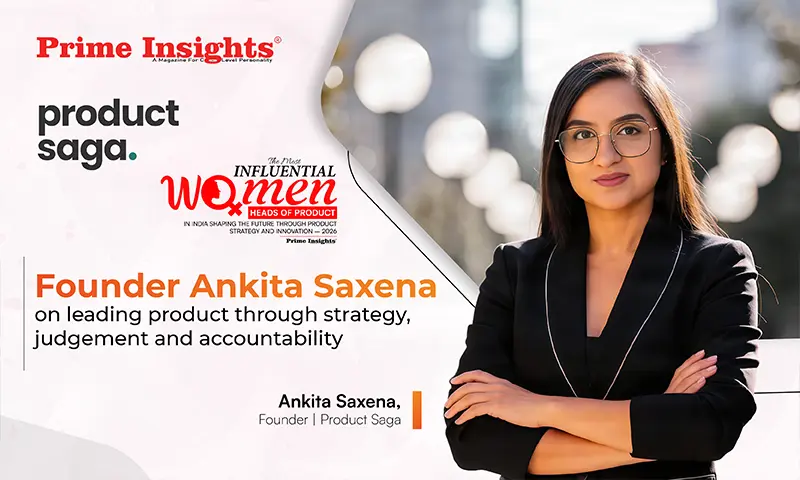
Ankita Saxena | Product Saga
Every product looks like one big launch from the outside. From the inside it is a series of decisions: which problem is worth solving first, what to bet on in discovery, what to trade away when reality changes the plan. Most of what is written about product management covers the launch. Very little covers the judgement calls before and after it, made by the people who had to live with the consequences. That gap is what Product Saga was founded to close.
At the forefront of this is Ankita Saxena, founder of Product Saga, a publication and podcast on the decisions that shape B2B products, told first hand by the leaders who made them. Ankita brings fourteen years in B2B SaaS to the venture, most recently as Chief Product Officer leading a 120-person product organisation and directing a 150-person India office for a private-equity-backed vertical SaaS platform. Her leadership philosophy centres on clear ownership, autonomous teams and measurable customer outcomes, and it runs through everything she writes. The first issue of Product Saga arrives in November 2026.
Product Saga follows a product through three stages: the early research and assumptions, the messy middle of bets and trade-offs, and what happens when the plan meets reality. Alongside the written stories, Ankita is launching a podcast series in conversation with product leaders across India and Europe. Her aim is simple: turn hindsight into better decisions for the people building products now.
In the spotlight is Ankita Saxena, Founder of Product Saga, in our prestigious The Most Influential Women Heads of Product in India Shaping the Future Through Product Strategy and Innovation 2026 edition. Learn from her insights, leadership journey and valuable lessons on building customer-focused products, empowering teams and driving innovation to create a stronger, future-ready organisation. Stay tuned as we explore her story of success.
Prime Insights: For the benefit of our readers, could you introduce yourself and share an overview of your professional journey and current role as a product leader?
I am Ankita Saxena, founder of Product Saga, a publication and podcast on the decisions that shape B2B products, told by the leaders who made them. I bring fourteen years in B2B SaaS, most recently as Chief Product Officer leading a 120-person product organisation and directing a 150-person India office for a private-equity-backed vertical SaaS platform.
Prime Insights: What inspired you to pursue a career in product management, and what key experiences influenced your journey to becoming a Head of Product?
I was drawn to the point where a company decides what to build and why, because that is where most value is won or lost. My early years were spent close to the software itself, seeing where it broke, where it confused people and where it quietly cost money. Carrying that outside-in view into strategic decisions is what shaped me into a product leader.
Prime Insights: How would you describe your leadership philosophy, and what core values guide your approach to product strategy and decision-making?
Make the why clear, make ownership clear, then get out of the way. I build autonomous teams around a shared mission where nobody waits for permission. Decisions are anchored in customer outcomes rather than feature counts, and I would rather hear an uncomfortable truth early than a comfortable surprise late. Clarity, accountability and candour are the values I hold myself and my teams to.
Prime Insights: What are the key responsibilities involved in your role, and how do you ensure that your product vision aligns with your organization’s broader business goals?
A product leader owns the vision, the strategy and the trade-offs in between, and is accountable for outcomes rather than output. Alignment comes from structure, not slogans: a few clear priorities, quarterly outcomes with a single owner each, and an explicit split of capacity between strategic bets, client commitments and keeping the lights on. If a team cannot explain why its work matters commercially, alignment exists only on paper.
Prime Insights: How do you identify customer needs, market opportunities, and emerging trends to develop products that deliver meaningful value?
By watching how work actually gets done rather than asking people what they want. In B2B the customer is an operator with a job to do, so I sit with them, read the support queue and treat usage and error data as the most honest feedback available. Opinions are plentiful; observed behaviour is rare and worth far more.
Prime Insights: What role do innovation, emerging technologies, and data-driven insights play in shaping your product strategy and driving continuous improvement?
Innovation earns its place only when it moves an outcome a customer can feel. Keep the operational core deterministic and reliable, and apply AI where judgement, pattern recognition or language add real value. Data closes the loop: adoption, error rates and time saved tell you whether to scale, refine or stop. Most innovation I have seen fail did so because nobody was willing to stop.
Prime Insights: As a product leader, how do you navigate complex challenges, changing market dynamics, and competing priorities while keeping your teams focused on shared goals?
By narrowing what counts. Growth targets, large clients with hard commitments and the engineering work nobody sees all compete for the same people, and a leader who says yes to everything delivers nothing. I make the capacity split explicit, protect stability with guardrails and phase risky change so the most exposed customers are never the first to feel it.
Prime Insights: Could you share a significant product launch, achievement, or milestone in your career that reflects your approach to leadership and innovation?
The milestone I am proudest of is a rebuild rather than a launch. I restructured an entire product and engineering organisation from module-based teams into value stream, platform and enabling teams, each outcome with a single accountable owner, without pausing delivery to clients. It changed how people made decisions, not just how they were drawn on a chart. Structure is strategy made visible.
Prime Insights: How do you build, motivate, and empower product teams while encouraging collaboration, creativity, and accountability across different functions?
Give people a clear outcome, a single owner and real room to decide. I measure product managers by outcomes moved rather than modules covered, bring engineering leads into direction setting rather than handing them a roadmap, and run cross-functional teams as deliberate experiments with a stated hypothesis. Accountability follows when ownership is unambiguous; motivation follows when people see their decisions land.
Prime Insights: As a woman in a leadership position, what challenges have shaped your professional journey, and how have these experiences influenced your leadership approach?
Becoming a mother while running a large product organisation and a country office was the hardest and most clarifying chapter of my career. It forced me to lead through others rather than through presence, to delegate properly and to be explicit about what I needed. I now design organisations so that no role, including mine, depends on one person always being available.
Prime Insights: What are some of your key professional achievements, and what future goals or initiatives are you currently working toward in your role?
Rebuilding a product organisation around outcomes and taking a portfolio of AI capabilities into production are the achievements I value most. My energy now goes into Product Saga: the first issue lands in November 2026, a podcast series with product leaders across India and Europe follows, and the goal is a body of first-hand product stories that help others decide better.
Prime Insights: What advice would you offer to aspiring women product professionals who aim to grow into leadership roles and make a meaningful impact in the industry?
Do not wait for a title to act like the owner. Learn the commercial side early; product leaders who can read a P&L and talk to investors get the room. Build a network of sponsors, not just mentors. And treat quality, delivery and support as doors into product rather than detours; the best product judgement comes from having seen where things break.
