

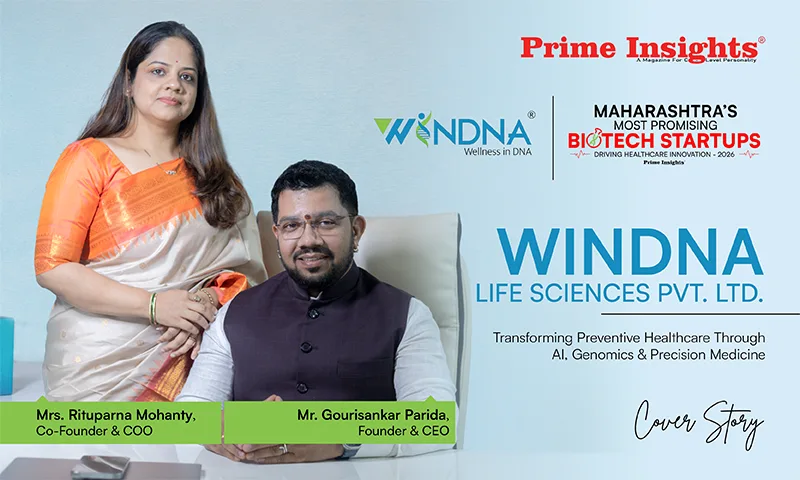
WinDNA Life Sciences Pvt. Ltd.
Many chronic conditions are influenced by a combination of genetics, lifestyle, environment and gut microbiome, yet they are often recognised only after symptoms appear. Advances in genomics, artificial intelligence and precision medicine are enabling healthcare to move beyond disease management towards earlier risk identification, personalised prevention and informed health decisions.
As diabetes, obesity, cardiovascular disease, fatty liver and other metabolic disorders continue to rise, healthcare is gradually moving beyond a purely reactive model. Genomics, gut microbiome science, bioinformatics, artificial intelligence and precision medicine are helping professionals examine why people with apparently similar lifestyles can experience very different health outcomes.
Among the Indian biotechnology companies contributing to this transformation is WinDNA Life Sciences Pvt. Ltd., founded in 2019 by Mr. Gourisankar Parida, Founder and CEO, and Mrs. Rituparna Mohanty, Co-Founder and COO. Guided by the belief that every individual is biologically unique, the company is building an integrated precision preventive healthcare ecosystem that combines genomics, gut microbiome science, artificial intelligence, personalised nutrition and practitioner led care.
WinDNA is more than a genetic testing company. Our mission is to transform biological data into meaningful health intelligence through scientific interpretation, practitioner guidance and personalised preventive healthcare. Every report is designed to become the beginning of a long term health journey rather than the end of a diagnostic process.
What differentiates WinDNA is its integrated approach. Rather than treating genetics, microbiome science, biomarkers, artificial intelligence and personalised nutrition as separate services, WinDNA is bringing them together through its evolving WinTwin platform to create a connected and continuously improving health ecosystem.
Our vision is to make personalised preventive healthcare practical, scientifically responsible and accessible for millions of people. Through WinTwin, we aim to create a secure digital health twin that helps individuals and healthcare professionals understand biology more clearly, make informed decisions and improve health outcomes throughout life.
In this exclusive conversation for Prime Insights’ “Maharashtra’s Most Promising Biotech Startups Driving Healthcare Innovation – 2026” edition, Mr Gourisankar Parida and Mrs Rituparna Mohanty discuss the purpose behind WinDNA, the evolution of WinTwin, the role of research and responsible innovation, and their vision for the future of personalised preventive healthcare.
Prime Insights: WinDNA was founded with a vision to change how people understand their health. What inspired that vision, and what problem were you trying to solve?
WinDNA Life Sciences is a precision preventive healthcare company built around a simple understanding: every person is biologically unique, while much of healthcare and wellness still relies on population averages.
We combine insights from genetics, gut microbiome science, biomarkers, lifestyle and nutrition to help individuals and healthcare professionals understand health more comprehensively. These assessments are important inputs, but they are not the final objective. The real value lies in interpretation, professional guidance and the ability to convert complex information into practical decisions.
Through WinTwin, we are developing a digital health twin that can organise biological and lifestyle information into an evolving health profile. Our mission is to make personalised, evidence-informed preventive healthcare more understandable, responsible and accessible, while supporting doctors, nutritionists and health coaches rather than attempting to replace them.
Prime Insights: Research is central to biotechnology. How does scientific research shape the development of WinDNA’s services and platform?
Research and development influence every important decision we make. Preventive genomics, microbiome science, personalised nutrition and digital health are developing rapidly, so interpretations cannot remain fixed while scientific evidence continues to evolve. Our team reviews peer-reviewed literature, clinical guidelines, population-specific studies and emerging Indian data to refine the way biological information is interpreted. We distinguish between well-established findings, promising associations and evidence that is still too early for practical use.
India’s genetic and cultural diversity makes local context particularly important. Research based mainly on Western populations cannot always be applied directly to Indian individuals. For that reason, we are also interested in academic and clinical collaborations that can strengthen India-specific knowledge. Our objective is not to create the longest report, but to provide clearer, more relevant and scientifically responsible insights.
Prime Insights: How has WinDNA evolved from its early days into the precision preventive healthcare company it is today?
The idea came from observing how frequently people discovered metabolic and lifestyle-related problems only after symptoms had become difficult to ignore. Conditions such as diabetes, obesity, fatty liver and cardiovascular risk often develop gradually, which means there may be a meaningful window for earlier awareness and action.
We initially focused on preventive genetics because inherited tendencies can provide useful context for metabolism, nutrition, and lifestyle responses. As our work progressed, we realised that genetics alone could never explain the full picture. Health is also influenced by the gut microbiome, current biomarkers, dietary habits, sleep, stress, physical activity, medications, and the environment.
That learning changed our direction. WinDNA evolved from a genetics-focused initiative into a broader precision preventive healthcare platform. The journey has been gradual and carefully built, with continuous learning from practitioners, institutions and the individuals who use our services.
Prime Insights: Which technologies and integrated solutions define the WinDNA ecosystem today?
Our work brings together preventive genomics, gut microbiome analysis, bioinformatics, personalised nutrition, practitioner-led counselling and selected natural therapeutic interventions.
The central technology vision is WinTwin. It is being designed to integrate genetic information, microbiome findings, biomarkers, health records, symptoms, lifestyle patterns and future follow-up data into one longitudinal profile. Instead of treating every report as an isolated event, the system aims to preserve context and show how health changes over time.
This approach can support more focused programmes for metabolic health, healthy weight, glucose regulation, liver health, hormonal wellbeing, gut health, cardiovascular risk and healthy ageing. Technology is valuable only when it improves understanding. We therefore place equal importance on scientific interpretation, professional oversight and the practical usefulness of every recommendation.
Prime Insights: How do your solutions help individuals and healthcare professionals make better health decisions?
Our contribution is to help move the conversation earlier, from reacting to disease towards understanding risk, behaviour and biological context before serious complications develop.
We combine individual insights with personalised nutrition, lifestyle guidance, health coaching and practitioner support. This can help people understand why generic recommendations may not have worked for them and where focused changes may be more relevant.
We are careful not to suggest that one test or one report can guarantee an outcome. Improvement depends on the quality of interpretation, the person’s medical context, adherence, follow-up and professional guidance. The value of our approach lies in helping individuals and practitioners ask better questions, prioritise appropriate actions and monitor meaningful changes over time.
Prime Insights: The healthcare technology space is becoming increasingly competitive. What distinguishes WinDNA from other companies in this field?
Many organisations specialise in one part of the healthcare journey, such as diagnostics, genetics, microbiome analysis, nutrition or wellness. WinDNA is being built to connect these areas rather than offer them as disconnected services.
We do not define ourselves as a testing company. Testing provides information; our larger role is to transform that information into practical health intelligence through interpretation, counselling, personalised planning and continued support.
Another important distinction is our practitioner-centred model.
Precision healthcare should strengthen the work of doctors, nutritionists and health coaches, not bypass their judgement. Our long-term objective is to build a trusted health intelligence platform that can remain relevant across different stages of an individual’s life.
Prime Insights: Looking back on the journey so far, which milestones have been the most meaningful for the organisation?
One of our most meaningful achievements has been building a credible India-focused foundation while remaining a bootstrapped company. We have earned the confidence of individuals and healthcare professionals, secured support from respected incubation and institutional networks, and continued developing WinTwin as our long-term technology platform.
We have also strengthened our interpretation capabilities by drawing on recognised scientific literature and population resources while pursuing academic and healthcare collaborations. These relationships have helped us understand both the potential and the limitations of precision preventive healthcare.
For us, a milestone is not only an award or an institutional association. It is also the moment when a practitioner uses biological insight more responsibly, or when an individual understands that predisposition does not mean destiny and becomes more engaged in improving health.
Prime Insights: How do genomics, microbiome science, bioinformatics and artificial intelligence come together within WinTwin?
These are not separate technologies within our model; each contributes a different part of the health picture.
Genomics can reveal inherited predispositions and biological pathways. Gut microbiome information provides a more dynamic view influenced by diet, environment, medication and lifestyle. Biomarkers indicate what is happening physiologically at a particular point in time. Bioinformatics is required to process and organise this complex information.
Artificial intelligence can assist in identifying patterns, prioritising relevant findings and supporting personalised recommendations. However, AI must work within clear scientific, clinical and governance boundaries. It should support professional judgement, not act as an independent authority.
Precision medicine brings these layers together around the individual. WinTwin is being developed as the connecting framework, allowing information to evolve with future assessments, health records, symptoms and lifestyle changes rather than remaining a one-time snapshot.
Prime Insights: With sensitive biological information, quality, ethics and data privacy are essential. How do you approach these responsibilities?
Trust is fundamental when working with genetic and health information. Our approach begins with informed consent, appropriate sample handling and collaboration with qualified laboratories that follow recognised quality systems.
Interpretations are based on peer-reviewed evidence and accepted scientific frameworks where applicable.
We also maintain a clear distinction between preventive wellness insights and clinical diagnosis. A genetic predisposition is not a diagnosis, and an association should never be presented as certainty. Whenever findings indicate a possible clinical concern, appropriate medical evaluation must take priority.
Data protection is equally important because genetic information is highly sensitive. Secure storage, controlled access, responsible use and compliance with applicable data protection requirements must be built into the system from the beginning. Quality is not a single audit; it is an ongoing discipline.
Prime Insights: Can you share an example that illustrates the real-world impact of your approach to preventive healthcare?
The most meaningful stories are often not dramatic; they begin with greater clarity. We have worked with individuals who finally understood why standard diet or lifestyle advice had produced limited results and who became more committed once recommendations were connected to their own biological and behavioural patterns.
We have also seen practitioners use these insights to ask more relevant questions, personalise counselling and monitor specific areas more carefully. The benefit is not in creating fear about future risk. It is in helping people understand that inherited tendency and final outcome are not the same.
We remain cautious about claiming that a report alone changes health. Real impact comes when information is interpreted responsibly and followed by sustained action, professional guidance and regular review.
Prime Insights: Every entrepreneurial journey has challenges. What have been the most important lessons in building WinDNA?
The greatest challenge has been changing the mindset that health deserves attention only after symptoms appear. Prevention requires people to value information and action before there is an immediate sense of urgency.
A second challenge is trust. Genetics, artificial intelligence and microbiome science can easily be surrounded by exaggerated claims. We have therefore tried to grow through education, practitioner engagement, and transparent communication rather than by making promises that the evidence cannot support.
Being bootstrapped has required discipline. We have had to build step by step, prioritise carefully and learn continuously from both success and error. That slower process has also been valuable because it has encouraged us to strengthen the foundation before attempting rapid expansion.
Prime Insights: How have collaborations with academic institutions, clinicians and industry partners influenced your growth?
Biotechnology advances through collaboration. No single organisation can independently master genomics, microbiome science, clinical practice, nutrition, software, data governance and population research.
Our engagement with universities, incubators, clinicians, researchers and healthcare professionals has helped us refine our scientific direction and understand practical healthcare needs. Associations with institutions such as Sambalpur University and AIC-RMP Mumbai have supported learning, research orientation and innovation.
Academic expertise helps strengthen evidence and population-specific understanding, while practitioner feedback shows where reports are useful, where they may cause confusion and how recommendations can become more practical. These collaborations help bridge the gap between scientific research and real-world application
Prime Insights: How do you see personalised preventive healthcare becoming more accessible, affordable and sustainable for a larger population?
Prevention is one of the most sustainable ways to reduce the long-term burden of lifestyle-related disease. Helping people understand risk earlier and improve everyday behaviour can complement the healthcare system’s essential role in diagnosis and treatment.
Accessibility requires more than reducing the price of a test. It also depends on simpler communication, trained practitioners, digital follow-up and scalable programmes that people can use in their own communities.
Through awareness initiatives, practitioner education, technology-enabled support and partnerships, we aim to gradually widen access to biology-informed healthcare. The long-term goal is to make personalised prevention more practical for a broader population rather than allowing it to remain a specialised service for a limited segment.
Prime Insights: What is your long-term vision for WinDNA and WinTwin over the coming years?
Our immediate priority is to strengthen WinTwin and the scientific, clinical and governance systems that support it. We are developing the platform in stages so that genetics, microbiome information, biomarkers, lifestyle data and practitioner feedback can be integrated responsibly.
We also plan to expand our metabolic health programmes, practitioner network, research collaborations and education initiatives across India. Over time, we see opportunities in carefully selected international markets, including the GCC region, where personalised preventive healthcare is gaining greater attention.
Our vision is that an individual’s health information should not remain scattered across reports and consultations. A well-governed digital health twin can help organise that information into a meaningful longitudinal view. Achieving this will require patience, validation, privacy safeguards and continued collaboration.
Prime Insights: Finally, what advice would you offer entrepreneurs who aspire to build meaningful businesses in biotechnology and healthcare?
Begin with a genuine healthcare problem, not with a fashionable technology. Genomics, artificial intelligence, and microbiome science are powerful tools. Their value depends on whether they improve understanding, support responsible decisions and genuinely help people.
Biotechnology requires patience because evidence, validation and trust cannot be created overnight. Entrepreneurs should be honest about what is known, what remains uncertain and what their solution can realistically achieve
Build strong collaborations, listen to practitioners, protect data from the beginning and never compromise scientific credibility for short-term attention. Commercial success is important for sustainability, but healthcare companies carry a larger responsibility. When innovation is guided by purpose, evidence and integrity, it can create lasting value for both individuals and society.
