

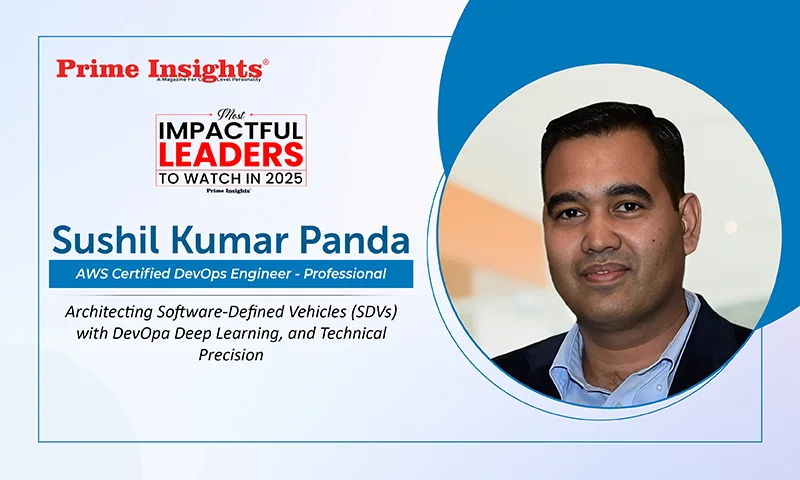
Sushil Kumar Panda
In the modern enterprise, particularly within the highly regulated and complex Automotive sector, success is measured by the speed, security, and quality of software-defined vehicle (SDV) delivery. This is a landscape where every strategic move—from Over-The-Air (OTA) updates to Battery Management Systems (BMS)—is driven by code, robust DevOps pipelines, and sophisticated Deep Learning models. In this high-velocity, high-stakes environment, the true leaders are those who possess both the strategic oversight of a Program Manager and the indispensable technical command of a Principal Software Architect. They are the individuals capable of translating multi-million-dollar visions into tangible, defect-free code that operates safely in a vehicle.
One such professional stands out in the industry: Sushil Kumar Panda. An AWS Certified DevOps Engineer – Professional, a PMP-certified leader, and a seasoned Program Manager with over 21 years of experience, his career is defined by his unique ability to bridge the strategic gap between executive vision and complex technical execution. His expertise is not merely administrative; it is deeply rooted in his Bachelor of Engineering in Computer Science, enabling him to be an architect of the technical solutions he oversees. He doesn’t just manage budgets; he architects the very frameworks that enable continuous, secure software delivery for Fortune 500 giants like General Motors and Volkswagen. His signature strength is applying rigorous process discipline, honed across banking and reinsurance, to the bleeding edge of automotive technology.
The Technical Architect: Expertise and Certifications in SDV
Sushil Kumar Panda’s leadership is underpinned by a powerful foundation of technical expertise and specialized certifications, setting him apart from typical program managers.
AWS DevOps Mastery and CI/CD Frameworks
As an AWS Certified DevOps Engineer – Professional, Sushil’s command over cloud infrastructure and automation is a core differentiator. His specialization lies in establishing and maturing robust CI/CD integration workflows within advanced DevOps pipelines, ensuring that development and operations teams function as a cohesive unit. This expertise directly contributed to improving delivery velocity and enabling rapid feedback loops for complex automotive software releases at GM. He understands the infrastructure-as-code (IaC) principles necessary to manage large, globally distributed test environments, ensuring that software destined for millions of vehicles is built, tested, and deployed with industrial-grade efficiency and security.
Deep Learning and EV Platform Thought Leadership
Sushil’s commitment to technical foresight extends beyond current project execution and into the future of automotive technology. His expertise in the Electric Vehicle (EV) space, a sector heavily reliant on software control, is evidenced by his recent technical publications:
- Deep Learning Approaches in solving Battery Health Problems in Electrical Vehicles: This research demonstrates a deep understanding of using advanced AI/ML solutions to address critical battery management issues, a foundational challenge for EV platforms.
- EV Power Train Market Trends: This work provides the strategic context for his technical programs, ensuring that current development aligns with future market demands and technological shifts.
This published research establishes him as a technical thought leader whose strategic planning is informed by current academic and industry advancements in complex, data-driven systems.
Engineering Innovation: Automation, Testing, and Integration
The true measure of a technical program leader is their ability to implement scalable solutions that drive measurable gains. Sushil’s career is marked by specific, high-impact technical innovations:
Python-Based BDD Automation
At General Motors, Sushil spearheaded a pivotal automation strategy for software delivery. He directed the development and deployment of a proprietary Python-based Behavior-Driven Development (BDD) framework. BDD, a methodology demanding collaboration and precise feature definition, was used here to bridge the gap between business requirements and technical testing. This initiative successfully integrated automated testing early in the software development lifecycle (SDLC), dramatically increasing test efficiency and reducing manual validation effort by a proven 60%. This massive efficiency gain directly accelerated time-to-market for complex infotainment systems.
Vehicle Integration and Low-Level Tools
Sushil’s programs demand full-stack technical knowledge, extending to the physical layer of the vehicle. His teams utilize specialized domain tools like CAN (Controller Area Network) and NEO-VI for vehicle integration and low-level validation. This proficiency ensures that software deliverables not only pass functional tests in a virtual environment but also integrate flawlessly with in-vehicle networking, firmware, and hardware. Furthermore, his experience with Postman and Insomnia ensures robust API testing and integration with backend systems for services like Google Automotive Services (GAS) and over-the-air communication.
Driving Mission-Critical Programs: Case Studies in SDV Transformation
Sushil’s leadership is best demonstrated through the complexity and strategic importance of the programs he has managed:
Case Study A: SDV Virtualization and “Shift-Left” Delivery
He directed the end-to-end program for GM’s strategic virtualization initiative, a critical component of the SDV architecture. This highly technical project required overseeing multi-disciplinary teams to deliver complex OTA and infotainment system releases ahead of hardware availability. This “shift-left” approach, enabled by virtual testing environments, robust simulation, and advanced test strategies, significantly minimized hardware dependencies, reduced development risks, and accelerated the overall product development timeline.
Case Study B: Core Platform Migration and Custom Apex Development
A major technical achievement involved directing the project lifecycle for the critical migration of GM’s core Over-the-Air (OTA) update platform. This was not a simple lift-and-shift; it involved moving the platform from Salesforce to a high-performance, custom Apex-based system. This technical migration was essential for scalability and control, demanding deep alignment between technical engineering teams and business stakeholders to ensure zero downtime and continuous functionality for a mission-critical vehicle feature.
Case Study C: Mobile, OTA, and Vehicle Integration Program
Currently leading a $4M mobile program with a global team of 20+ engineers, Sushil manages the complex integration points between external mobile applications (leveraging his Android development skills), OTA services, and vehicle hardware. This project requires meticulous technical governance to harmonize deliverables across multiple interdependent test projects—from UAT and functional testing to low-level vehicle integration—ensuring cohesive program execution and on-time, high-quality delivery aligned with global business objectives.
The Versatile Edge: Cross-Domain Technical Leadership
Sushil’s ability to transition and excel across diverse sectors is not merely managerial versatility; it is the cross-pollination of technical discipline. His experience in other highly regulated fields directly informs the quality and risk management of his automotive programs:
- Banking and Mortgage: Leading technical projects for institutions like Fifth Third Bank involved strict regulatory compliance, rigorous security protocols, and expertise with large-scale enterprise data infrastructure, including SQL and Oracle database solutions. This experience instilled an unparalleled discipline in quality gates and risk management, which he applies to vehicle safety and security standards.
- Reinsurance: His experience in the reinsurance domain sharpened his skills in risk assessment and modeling, enabling him to proactively identify program-level threats (technical debt, integration failures, vendor quality risks) and implement robust, data-driven mitigation strategies that safeguard schedule adherence and quality standards across global delivery teams.
The Architect’s Philosophy: Strategy Rooted in Code & The Future
Sushil Kumar Panda’s leadership philosophy is best summarized as “strategy rooted in code.” He believes that programs succeed by empowering technical teams and providing them with the necessary frameworks—DevOps, BDD, and clear architectural guidelines—to execute flawlessly.
His vision for the future is focused on integrating Generative AI applications and advanced Deep Learning techniques into enterprise software solutions, particularly within the evolving SDV ecosystem. He is dedicated to mentoring the next generation of professionals, focusing their development on mastering these cutting-edge skills and ensuring they possess both the technical mastery and the strategic foresight to lead complex global transformation.
Sushil Kumar Panda is more than a Program Manager; he is a technical strategist, a certified DevOps leader, and a catalyst for digital transformation whose technical authority and business acumen are indispensable to the future of the software-defined world.
