

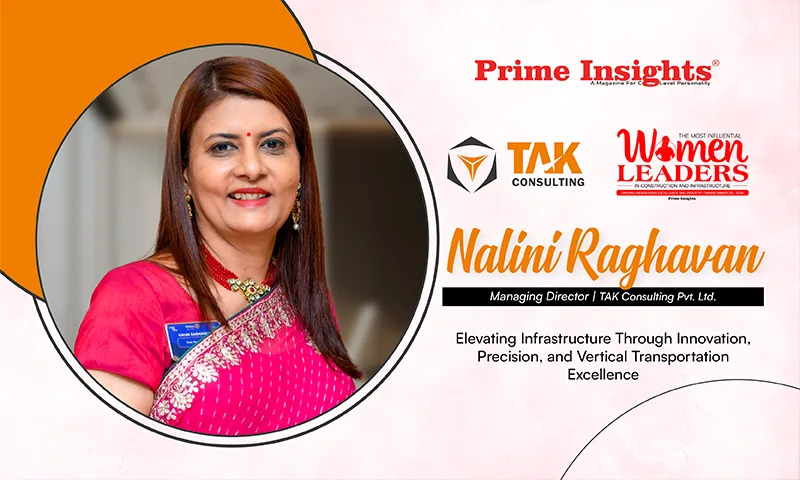
Nalini Raghavan | TAK Consulting Pvt. Ltd.
Did you know that the average city dweller spends up to a cumulative 10 months of their lives just waiting for and riding elevators? In an age of sky-high skyscrapers and fast-paced urbanization, vertical transportation is the unseen circulatory system of our modern cities. It is a fast paced industry with intense competition that demands perfect efficiency in high-stakes urban planning. A key infrastructure challenge is getting people moving safely and smoothly, and independent elevator consulting is a vital asset for developers looking to build smarter, more efficient buildings.
At the forefront of this specialized field is TAK Consulting Pvt. Ltd., led by Ms. Nalini Raghavan, Managing Director. Founded to bring scientific precision and strategic insight to vertical transportation planning, the firm has earned a distinguished reputation, reinforced by its rare ISO 17020 accreditation. With a unique blend of analytical expertise and business acumen, Ms. Raghavan has carved a remarkable niche in an industry where technical excellence and innovation are paramount. A mathematics graduate with an MBA, a LEED Accredited Professional since 2008, and a certified Project Management Professional (PMP), she has successfully transformed complex elevator traffic analysis into a strategic advantage for developers, architects, and project teams across India.
TAK Consulting has become the go-to advisor to some of the nation’s most prominent developments under her leadership. The company is leveraging cutting-edge traffic analysis, statistical modeling and new technologies such to help you optimize vertical transportation systems from the earliest stages of project planning. Her passion for innovation, sustainability and operational excellence continues to reshape the way people experience movement within modern buildings.
In the spotlight is Ms. Nalini Raghavan, Managing Director of TAK Consulting Pvt. Ltd., in an exclusive interview for our prestigious “The Most Influential Women Leaders in Construction and Infrastructure 2026” edition. Through her inspiring journey, leadership philosophy, and industry expertise, she shares valuable insights on resilience, innovation, sustainable infrastructure, and the future of vertical transportation. Stay tuned to discover her remarkable story of success and the lessons that continue to shape her leadership journey.
Prime Insights: Please introduce yourself and tell our readers about your role.
My name is Nalini Raghavan and I am a Director at TAK Consulting, where we are independent vertical transportation and elevator consultants. My function is located at the intersection of business development, client advisory and the conceptual stage of projects. I help developers, architects and project teams understand how to plan for vertical movement long before the first elevator is ever installed. I’ve also become very involved in the traffic analysis aspect of our work over the years, which is the science of how efficiently people and lifts move within a building.
I come from a bit of a strange background for this field. I am a mathematics graduate with an MBA. I started my career in marketing in the iron and steel industry, then worked in the enterprise software space. That mix of analytical training and commercial experience is what I bring to the consulting table every day.
Prime Insights: What motivated you to take a career in construction and infrastructure and how did your leadership journey begin?
I’ve got construction in my blood. My father was a civil engineer. My grandfather was also a civil engineer and worked on many bridge projects in the British era. I never formally studied engineering, but I have always had a strong leaning towards the built environment and how infrastructure shapes cities.
I came into this industry after nearly a decade working in the iron and steel industry, which is a backbone of infrastructure in itself, before moving into consulting. What really drew me in was traffic analysis. It’s a very statistical, very math-heavy subject and my background made me a good fit for it. The early 2000s in Mumbai were a game changer. As the old mill sites were redeveloped and a construction boom pushed buildings higher and denser, the question of how to move people efficiently through these towers became critical. I stepped into that space, which became the basis of my expertise and my leadership journey.
I didn’t just want to explain how elevators work. I wanted to help clients understand the logic of movement within their buildings.
Prime Insights: As a woman leader in a traditionally male-dominated industry, what challenges have you faced and how have you overcome them?
I feel lucky. Most of my career has been Mumbai based and Mumbai has a very open professional culture. We have a fair share of female architects and consultants here, and because our work is advisory and not on the shop floor, I’ve rarely felt that my voice was less important because of my gender. From day one, the support of my peers and a strong team at TAK Consulting made a big difference.
That said, the industry has its moments. I remember negotiating a contract with one developer whose project manager said he wouldn’t negotiate with a lady. It was a one-off and I didn’t let it define my experience. The bigger challenge in the early years was just educating the market. People often didn’t know what an elevator consultant was or why one was needed, so a great deal of my work involved patiently explaining the value we bring. I overcame both by letting competence speak for itself.
Prime Insights: What does engineering excellence mean to you and what principles inform your leadership?
To me, engineering excellence is one simple test: does the project succeed? The question is not whether a particular solution is pleasing to one’s personal preferences or individual likes and dislikes, but whether the recommendation is truly in the service of the project. What is best for the building and its users is always my advice to clients, even when it is not the easiest or most obvious.
Excellence is putting the project above ego. The best recommendation is the one that makes the project work, not the one that pleases the room.
That’s the principle that guides how I lead, too. I tell my team to think backwards from the result, to be objective and to treat the quality of the end result as the only real success factor.
Prime Insights: What are the key projects or initiatives you have been involved in that have contributed to your career trajectory and your influence on the industry?
A defining experience was working on Reliance’s landmark Jio development in Mumbai with American consultants Van Deusen and Associates. A steep learning curve was experienced by witnessing international best practices firsthand. The impact we had was so big that the client ultimately promoted us from local partner to the single lead consultant. This milestone, and our work on other prestigious developments, cemented TAK Consulting’s position as a trusted partner for the nation’s most iconic addresses.
Prime Insights: What are the measures you take to keep innovation, quality and sustainability on the top of your projects’ agenda?
For us, people are the starting point of innovation. We are always state of the art with our advice, because we are continuously trained on new technologies, changing codes and safety. On the sustainability side, we’re actively pushing features like regenerative drives that capture energy. While not yet widespread in India, the potential of grid-tied net metering is tremendous. As a LEED Accredited Professional, I integrate these forward-thinking green building strategies into our design recommendations seamlessly.
Prime Insights: How does tech and digital transformation help in improving efficiency and infrastructure development?
Technology has transformed vertical transportation in ways that most building users never see. Modern systems are more and more combining the elevator with the access control of the building. In a commercial tower, for example, destination control technology often connected to the turnstile, so that the moment a card is swiped, the system already knows the destination and allocates the most suitable lift, calculating even how long it will take for the person to walk from the turnstile to that car. It removes the ever-present frustration of the lift doors closing before you can get on.
As consultants and not manufacturers, we are tasked with making clients aware of these technologies such as elevator management systems for complex projects and helping them to incorporate the right solutions into their developments. We are the connection between what can be done with technology and what is really useful for a given building.
Prime Insights: How do you manage big teams, stakeholders and complex projects and still keep operational excellence?
TAK Consulting is intentionally a lean and focused team. Even our most complex engagements, including the large Jio project and other landmark developments, were delivered by tight teams of four or five specialists. Complexity doesn’t mean large-scale delegation for a consultancy. This means deep expertise and clear communication with the outside project teams, developers and project managers we work with.
My approach is based on disciplined project management and good communication with stakeholders. I’m a certified Project Management Professional (PMP), and that international framework informs how we organize responsibilities, set expectations and keep complex projects on track. Rather, each function has a designated point person and backup, which keeps accountability clear and operations smooth.
Prime Insights: How do you approach evolving industry challenges, such as urbanization, sustainability, and resource optimization?
Urbanization is what made our specialization indispensable. As cities grow vertically and densely, moving people efficiently becomes a resource optimization problem in its own right. Here we primarily use traffic analysis. By simulating the flow of people through a building at peak times, we help developers right-size their vertical transportation rather than over-designing or under-providing, which saves both capital and energy over a building’s lifetime.
On sustainability, we are still working to promote awareness of green features and energy efficient systems. Even though the larger ecosystem in India is yet to catch up, we believe in keeping our clients informed to enable them to make forward-looking choices.
Prime Insights: How can you foster a culture of collaboration, safety and continuous improvement in your organization?
We have built a very flat organization. There’s little rigid hierarchy, and a lot of room for people to pursue what genuinely interests them. One example is a colleague who came in as a technical engineer, but had a real knack for sales, so we let her balance her time between both. This openness keeps people engaged and helps the organisation grow in unexpected directions.
Regular internal presentations embed continuous improvement. Just recently some of our youngest engineers who joined less than a year ago presented to the team. It’s a learning moment for all of us. The senior members understand the freshers’ work and the freshers themselves often realise new perspectives in the act of presenting. Safety continues to be a formal priority supported by our safety policy. But most importantly, we encourage individuality. If someone is passionate about something, we make room for it, and that spirit of collaboration flows directly into how we serve clients.
“If someone has a passion, we promote it. A team that keeps improving is a flat, curious team.”
Prime Insights: Name one milestone/achievement that best reflects your contribution to the sector.
There are two significant milestones. The first was our work on the big Jio development, where we went from being a local partner to being sole consultant, which was a real validation of the quality we provide. The second one is more recent and equally meaningful in its own way: TAK Consulting achieving ISO 17020 accreditation.
This type of accreditation is common in testing and inspection laboratories but very rare for elevator inspections. To secure it was a big step for us and a marker of the rigour we hold ourselves to.
Prime Insights: How do you encourage and mentor more women to step up to leadership roles in engineering, construction and infrastructure?
It starts with opportunity. We strongly encourage women to apply and to develop into positions that play to their strengths, including allowing them to diversify across functions where they show an aptitude. But mentorship, to me, is also about flexibility and faith. One of our design engineers got married and shifted to Ratnagiri. We didn’t want to lose her, so we made remote working really work. She has worked remotely for clients for over 3 years and we make sure that her client meetings in person are scheduled when she visits Mumbai. Many clients don’t even realise she works remotely, which is the best testimony to how well it works.
I am particularly proud of colleagues like Manisha who is completing twenty years with TAK Consulting and recently turned fifty. She’s gone from teaching computers at a school to leading and mentoring others. To see someone evolve so profoundly over the course of two decades is precisely the goal of mentorship. I think it’s simple: talented women can have lasting careers and lead if they have real-world experience, supportive structures and authentic encouragement.
Prime Insights: What actions has your organization taken to encourage sustainability, community development and responsible growth in infrastructure?
In terms of sustainability, we are in favor of energy-conscious technologies, such as regenerative drives, and the optimization of infrastructure by means of rigorous traffic analysis in order to avoid waste.
I feel a personal commitment to the community outside the city skylines and hence, through Rotary, I support rural projects near Mumbai such assolar installations, computer labs, and skilling of marginalized groups. To me, responsible growth means ensuring technology benefits everyone.
Prime Insights: What advice would you give aspiring professionals looking to build successful careers in construction and engineering?
My advice is based on two pillars: discipline and the desire to push your limits. Discipline is what carries you through the long haul, the detailed, often unglamorous work that real expertise demands. It’s the pushing of your limits that guarantees you keep growing, not settling into the comfortable and familiar.
“Be disciplined, and always keep pushing your own limits. “The real world will teach you more than any certificate ever will.”
I would also tell young professionals not to wait for the perfect background or qualification to get started. I am not an engineer but have a background in math and marketing and it is my curiosity and dedication that has led to my expertise in this field. The willingness to learn on the ground is worth more than any credential.
Prime Insights: Finally, what is your message to people about leadership, resilience and shaping the future of infrastructure?
Leadership in infrastructure is, at its core, service. Service to the project, service to the team, and service to the people who will live and work in the spaces we help create.
Resilience is about staying objective when opinions differ, putting results ahead of ego, and creating a team culture where people are trusted, encouraged and free to grow. As long as we continue to learn, keep our high standards and be open to talent in all its forms, the future of infrastructure will be in very good hands.
Put the project first, trust your people and keep learning. “That is how you build lasting things.”
