

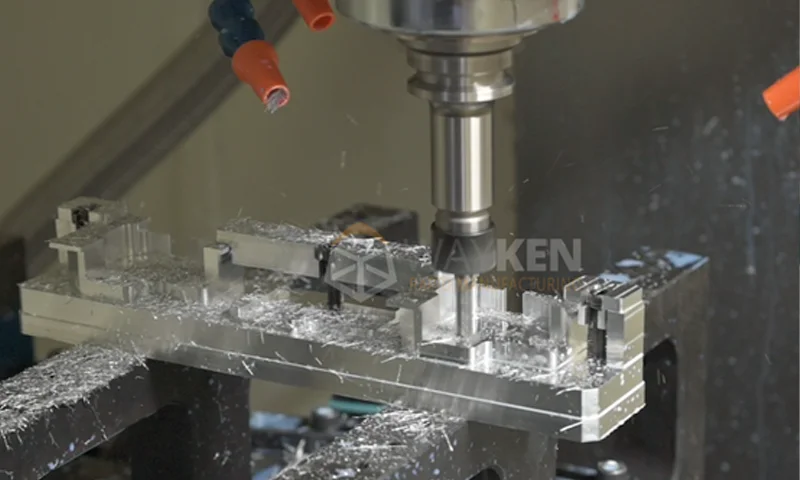
Metal Rapid Prototyping
Deformation and Stress Concentration are the most frequent problems arising in metal prototyping. These are usually found around sharp corners, edges, and notches. These regions have to bear high stress and loads. Therefore, there is a higher chance of their deformation under the influence of a high force.
To avoid these issues at the early stages of CNC metal machining, apply a uniform wall thickness throughout the part. Include indulgent chamfers and fillets wherever there are corners/edges involved. This helps distribute the load more uniformly and avoids localised distortion.
In addition, amplify the material behaviour in the thermal and mechanical cycles. Titanium can maintain its shape, whereas aluminum is relatively flexible and expands its shape. So, always simulate cutting to determine the part movement.
In this guide, we will discuss the practical strategies to address prototype deformation and stress concentration in rapid prototyping manufacturing.
Locating Critical Stress Risers in Prototype Metal Structures
Stress risers normally appear in locations where an abrupt change in loading cause due to geometry. They are normally found in interior corners or ends of slots. Carefully check tiny holes, sharp grooves, and blind notches at all times. These zones are mainly prone to cracks under repeated mechanical loads. Therefore, employ inspection tools and simulations to identify force concentration areas. Even though fillets minimize the maximum stress, they do not eliminate the whole risk. So, use the FEA or DIC scans in high-strain areas.
During metal prototyping, you should carefully inspect holes and fasteners. Stress tends to build up where there are sudden changes in the material’s shape. Using relief cuts or edge rounding reduces stress.
Additionally, warping happens in the thin-walled structures and forms secondary hidden risers. Checking should be done on the tap locations, bends, and welds. Even asymmetric clamping can cause localised spots of tension. The presence of risk areas needs to be verified through dye-penetrant and load tests. Early detection of these issues allows for the improvement of structural life and production repeatability.
Geometry Optimization to Diffuse Concentrated Loads
It’s important to strike a balance between the thickness and stress lines. Do not use sudden steps, abrupt angles, and unsupported cut-outs. Load gets trapped in irregular geometry and forms a fatigue point over a period of time. Here are the common ways for optimizing geometry to diffuse concentration loads.
- Use Fillets to Soften Load-Bearing Transitions
Load spikes at sharp corners are minimized by using fillets. You must employ the same radii in areas where two surfaces touch. Such an addition makes the component last longer under frequent loads.
- Maintain Uniform Wall Thickness Throughout
Various thickness of walls brings about unbalanced thermals and stresses. You ought to maintain dimensions, along with fine features. This prevents the building up of internal stresses when cooling/machining.
- Taper Sections Instead of Sudden Cutbacks
Elude hard step-downs in the structural components. Tapering causes the redistribution of the force, and it minimizes crack initiation. It is a tried and tested strategy in low-weight load-bearing components.
- Eliminate Unnecessary Internal Corners or Blind Pockets
Blind pockets are the places where the heat and the leftover strain tend to accumulate. Redesigning these features ought to have open, rounded ends. This guarantees cleaner machining and reduced structural risks.
Thermo-Mechanical Process Controls to Prevent Shape Distortion
During the prototyping, heat and stress tend to deform metal. So, both need to be handled to keep the shape accurate and as intended. Thin walls can be warped even by a minor change in temperature. Shape retention also depends on how heat is applied and removed.
Start by regulating the heat entry into the material being processed. Apply uniform speed and keep a controlled flow of coolant. Use heat-reducing toolpaths to restrict thermal gradients. Internal tension and sluggish distortion arise due to sudden temperature changes.
Stress relief in and after machining should also be taken into account. Intermediate stress relief should be applied to larger-sized components. During multi-pass cuts, allow settling of materials. This maintains complicated functions steady and predictable following an up-to-date discharge.
Relieving Stress After Metal Prototyping Builds
Once a prototype build is completed, chances are there for residual stress to adversely affect precision. These cases usually warp during the finishing stages. Even the stable parts can shift after long exposure and loading.
Heat, part geometry, and clamping are the major influencing factors of cause stress. By following the right strategy and technique, you can prevent this cycle early enough. As a result, the components nearer to reality, and they need less rework in the future.
- Apply Thermal Stress Relief in Stages
Thermal cycling is beneficial for stabilizing the material under low stress. The part has to be heated and cooled slowly. This minimizes excision that may entrap the internal pressure.
- Avoid Heat by Using Mechanical Stress Relief
Sensitive metals might be worn out by thermal relief. The mechanical vibration does not give high exposure to heat to disperse stress. Use it on the thin-walled / distortion-prone parts.
- Keep Parts Stable with Uniform Cutting
These uneven cutting leads to tension on the finished surfaces. Keep the part Smooth on one side and rough on the other during machining. This will save the part from curling or twisting after release.
Conclusion
Metal prototyping demands careful attention to stress and deformation issues. It is necessary to scheme geometry, material choice, and heating schedules. Any neglect of these areas may result in costly building failures.
Always identify the stress risers at the initial stages of your design. Incorporate fillets, tapering transitions, and validate that the walls are of uniform thickness. These minor amendments assist you in the dispersion of the concentration loads and minimize the distortion. Geometry is just as important as thermo-mechanical control. Apply optimized tool paths, adequate cooling, and stress relief after the build.
Any wrong design decision made can impact dimensional stability and functionality in the future. Optimal design in line with intelligent geometry can help you achieve reliable results. This way, you can save rework and safeguard your prototyping investment.
