

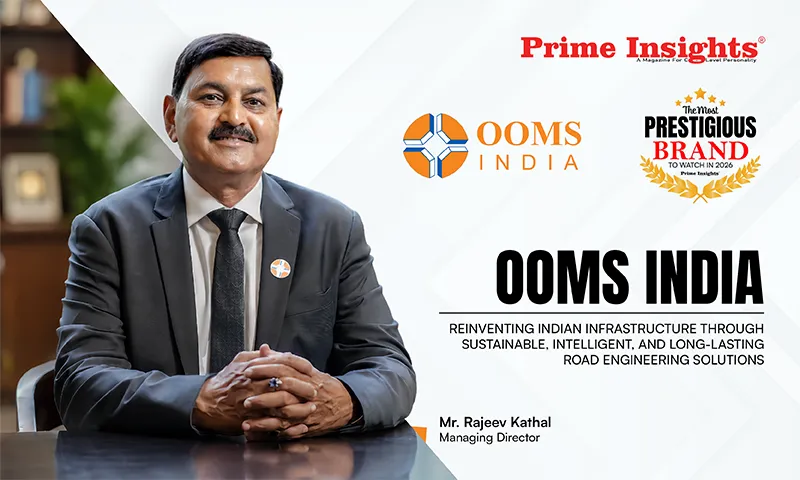
Ooms India (Ooms Polymer Modified Bitumen Pvt. Ltd.)
Modern roads are often trapped in a costly cycle of build, deteriorate, repair, and rebuild. In today’s infrastructure industry, success is frequently measured by speed rather than long-term durability, creating a “commodity mindset” that treats highways as disposable assets. The result is rising maintenance costs, endless construction zones, and failing roads. True industry leaders are now challenging this approach by focusing on intelligent, long-lasting infrastructure designed to survive time, traffic, and environmental stress.
Steering this paradigm shift is Ooms India (Ooms Polymer Modified Bitumen Pvt Ltd), an institution that introduced Polymer Modified Bitumen (PMB) Gellation technology to India in 1999, bridging a century of Dutch engineering heritage with Indian leadership. Since its strategic consolidation under Indian ownership in 2015, the enterprise has been dynamically led by Mr. Rajeev Kathal, Managing Director. Under his family stewardship, the company has transformed from a material supplier into a full-spectrum infrastructure solutions partner. Guided by the philosophy that infrastructure must endure, Mr. Kathal has championed a values-driven leadership model rooted in trust, technical integrity, and a refusal to compromise quality for short-term volume.
Operating on the conviction that roads should outlive their construction phase, Ooms functions by diagnosing infrastructure challenges from the ground up—analyzing soil, traffic, and climate before deploying tailored, high-performance binders. Its advanced portfolio features high-impact innovations developed in collaboration with CSIR-CRRI, such as REJUBIT, a next-generation pavement rejuvenator that unlocks circular recycling, and KrishiBind, a pioneering bio-bitumen made from agricultural residue launched by Union Minister Shri Nitin Gadkari in January 2026. Backed by NABL-accredited laboratories and an internal logistics fleet, Ooms brings strong engineering precision directly to project sites, helping set records on national highways and meeting stringent FIA Grade-1 standards on Formula 1 tracks.
In the spotlight are Mr. Rajeev Kathal, Managing Director; Mrs. Renuka Kathal, Director; Mr. Palash Kathal, Director; and Mrs. Arushi Arora Kathal, Chief Technology & People Officer, in an exclusive interview for our prestigious The Most Prestigious Brands to Watch in 2026 edition. Learn from their visionary insights and invaluable entrepreneurial lessons on how to transcend commodity mindsets, excel through substance, and build a lasting legacy. Stay tuned to discover their remarkable tale of success.
Prime Insights: Can you introduce your brand and share the vision that drives its growth and market presence?
Ooms India is the institution that introduced Polymer Modified Bitumen technology to the country and continues to set the benchmark for what advanced bituminous materials can achieve in Indian conditions. To describe the company as a manufacturer, however, is to describe only a part of what it does.
The philosophy was set more than a century ago in the Netherlands: infrastructure should be engineered to endure, not merely constructed quickly. That conviction carried into India in 1999, and it remains the organising principle of the company today. Ooms manufactures advanced bituminous materials and infrastructure solutions for highways, urban networks, airport runways, and specialised motorsport surfaces — and, in doing so, participates directly in the national conversation about what road-building in India should be for.
Much of the industry continues to operate within a four-step cycle of build, deteriorate, overlay, and rebuild. Ooms believes that model has reached the limits of its usefulness. Rising road levels, drainage failures, escalating maintenance budgets, and a significant environmental footprint are all symptoms of a single underlying disposition: roads treated as disposable. The company exists to argue, in product after product and project after project, that they need not be.
Growth at Ooms is driven by engineering credibility, R&D depth, a nationwide technical-support network, and the trust the company has earned in some of India’s most demanding infrastructure environments. Ooms has stayed in the business of value, not volume — and the market is moving decisively in that direction.
Roads should age with intelligence, not fail by design.
Prime Insights: What inspired the foundation of your brand, and how has your journey evolved over time?
The Ooms legacy began in 1913 in Avenhorn, the Netherlands, when Jan Ooms Pzn laid the foundation for what would become a century-long engineering journey. From the beginning, the company was built around a simple but powerful belief: infrastructure should be designed for durability and long-term societal impact. Long before sustainability became part of mainstream conversations, endurance had already become part of the Ooms philosophy.
Over generations, that philosophy continued to evolve through leaders who pushed the boundaries of engineering and innovation. Among them, Jan Dirk Ooms played a defining role in shaping Ooms’ culture of technical excellence and pioneering new technologies, including modified bitumen solutions that later gained global recognition.
In 1999, that philosophy crossed continents. Ooms entered India with a defining objective — to introduce Polymer Modified Bitumen technology to a market still dominated by conventional materials and short-term construction logic. PMB transformed how the country thought about pavement performance, and the introduction of gelation-based PMB to India remains a foundational chapter in the company’s Indian heritage.
In 2015, the journey entered its most consequential phase. The Indian operations of Ooms Group were consolidated under Indian ownership by us, through a structured, multi-year process — a transition that brought together a century of Dutch engineering heritage with the conviction, ambition, and on-ground intelligence required to lead in one of the world’s most demanding infrastructure markets.
From there, the company expanded well beyond material supply. Advanced binders, emulsions, airport-grade technologies, mix-design support, and pavement rehabilitation systems followed in succession — repositioning Ooms as a full-spectrum infrastructure solutions partner rather than a vendor.
The most defining shift, however, has been the deliberate move toward circular infrastructure. Project after project made visible the environmental and economic limits of rebuilding roads with virgin material. The response was a sustained investment in recycling-led technology. That investment produced REJUBIT — a next-generation rejuvenator developed in partnership with CSIR-CRRI that restores aged pavements rather than discarding them. Inaugurated by Union Minister Shri Nitin Gadkari, it represents the beginning of how Indian roads will be maintained in the coming generation.
The result is an enterprise that combines global heritage, Indian leadership, and future-focused innovation under a single brand — and continues to be steered by the same family stewardship that has guided it since the Indian consolidation.
Prime Insights: What core values define your brand identity and prestige in the market?
At Ooms, prestige has never been a product of marketing. It has been earned, project by project, in environments where failure is not a permissible outcome — on active runways, on Formula 1 circuits, on expressways carrying tens of thousands of vehicles each day, and on the corridors that connect India’s cities to its ports.
Four principles define the institution.
- Innovate for Impact — innovation must address real infrastructure problems, not generate visibility. This conviction produced PMB, AeroPave, the RoadGuard range, and REJUBIT.
- Think Big — pavements should be engineered for lifecycle performance, not short-term completion.
- Team on a Mission — a collaborative culture connecting R&D, manufacturing, logistics, and field engineering.
- Excellence is a State of Mind — consistency, quality, and accountability across every stage of operations.
These principles rest on a deeper cultural foundation Ooms calls TRUST: Teamwork, Responsibility, Unity, Synergy, and Transparency. It is not language printed on office walls. It is the operating discipline the organisation runs on — particularly when a project demands a level of engineering judgment that no specification document can fully anticipate.
In critical infrastructure, performance is remembered long after pricing is forgotten.
Prime Insights: What products or services make your brand stand out among competitors?
The manufacturing portfolio spans the full spectrum of high-performance bituminous products — from everyday road maintenance to the most demanding aviation and motorsport surfaces.
- Polymer Modified Bitumen (PMB) and Performance Grade PMB
- Crumb Rubber Modified Bitumen (CRMB)
- Bitumen emulsions and microsurfacing emulsions
- AeroPave Max — airport-grade binders engineered for runway loads
- Ooms RoadGuard — preventive maintenance range
- REJUBIT — next-generation bitumen rejuvenator, developed with CSIR-CRRI
- KrishiBind — bio-bitumen, licensed from CSIR-CRRI
The catalogue, however, captures only part of the proposition. What distinguishes Ooms is the engineering architecture that sits around the product — mix-design assistance, on-site technical support, pavement rehabilitation guidance, preventive maintenance systems, and validation through NABL-accredited laboratories. The company deploys engineering talent drawn from India’s leading technical institutions onto project sites across the country. Problems are diagnosed from the ground up — soil, traffic, climate, distress, execution — before a single product is recommended.
A nationwide manufacturing footprint and an in-house logistics fleet ensure that this calibre of engagement reaches every project, regardless of scale. The discipline applied to a Formula 1 racing surface is the discipline applied to a state PWD overlay. That uniformity of standard is, more than any single product, what defines the company in the market.
Ooms does not compete in the commodity mindset of ‘supply and forget.’ The company stays involved until the pavement performs.
Prime Insights: What key milestones or achievements have strengthened your brand’s reputation?
The earliest milestone — bringing PMB gellation technology to India — helped redefine the country’s pavement durability standards. The achievements since then have followed a single, consistent pattern: trust earned in environments where reliability is non-negotiable.
THE AVIATION CHAPTER
Ooms has been a long-standing trusted supplier for runway works at Delhi Airport since the airport’s modernisation work began — a relationship measured not in years but in decades, in a setting where one underperforming batch is one too many. The company is also a key bituminous materials partner bituminous materials partner for Noida International Airport at Jewar, one of India’s most ambitious aviation projects currently under construction.
The Yelahanka Air Force airfield offers another long-standing proof point: Ooms materials have continued performing reliably under demanding operational conditions for years. When aircraft, rather than vehicles, meet the pavement, long-term performance becomes the most credible engineering reference a company can hold.
THE MOTORSPORT STANDARD
Few infrastructure surfaces in the world are tested as unforgivingly as a Formula 1 circuit. The Buddh International Circuit at Greater Noida — the venue that hosted India’s Formula 1 Grand Prix — was surfaced using Ooms-supplied bituminous technology engineered to FIA Grade 1 standards. The track demanded a binder capable of withstanding extreme thermal cycling, lateral loads at racing speeds, and the precise surface texture required for high-performance motorsport tyres. For Ooms, the project remains one of the most exacting validations of what its modified bitumen technology can achieve.
THE HIGHWAY RECORDS
Ooms-supplied modified bitumen was the material specified for two of the most celebrated highway execution achievements in recent Indian history — the ‘100 Lane Kilometres in 100 Hours’ project, and the construction of 34.24 kilometres of road in 24 hours on the Ganga Expressway. These are records held by the executing contractors. The binder beneath those records, however, was Ooms’. It is a quiet credential, and the company values it more than the headlines.
THE INNOVATIONS
In recent years, two CSIR-CRRI collaborations have moved from laboratory to national consequence. REJUBIT, a next-generation bitumen rejuvenator, was launched by Union Minister Shri Nitin Gadkari Ji — a moment that placed circular infrastructure firmly on the national agenda. KrishiBind, a bio-bitumen technology licensed to Ooms from CSIR-CRRI, has positioned India among the very few nations globally to have commercialised bio-bitumen produced from agricultural residue.
Combined with NABL-accredited R&D, a nationwide manufacturing network, and recognition at platforms such as the CIDC Vishwakarma Awards, these milestones describe the trajectory of an institution that has moved from product manufacturer to technology-driven infrastructure engineering partner.
From Formula 1 to airport runways to national highways — when the country’s most demanding surfaces consistently rest on your materials, consistency stops being a claim and becomes a responsibility.
Prime Insights: How do you maintain consistency in quality, innovation, and customer experience?
Consistency at Ooms is the product of disciplined systems rather than individual effort. NABL-accredited laboratories, in-house process monitoring, and rigorous material-validation protocols ensure that every batch leaving every facility is tested against the same exacting standard, regardless of the commercial size of the order.
Innovation is sustained through continuous R&D investment and active collaboration with CSIR-CRRI and the IITs. The conviction at Ooms is that innovation must remain anchored to real industry problems rather than isolated in theory. Every product in the portfolio began as a problem the company encountered repeatedly on project sites.
Customer experience follows the same logic. Ooms engages with projects from the earliest stage — mix design, material selection, execution support, troubleshooting — and remains involved through the full lifecycle. A project is not considered closed when the invoice is settled. It is considered closed when the pavement is performing as it was engineered to.
Quality is not inspected into the product at the end. It is engineered into every stage of the process.
Prime Insights: What strategies do you use to build strong brand recognition and loyalty?
Ooms has built its brand through engineering performance rather than promotional campaigns. Its reputation comes from delivering durable roads, highways, runways, and racing circuits that continue performing years after completion. The company focuses on measurable outcomes such as durability, reduced maintenance, lifecycle efficiency, and dependable technical support. A key differentiator is its strong technical engagement, with skilled engineers working directly on project sites to understand real-world conditions and challenges. Ooms also strengthens industry knowledge through workshops, technical presentations, and training programs focused on pavement preservation, recycling, preventive maintenance, and lifecycle engineering, helping improve infrastructure standards across the sector.
Loyalty in infrastructure is built on confidence — that the road will last, that the runway will perform, and that the partner will stand behind the project long after delivery.
Prime Insights: How do you leverage technology and digital platforms to enhance brand visibility and engagement?
For Ooms, technology is not a visibility instrument. It is a means of making complex infrastructure knowledge accessible, practical, and actionable. Road engineering is technical by nature, and better infrastructure decisions become possible only when complex concepts are translated, simplified, and shared across the ecosystem.
Through LinkedIn, technical case studies, project showcases, and engineering-led storytelling, the company shapes conversation around pavement durability, airport-grade infrastructure, recycling, lifecycle engineering, and sustainable rehabilitation. The objective is technical confidence in the industry, not promotional reach for the brand.
Internally, technology strengthens execution — across manufacturing, laboratories, logistics, quality systems, and field coordination. It is also deeply embedded in R&D, where advanced testing, mix-design analysis, blending systems, and performance evaluation tools continuously refine product quality. Throughout, the principle is constant: technology must remain practical and usable for the people actually on the ground. A digital tool that complicates a site engineer’s day is not progress; it is friction in a more sophisticated costume.
Prime Insights: Can you share a success story where your brand significantly impacted customers or the industry?
India’s road sector has long depended on repetitive reconstruction, increasing maintenance costs and environmental impact over time. Ooms addressed this challenge through REJUBIT, developed with CSIR-CRRI to restore aged bitumen and enable higher utilization of Reclaimed Asphalt Pavement (RAP). Instead of rebuilding roads repeatedly, the technology extends pavement life through intelligent rehabilitation. More importantly, REJUBIT represents a successful transition of research from laboratory validation to large-scale industrial application, officially launched by Union Minister Shri Nitin Gadkari. Today, it is helping shift the industry toward sustainable infrastructure with lower lifecycle costs, reduced virgin material use, and a smaller environmental footprint.
Innovation has value only when it survives traffic, weather, pressure, and time.
Prime Insights: How do you ensure customer trust and long-term relationships?
In infrastructure, customers invest in confidence as much as materials. Ooms builds that trust through three core commitments: technical integrity, transparent communication, and rapid responsiveness. The company recommends solutions based on actual site needs, maintains open communication during challenges, and provides strong on-ground engineering support whenever required. Continuous investment in quality assurance, logistics reliability, and technical expertise ensures consistent performance across projects. This disciplined approach has helped Ooms build long-term relationships with some of India’s most demanding aviation, expressway, motorsport, and defence infrastructure clients.
Prime Insights: What role does sustainability and corporate responsibility play in your brand strategy?
Sustainability is no longer optional in infrastructure. It is foundational. At Ooms, it lives across three layers of the institution: products, operations, and partnerships.
IN PRODUCTS
The company advocates for circular infrastructure, pavement recycling, preventive maintenance, and lifecycle engineering. REJUBIT enables aged roads to be restored and reused rather than rebuilt; resulting in reduced use of fresh aggregates and binders, lower material movement, and lower lifecycle emissions. Performance Grade PMB and the RoadGuard preventive maintenance range extend pavement life, materially reducing the consumption of resources over the long term. KrishiBind, the bio-bitumen technology held under licence from CSIR-CRRI, points further forward — toward reducing dependence on fossil-based binders altogether. Launched by Union Minister Shri Nitin Gadkari Ji in January 2026, KrishiBind has placed India among the very few nations globally to have commercialised bio-bitumen from agricultural residue. Ooms holds this commercial licence.
IN OPERATIONS
Sustainability also shapes the way Ooms manufacturing facilities are run. The company has adopted biomass briquettes for thermal operations and solar power for electrical requirements, steadily lowering the operational carbon footprint of production. The work is ongoing — there is no final line to be crossed — but the direction is set, and the discipline is consistent.
IN PARTNERSHIPS
Responsible infrastructure development requires close collaboration between industry, research institutions, and policymakers. Ooms remains actively engaged in those conversations, both formally through CSIR-CRRI and the leading academic institutions, and informally with the agencies and EPC partners with whom the company works daily.
Sustainability is not a compliance requirement. It is the future of infrastructure itself.
Prime Insights: How do you stay ahead of market trends and evolving consumer expectations?
Ooms stays ahead by integrating research, field execution, and long-term infrastructure thinking. As the industry faces rising traffic loads, climate challenges, sustainability demands, and evolving airport and motorsport standards, the company develops solutions proactively rather than reactively. Its advanced R&D and testing facilities focus on product innovation, pavement evaluation, mix-design support, and quality validation, enabling project-specific customization. Collaborations with CSIR-CRRI and leading academic institutions, including IITs, further strengthen innovation through real-world applications. Ooms believes the future of infrastructure lies in lifecycle engineering, preventive maintenance, recycling, and intelligent rehabilitation rather than simply building roads faster.
Prime Insights: What challenges have you faced in maintaining brand prestige, and how have you overcome them?
The infrastructure industry remains highly price-sensitive, where decisions are often based on immediate cost rather than long-term lifecycle performance. For Ooms, introducing advanced technologies like PMB, preventive maintenance systems, REJUBIT, and KrishiBind required changing industry mindsets alongside delivering product innovation.
The company addressed this challenge through continuous technical engagement, workshops, and knowledge-sharing programs with EPC firms and government bodies. By adopting a consultative, engineering-led approach that studies site conditions, climate, traffic, and pavement behavior, Ooms shifted conversations from “price per ton” to “performance over lifecycle,” strengthening its credibility, customer trust, and long-term brand prestige.
Prime Insights: What are your future plans for expansion, innovation, and global presence by 2026 and beyond?
Ooms aims to reshape how infrastructure is designed, maintained, and rehabilitated in India and beyond. Its future roadmap focuses on three priorities:
- Scaling sustainable technologies like REJUBIT, KrishiBind, RAP utilisation, and intelligent rehabilitation systems.
- Deepening R&D collaborations with institutions like CSIR-CRRI and IITs to commercialize advanced innovations.
- Strengthening operational capabilities through advanced manufacturing, sustainable energy, digital integration, and engineering talent.
The next generation of infrastructure will not be defined by how much is built — but by how intelligently it survives time, traffic, and climate.
Prime Insights: What advice would you give to emerging brands aiming to build a prestigious and trusted identity?
Prestige is not created through marketing alone; it is earned through consistency, innovation, and dependable performance over time. Emerging brands should focus on solving real problems, building capability before perception, and staying committed to quality even under pressure. Meaningful innovation must create practical impact, supported by investment in people, systems, and long-term growth. Most importantly, brands must stay true to their core philosophy. As Ooms believes, infrastructure may begin with construction, but legacy is ultimately built through performance and trust.
