

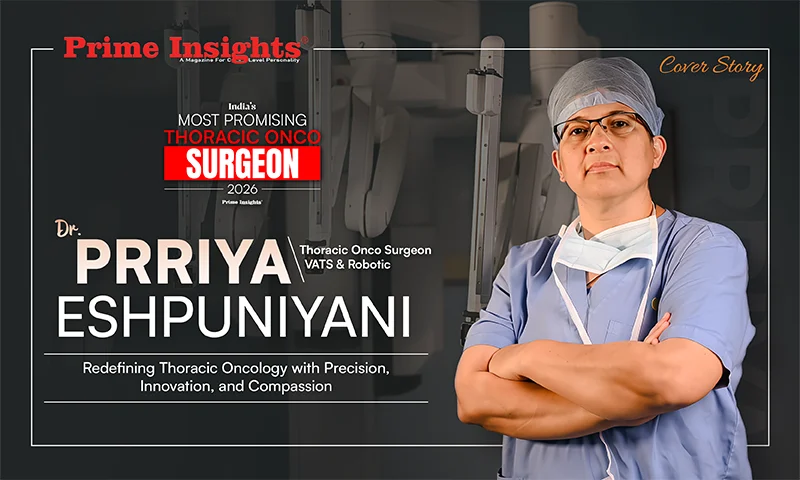
Dr. Prriya Eshpuniyani
Did you know that the space a thoracic surgeon operates in is often no larger than the palm of your hand, yet it contains the engines of human life? In the medical world, thoracic surgery was long considered the “Final Frontier” due to its sheer complexity. Today, the industry is witnessing a seismic shift; it is no longer just about survival, but about the quality of that survival. As competition intensifies among healthcare providers to adopt the latest tech, the industry has moved from “maximal intervention” to “minimal intrusion.” In a field where a single millimeter can change a life, the pressure to innovate isn’t just a business strategy—it is a moral imperative.
Standing at the vanguard of this shift is VATS & Robotic, a specialized practice dedicated to redefining the boundaries of thoracic care. Founded on the belief that advanced cancer care should be as precise as it is compassionate, the company has become a beacon for minimally invasive excellence. Leading this charge is Dr. Prriya Eshpuniyani, a visionary who was among the first in India to secure a DrNB in Thoracic Surgery. With a background rooted in prestigious institutions like Tata Medical Centre and specialized training from Shanghai, Dr. Prriya’s journey is one of relentless academic and technical pursuit. As a leader in advanced thoracic care, her philosophy is anchored in the ‘Three Pillars”: innovation through technology, academic engagement, and life-changing research.
The operational excellence of VATS & Robotic is driven by the integration of Video-Assisted Thoracoscopic Surgery (VATS) and Robotic platforms. By utilizing “Uniportal” techniques—operating through a single, tiny incision—and AI-driven 3D reconstruction, the practice turns once-daunting surgeries into streamlined, high-precision procedures. This approach works by combining the surgeon’s intuition with robotic dexterity, allowing for complex “sleeve resections” that save healthy lung tissue while eradicating disease. For the patient, this means the “best of both worlds”: the highest standard of oncological safety paired with a recovery time that was once thought impossible.
In the spotlight is Dr. Prriya Eshpuniyani in an interview of our prestigious “India’s Most Promising Thoracic Onco Surgeon 2026” edition. Learn from her insights and valuable lessons as an entrepreneur to excel and make it the best company. Stay tuned and know her tale of success.
Prime Insights: Can you introduce yourself and share your journey into thoracic oncology surgery?
I am Dr. Prriya Eshpuniyani, a Thoracic Surgeon and Surgical Oncologist based in Navi Mumbai. My journey into thoracic oncology has been shaped by a deep commitment to managing complex cancers with precision and advanced surgical techniques.
I began my medical career at PDM Dr. D. Y. Patil Medical College, Mumbai, where I completed my MBBS in 2000. I then pursued General Surgery and earned my DNB from the Bhabha Atomic Research Centre and Hospital in 2007. However, I was always drawn toward more specialized and technically demanding areas of surgery.
This led me to pursue a Fellowship in Surgical Oncology at Tata Medical Centre, Kolkata, in 2013, where I developed a strong foundation in cancer care. I further specialized by completing my DrNB in Thoracic Surgery from RG Kar Medical College and Hospital in 2016, becoming part of the first cohort in the country to achieve this qualification.
Recognizing the importance of technology in modern surgery, I completed the Fellowship of Advanced Robotic and Innovative Surgery (FARIS) in 2023. Today, I practice across multiple leading institutions, including Asian Cancer Institute, Apollo Hospital Navi Mumbai, MGM Hospital, and Kokilaben Dhirubhai Ambani Hospital, focusing on delivering comprehensive thoracic oncology care.
Prime Insights: What inspired you to specialize in thoracic oncology, and what motivates you in this field?
My decision to specialize in thoracic oncology was driven by a desire to bridge the gap between general surgery and highly specialized cancer care. After completing my DNB in General Surgery, I realized that oncology demanded a level of precision and depth that truly challenged me.
Thoracic surgery, in particular, deals with one of the most complex anatomical regions of the body—the chest, which houses the lungs, heart, and major vessels. This complexity, combined with the high stakes involved, inspired me to pursue this field further.
My motivation today comes from three core aspects. First is innovation—being able to use advanced tools like robotic systems and VATS to perform highly precise surgeries. Second is academic engagement through platforms like the Lung Cancer Masterclass and Year End Review, which keep me aligned with global advancements. Third is research, where I focus on improving surgical outcomes and preserving lung function through techniques like sleeve resections.
Ultimately, what drives me most is the impact on patients—whether it is treating rare tumors or improving quality of life through minimally invasive procedures.
Prime Insights: What are the most common thoracic cancers you treat, and how have their trends changed?
In my practice, lung cancer is the most common thoracic malignancy I treat, followed by esophageal cancer, mediastinal tumors such as thymomas, and pleural mesothelioma.
Over the years, there has been a noticeable rise in lung cancer incidence in India. While it was traditionally more common in older males with a history of smoking, we are now seeing increasing cases among women and younger individuals. Environmental pollution and changing lifestyle patterns are significant contributing factors.
Esophageal cancer continues to have a high burden in certain regions of India, with significant geographical variations in its incidence. Overall, the cancer burden is increasing, which underscores the need for early detection and advanced surgical approaches to improve outcomes.
Prime Insights: What advanced surgical techniques and innovations do you specialize in?
My practice focuses on minimally invasive thoracic surgery, particularly Video-Assisted Thoracoscopic Surgery (VATS) and robotic-assisted procedures.
I have received specialized training in Uniportal VATS at the Shanghai Pulmonary Hospital, which allows major lung surgeries to be performed through a single small incision. This significantly reduces pain and recovery time.
In robotic surgery, I am proficient in advanced robotic surgical platforms like the CMR Versius system, which provides enhanced 3D visualization and superior dexterity. This is especially useful in complex thoracic procedures.
I also specialize in advanced reconstructive surgeries, including tracheal and bronchial procedures and sleeve resections. These techniques allow removal of tumors while preserving as much healthy lung tissue as possible.
Additionally, I manage mediastinal tumors, rare thoracic conditions like solitary fibrous tumors, and complex cases requiring prosthetic reconstruction, such as congenital diaphragmatic hernias.
Prime Insights: How do you ensure precision and safety during complex thoracic cancer surgeries?
Precision and safety in thoracic surgery require a multi-layered approach.
I utilize advanced technologies such as robotic-assisted systems and Uniportal VATS to achieve high-definition visualization and enhanced surgical control. These tools allow me to operate in confined spaces with minimal trauma.
Preoperative planning is equally critical. I rely on imaging modalities like CT and PET-CT scans for detailed tumor mapping. Each complex case is evaluated in a multidisciplinary tumor board to determine the safest and most effective approach.
Organ preservation is a key priority. Techniques such as sleeve resections allow me to remove tumors while maintaining lung function, avoiding more radical procedures like pneumonectomy whenever possible.
Continuous learning and adherence to global standards further ensure that patient safety remains paramount.
Prime Insights: Can you share a challenging case that had a significant impact on your career?
One of the most impactful cases I handled was that of a 17-year-old boy with a massive mediastinal tumor measuring nearly 20 x 15 cm. Despite chemotherapy, the tumor continued to compress his lungs and heart.
He came to me as a last hope. Considering his age and the tumor type—a germ cell tumor—I decided to proceed with surgery despite the risks.
With meticulous planning and strong team coordination, we successfully removed a 2.3 kg tumor along with a portion of the lung. His recovery and eventual discharge with a smile remain one of the most fulfilling moments of my career. It reinforced my belief in taking on challenging cases with determination and precision.
Prime Insights: How do you collaborate with other specialists for comprehensive patient care?
Thoracic oncology requires a multidisciplinary approach.
I work closely with medical oncologists to determine chemotherapy or immunotherapy strategies, and with radiation oncologists for post-operative treatment planning. Radiologists play a critical role in imaging interpretation, while pathologists guide histological and molecular diagnosis.
These collaborations happen through structured tumor board meetings, ensuring that every patient receives a well-rounded treatment plan.
I also coordinate with pulmonologists, critical care specialists, and interventional radiologists for perioperative management. This integrated approach ensures seamless care from diagnosis to recovery.
Prime Insights: What role does technology, such as robotic surgery and AI, play in improving patient outcomes?
Technology has significantly transformed thoracic oncology.
Robotic-assisted surgery provides enhanced precision through 3D visualization and wristed instruments, allowing for delicate dissection in complex anatomical areas. It also minimizes trauma, leading to reduced pain, lower blood loss, and faster recovery.
Artificial Intelligence is increasingly being used for early detection, analyzing imaging to identify lung nodules that may otherwise be missed. It also aids in surgical planning through 3D reconstruction and helps predict patient risks using data-driven models.
Combined with minimally invasive techniques like VATS, these advancements enable safer surgeries and better overall outcomes.
Prime Insights: How do you approach early diagnosis and patient awareness?
Early diagnosis is critical in improving survival rates in thoracic cancers.
During the COVID-19 pandemic, we observed an increase in incidental detection of lung nodules due to widespread CT scanning. This highlighted the importance of opportunistic screening.
I advocate for proactive monitoring of such findings and early referral to specialists. Screening high-risk individuals, particularly smokers, using low-dose CT scans is also essential.
Equally important is patient education. I focus on explaining medical conditions in simple terms so that patients and their families fully understand their diagnosis and treatment options.
Prime Insights: What are the biggest challenges in treating thoracic cancers in India?
One of the biggest challenges is late diagnosis, as many patients present with advanced disease. Limited awareness and access to specialized care further complicate outcomes.
Another challenge is the variability in infrastructure and expertise across regions. While advanced technologies like robotic surgery are available, they are not yet universally accessible.
Addressing these challenges requires improved screening programs, better awareness, and continued investment in healthcare infrastructure and training.
Prime Insights: How do you support patients emotionally and psychologically during their treatment journey?
Cancer treatment is not just physical—it is deeply emotional.
I prioritize clear and transparent communication, ensuring patients understand their condition and treatment plan. This helps reduce anxiety and builds trust.
I also encourage peer support through patient communities, where individuals can connect with others who have undergone similar experiences.
Addressing financial concerns and providing continuous post-operative support are equally important in ensuring holistic care.
Prime Insights: How do you contribute to research, training, and mentoring?
I actively contribute to research, with over 20 publications in peer-reviewed journals focusing on lung cancer screening and rare thoracic conditions.
As the Organizing Secretary for the Lung Cancer Masterclass and Year End Review series, I play a role in shaping academic discussions and training programs in India.
Mentorship is also a key focus. I train young surgeons in minimally invasive techniques like VATS and robotic surgery, helping them transition from traditional approaches to advanced methods.
Prime Insights: What are your future goals in advancing thoracic oncology care in India?
My goals are centered around expanding access to minimally invasive and robotic surgery, strengthening early detection programs, and advancing research in complex thoracic conditions.
I aim to standardize screening protocols and improve differentiation between infections like tuberculosis and malignancies.
Additionally, I am committed to mentoring the next generation of surgeons and ensuring that high-quality thoracic oncology care becomes more widely accessible across India.
Prime Insights: What advice would you give to aspiring thoracic surgeons?
Thoracic oncology requires a strong technical foundation, particularly in minimally invasive and robotic techniques. A deep understanding of anatomy and cancer biology is essential.
Equally important is the ability to work within multidisciplinary teams and communicate effectively with patients.
Resilience is key, as the field involves high-risk surgeries and emotionally challenging situations. However, the impact you can make on patients’ lives makes it an incredibly rewarding specialty.
