

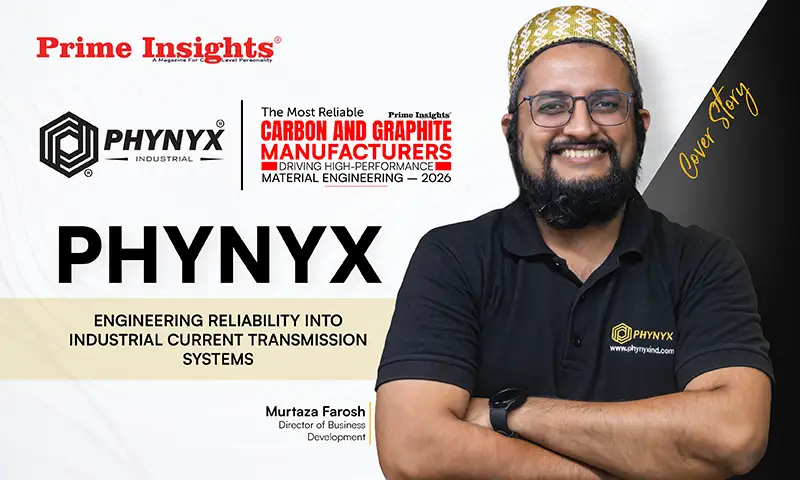
Phynyx
In heavy industrial environments, even a small interruption in current transmission can lead to major operational losses. Motors operating in cement plants, steel mills, mining operations, and power generation facilities often run continuously under heat, dust, vibration, and fluctuating loads. In such conditions, components like carbon brushes, brush holders, and slip ring assemblies play a far more critical role than most industries realize.
For Murtaza, this understanding came not from theory, but from observing how standard components often failed when exposed to actual operating environments. Many products available in the market were being treated as generic consumables, despite the fact that motor behavior, environmental conditions, and load characteristics could vary significantly from one application to another.
That realization eventually led to the foundation of Phynyx — a company focused on improving the reliability of rotating electrical equipment through better-engineered carbon and graphite solutions. Over time, the organization has evolved into a technically focused manufacturer serving industries where uptime, consistency, and operational reliability are critical.
In this conversation with Prime Insights for the feature “The Most Reliable Carbon and Graphite Manufacturers Driving High-Performance Material Engineering – 2026,” Murtaza shares insights into industrial reliability, material engineering, application-specific design, and the future of carbon and graphite components in modern industry.
Prime Insights: Many industries still treat carbon brushes and related components as standard consumables. Why do you believe their engineering is often underestimated?
Murtaza: One of the biggest misconceptions in the industry is that carbon brushes are interchangeable standard products. In reality, their performance depends heavily on the operating environment of the equipment.
A motor running in a cement plant under high dust and continuous load behaves very differently from equipment operating in a controlled environment. Factors such as temperature, vibration, load variation, speed, and atmospheric conditions directly affect brush performance, wear characteristics, and current transmission stability.
When these variables are ignored, industries often experience excessive wear, sparking, unstable contact, and repeated maintenance interruptions. Unfortunately, many of these issues are blamed on the motor itself when the actual problem lies in component selection or design compatibility.
At Phynyx, we approach these components from an engineering perspective rather than treating them as generic consumables. The focus is always on aligning material properties, dimensions, holder configuration, and contact behavior with the actual application.
Prime Insights: What originally inspired you to build Phynyx, and what gap did you see in the market?
Murtaza: The foundation of Phynyx came from observing recurring operational problems in industrial motors and generators where standard products were not performing consistently.
We noticed that many industries were sourcing carbon brushes and related components primarily based on dimensions or availability, without enough focus on operating requirements. This often resulted in frequent brush failures, uneven wear, sparking, and avoidable downtime.
What stood out to us was that even though these components were comparatively small, they had a major influence on equipment reliability and maintenance cycles.
That created an opportunity for a more technically focused approach — one where components were selected and refined based not just on specifications, but on how the equipment actually operated in the field.
Over time, Phynyx evolved into a company focused on solving these kinds of operational challenges through better material selection, manufacturing consistency, and application-focused engineering.
Prime Insights: A lot of companies manufacture carbon brushes and holders. What, according to you, actually separates a reliable solution from a standard one?
Murtaza: In our view, reliability comes from understanding how the component behaves during operation, not just whether it matches a drawing.
For example, in carbon brushes, aspects such as material composition, density consistency, contact behavior, and even how spring pressure is distributed through the brush top can influence performance significantly.
Similarly, in brush holders, alignment stability, insulation quality, and dimensional consistency directly affect contact reliability and wear behavior.
Even terminal design and plating quality can influence electrical resistance, corrosion protection, and operational life.
A reliable solution is therefore not simply about manufacturing a component — it is about understanding how that component interacts with the motor under actual operating conditions.
Prime Insights: Your work is closely connected with industries like cement, steel, mining, and power generation. What are some of the common operational challenges you see in these environments?
Murtaza: The biggest challenge in these industries is that equipment often operates continuously under aggressive conditions.
In cement plants, for example, motors may operate in high-dust and high-temperature environments for extended durations. In steel plants, load fluctuations and operating stress can be significant. Mining environments introduce vibration, contamination, and difficult maintenance conditions.
Under such circumstances, even small inconsistencies in current transmission can gradually develop into larger operational problems.
We regularly encounter issues such as unstable contact, sparking, accelerated brush wear, uneven pressure distribution, and maintenance frequency increasing far earlier than expected.
Most of these issues are not isolated manufacturing defects — they are usually the result of a mismatch between the component design and the actual operating environment.
Prime Insights: Can you share an example where a technically focused approach helped solve a major operational issue for a customer?
Murtaza: One case that stands out involved a cement plant where motors were experiencing repeated brush wear and sparking problems under continuous operation.
The environment involved high dust exposure, elevated temperatures, and demanding load cycles. The customer was facing repeated maintenance interruptions, which naturally affected operational continuity.
Instead of immediately replacing components with identical parts, we studied the application in detail — including environmental conditions, load behavior, contact characteristics, and holder alignment.
Based on our observations, we refined the carbon grade selection and optimized certain design aspects related to brush configuration and holder alignment.
After implementation, the customer observed noticeably improved contact stability, reduced sparking, and longer component life. More importantly, maintenance frequency reduced significantly.
For us, projects like these reinforce the importance of application-focused engineering rather than treating all operating environments the same.
Prime Insights: How does Phynyx maintain consistency and quality in products that are expected to operate under such demanding conditions?
Murtaza: Consistency becomes extremely important when components are operating in critical equipment.
Our manufacturing and inspection processes are aligned with ISO 9001:2015 standards, and we follow IEC 60136 and IS 1028:2013 standards for dimensional and marking consistency.
We also maintain product traceability through SKU and batch identification systems so that every component can be tracked throughout production.
From a manufacturing perspective, we focus heavily on dimensional accuracy, material consistency, and controlled process monitoring.
To improve precision and manufacturing consistency, we utilize CNC machining and EDM-based processes where required. These processes help us achieve tighter tolerances, cleaner finishes, and reduced material wastage during production.
At the end of the day, quality is not just about inspection — it is about maintaining consistency from one production batch to the next.
Prime Insights: How do you see the carbon and graphite industry evolving over the next few years?
Murtaza: The industry is gradually moving toward more application-specific and reliability-focused solutions.
As industries continue to push for higher uptime, lower maintenance frequency, and greater operational efficiency, there is increasing awareness that standard one-size-fits-all solutions are often not enough.
We are also seeing growing demand for better dimensional consistency, improved wear performance, and more stable current transmission behavior in rotating equipment.
From a manufacturing perspective, there is a stronger push toward precision inspection systems, improved machining capability, and tighter process control.
At Phynyx, we are investing in technologies such as Vision Measuring Machines (VMM), CNC machining expansion, and EDM capabilities to support higher manufacturing precision and inspection consistency.
The future of this industry will increasingly depend on combining material understanding with practical operational knowledge.
Prime Insights: What advice would you give industries while selecting carbon and graphite components for critical equipment?
Murtaza: The biggest advice I would give is not to evaluate these components only on price or dimensions.
A carbon brush may physically fit into a holder, but that does not necessarily mean it is technically suitable for the application.
Industries should evaluate factors such as load conditions, speed, operating temperature, environmental exposure, duty cycle, and equipment behavior before selecting materials and configurations.
In many cases, repeated maintenance issues are not caused by poor equipment — they are caused by components that are not properly aligned with operating requirements.
Working closely with technically knowledgeable manufacturers can help industries improve equipment reliability, reduce maintenance interruptions, and significantly lower long-term operational costs.
Ultimately, reliability comes from understanding the application, not just supplying the component.
