

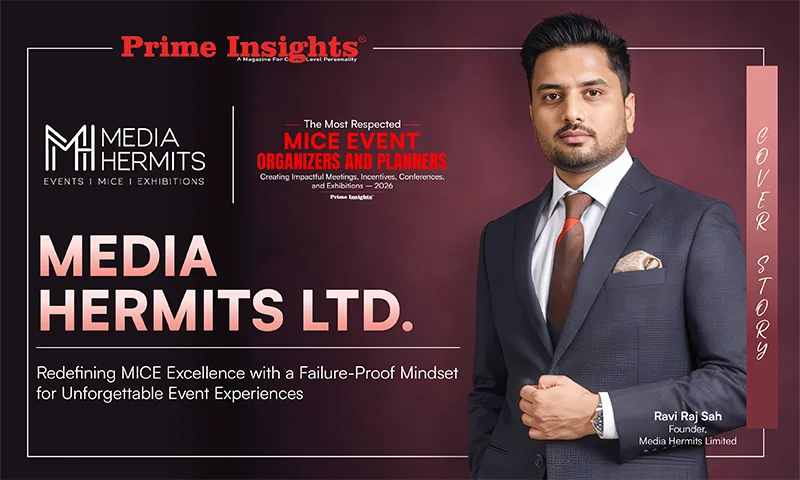
Media Hermits Limited
They say if you can survive a career in event planning, you can survive anything. Ranked alongside pilots on the global stress index, event coordination is a high-stakes performance requiring caffeinated adrenaline to master sudden monsoons and live-link glitches. Today, success isn’t about ballroom size; it’s about transforming logistical nightmares into seamless “Aha!” moments where a room of strangers finally becomes a unified community.
Rising to meet this challenge is Media Hermits Limited, a powerhouse founded in 2019 with the “stubborn belief” that events should never be a burden to the organizersor a blur to the attendees. Spearheading this vision is Founder Ravi Raj Sah, a leader who built the company not through grand proclamations, but through the grit of solving on-ground problems one project at a time. Under his leadership, Media Hermits has evolved from a small team in Pune to a global player headquartered in Mumbai, boasting a portfolio of over 900 projects across 20+ countries.
Ravi’s journey is one of relentless pursuit; his team’s dedication earned them the Best Event Planner recognition at the ET Now Business Conclave and Awards 2025, proving that when you prioritize the “why” behind an event, the accolades follow. His message to the business world is clear: transparency and consistency are the cornerstones of any lasting partnership.
At its core, Media Hermits operates as a strategic extension of a client’s team rather than a traditional vendor. The company utilizes a sophisticated, layered planning structure that integrates Standard Operating Procedures (SOPs) across production, MICE, and operations to manage complex movements for industries ranging from BFSI, Pharmaceuticals, Manufacturing, IT, and a range of other industries.. Whether it is navigating a nationwide airline disruption during a 400-person incentive trip to Colombo or leveraging data analytics to track attendee engagement, they employ a “failure mapping” philosophy. This proactive approach ensures that technology remains a helpful, invisible tool that enhances the human experience rather than distracting from it.
In the spotlight is Ravi Raj Sah, Founder of Media Hermits Limited, in an interview for our prestigious “The Most Respected MICE Event Organizers and Planners Creating Impactful Meetings, Incentives, Conferences, and Exhibitions – 2026” edition. Learn from his entrepreneurial insights to excel and make your company the best. Stay tuned and learn his tale of success.
Prime Insights: Can you introduce your organization and share its core vision in the MICE industry?
Media Hermits started with a basic, almost stubborn belief—that events should never feel like a burden to the people running them or a blur to the people attending them. Founded in 2019 in Pune and now headquartered in Mumbai, we set out to build a company that could hold both the strategy and the emotion of an event in the same hand.
Today, Media Hermits Limited works with corporate brands, government bodies, and fast-growing businesses across India and the world, from high-stakes conferences and international MICE movements to exhibitions, product launches, and BTL activations. With 900+ projects delivered, 300+ clients served, and work spanning 20+ countries and 100+ cities, we have evolved into a trusted partner for brands seeking events that deliver meaningful impact.
Our vision is not complicated: we want every client who works with us to feel, at the end of their event, that their audience was moved—and that they themselves never had to worry about the how.
Prime Insights: What inspired you to enter the MICE events space, and how has your journey evolved over the years?
The honest answer is that nobody at Media Hermits started out planning to build a MICE company. They started by doing events—the kind where you show up, solve problems on the fly, go home exhausted, and then wake up the next morning wanting to do it all over again.
Over the years, as projects got bigger and briefs got more complex, there came a moment of clarity: corporate India was spending serious money on meetings, incentives, conferences, and exhibitions, but the experience of those events rarely matched the investment. Delegates were bored. Logistics were messy. Clients were stressed. The gap between what was possible and what was being delivered was wide open.
That gap is what Media Hermits walked into. Media Hermits entered this gap not with a grand announcement, but quietly, project by project. We organized a conference here, an international incentive there, and a flagship exhibition in between. Each one taught us something new about what corporate audiences actually need versus what they are usually given.
Since 2020, the journey has gone from a small team managing a handful of events to a structured company with departments, SOPs, cross-functional expertise, and a roster of clients who keep coming back. We have won the Best Event Planner recognition at the ET Now Business Conclave and Awards 2025, West Edition — not because we chased awards, but because the work earned it.
Prime Insights: What types of events and industries do you primarily cater to?
If you look at the range of clients who have trusted us over the past five years, the one thing they all have in common is that they take their people seriously—whether those people are employees, business partners, distributors, or customers.
On the industry side, we work with BFSI companies doing large-scale annual conclaves; pharmaceutical companies running medical conferences and incentive programs; consumer brands activating in-store and on-ground; technology companies hosting product launches; manufacturing firms moving hundreds of dealers to international destinations; and startups making their mark with their first public showcase.
On the event format side, our days are spread across corporate offsites, MICE movements, domestic and international conferences, exhibitions and trade show participation, incentive travel programs, award ceremonies, artist-managed evening galas, press events, fashion shows, BTL activations, virtual and hybrid events, product launches, and grand openings.
This breadth is intentional, keeping the team sharp, curious, and cross-pollinating ideas from one format into another. Something we learn managing a healthcare conference in Singapore often improves how we run a dealer incentive in Rajasthan—and vice versa, as the diverse experiences and challenges faced in each location provide valuable insights that enhance our overall event management strategies.
Prime Insights: What sets your organization apart in delivering impactful and memorable MICE experiences?
There is a version of event management that is about vendors, spreadsheets, and checklists. We do all of that. But what actually sets Media Hermits apart is a habit we developed early: asking the client what success looks like six months after the event.
That question changes everything. It changes the talk from “what do you want on stage” to “how do you want your people to feel when they go home?” And once you are solving for that, the creative, the logistics, the venue, and the programming all align differently.
Practically speaking, we have built a structure that gives clients the reliability of a large agency with the agility of a boutique one. We have SOPs for every vertical—production, MICE, operations, and client servicing—so nothing gets dropped between departments. Our turnaround time is faster than most. Our vendor network is deep and tested. And critically, our team leads are senior enough to make decisions on the ground without running back to a chain of approvals.
Clients often describe us as feeling like an internal team. Not a vendor. That distinction matters to us enormously.
Prime Insights: How do you ensure seamless planning, execution, and coordination across large-scale events?
There is a phrase we use internally: the best event is one the audience thinks ran itself.
Achieving that illusion takes a lot of invisible effort. It starts weeks, sometimes months, before the event date—with objective mapping sessions where we understand not just the brief but also the pressure the client is carrying. What is the business context? Who is in the room and how do they need to feel? What could go wrong, and what is the plan when it does?
From there, we build the event in layers: venue and destination locking, travel and logistics planning, vendor briefings and confirmations, delegate communication schedules, content flow and run-of-show documents, production and AV (audiovisual) planning, hospitality and F&B (food and beverage) coordination, and on-ground team allocations and role-specific checklists.
For large-scale events spanning multiple cities or countries, we set up a central coordination structure with separate cluster leads for travel, production, delegate management, and on-ground hospitality—all connected to a single war room that monitors everything in real time.
The result is that, on event day, the client is standing in a room that feels effortless— while somewhere nearby, our team is quietly managing forty moving parts at once.
Prime Insights: What role does creativity and innovation play in designing unique event experiences?
We always tell new team members: creativity is not the decoration at the end of a plan. It is woven into the plan from the very beginning.
When we get a brief, the first creative question we ask is, “What feeling should this event leave behind?” Not what theme, not what color palette. The feeling. From that answer, everything else flows: the venue mood, the programming format, how music and light are used, how the key message lands, and whether the evening ends with a bang or a quiet, personal moment.
What this means practically is that a conference for a pharmaceutical company and a conference for a consumer brand should feel entirely different, even if they are both held in five-star hotel ballrooms. The audience is different. The culture is different. The emotional stakes are different.
We also invest in format innovation—not just for novelty, but because formats shape behavior, influencing how participants engage and interact during events. An interactive fishbowl session generates conversation in a way that a panel discussion simply does not. A culturally rooted evening experience in a destination city creates memories that a standard gala dinner cannot. These choices are deliberate, and they come from a team that has attended enough events to know the difference between what looks good and what actually works.
Some of our most celebrated projects have been the ones where we pushed back gently on a conventional brief and offered something the client had not imagined but instantly recognized as right.
Prime Insights: How do you leverage technology such as virtual platforms, event apps, and data analytics to enhance attendee engagement?
We treat technology the way a good host treats good furniture—it should be thoughtfully chosen, easy to use, and invisible to the guest once the experience is underway.
For delegate management, we use registration platforms that reduce friction from the first confirmation email to the on-site check-in. For communication, we build out structured pre-event, during-event, and post-event journeys that keep delegates informed without overwhelming them. For engagement during conferences and summits, we incorporate polling, live Q&A tools, and interactive session formats that make large audiences feel personally involved.
For hybrid and virtual events, we design experiences that give remote participants a genuine reason to stay engaged—not just a livestream window to peer through, but meaningful participation, curated content, and real-time interaction.
On the analytics side, we capture participation data, session attendance patterns, and delegate feedback wherever possible. This helps clients understand where the energy was in the room—which session sparked the most conversation, which moment people photographed, and which part of the program fell flat. For future editions, this data becomes a goldmine.
That said, we are careful never to let the tool become the show. The moment technology starts confusing delegates or slowing down the energy of a room, it has done more harm than good, as it detracts from the overall experience and engagement that is crucial for successful events.
Prime Insights: Can you share a success story of a major event that significantly impacted your client’s objectives?
There are many projects we are proud of, but the one that stays with us most is a large MICE movement we executed for SUD LIFE—an incentive trip to Colombo for their topperforming teams and distribution partners.
The brief was to celebrate high achievers and give them a world-class experience that they would carry as a memory for years. The stakes were personal—these were people who had worked hard for a specific reward, and the event was the company’s way of saying, “We see you.”
What made the execution complex was the scale: over 400 participants across the country, multiple flight routes, hotel blocks across destinations, an itinerary packed with curated experiences, recognition ceremonies, and evening programs. During the travel date, a nationwide airline disruption threatened to unravel months of planning. Our team —spread across Mumbai and on the ground in the destination—worked through the night, rebooking, rerouting, and communicating with delegates individually to ensure nobody was stranded and the program could continue.
The client did not have to manage a single piece of that chaos. By the time delegates arrived at the destination, everything was in place.
When the client wrote to us afterward and said that the event was the first incentive where their team genuinely came back recharged and grateful, it was one of those moments where you remember why this work matters. The event had done what it was supposed to do—it made people feel recognized, valued, and inspired.
MEDIA HERMITS, INTERNATIONAL COLLABORATIONS.
Asia Pacific Life Insurance Congress (APLIC) 2025 is one of the region’s most prominent gatherings for financial advisors, insurers, and industry leaders, organised under the umbrella of the Asia Pacific Financial Services Association (APFinSA). The congress serves as a platform for knowledge exchange, professional recognition, and cross-border collaboration, bringing together participants from across Asia-Pacific to discuss industry trends, best practices, and leadership in financial services.
Media Hermits has played a key role in strengthening APLIC’s presence within the Indian market by driving awareness, engagement, and participation among Indian advisors and insurance professionals. Through targeted outreach, partnerships with industry stakeholders, and curated communication strategies, Media Hermits successfully mobilised a strong Indian contingent to attend APLIC 2025 Bangkok, significantly enhancing India’s representation at the regional platform.
In addition to market mobilisation, Media Hermits also supported large-scale event execution, contributing to the successful management of APLIC 2025 Bangkok, which hosted more than 5,500 delegates. This included handling on-ground coordination, communication support, and engagement initiatives to ensure a seamless experience for participants, further reinforcing Media Hermits’ capability in delivering high-impact international industry events.
Prime Insights: How do you manage logistics, vendor coordination, and onground challenges during complex events?
Logistics in MICE is a bit like plumbing—when it is working, nobody thinks about it. When it is not, it is the only thing anyone can think about.
Our approach to logistics starts with what we call a “failure mapping” exercise during the planning phase. For every critical dependency—a flight connection, a hotel allocation, a stage technical element—we ask, “What happens if this fails?” And we build the contingency before the main plan is even finalized. This mindset shifts the team from reactive firefighters to proactive architects.
For vendor coordination, we work with a mix of long-standing partners and destinationspecific specialists. Our long-standing partners know our standards without being briefed from scratch each time. Our destination specialists give us genuine local knowledge that no amount of internet research can replicate — the right F&B vendor in a specific city, the reliable local crew, the hotel that actually delivers on promises.
On the ground, our team structure ensures that every area has a dedicated owner— someone who is physically present, not on a call from elsewhere. This person has the authority to make decisions without routing everything back to the client or to a senior in Mumbai. Speed of decision-making on the ground is often the difference between a smooth event and a visible disaster.
And when things still go sideways—because in MICE, they sometimes do—our culture is to fix them first and discuss them later. The client hears about problems only once they are solved.
Prime Insights: What strategies do you use to ensure client satisfaction and longterm partnerships?
The simplest answer is that we try to be the partner who tells the truth.
In a business where vendors often say yes to everything just to win the project and then manage expectations downward, we have built a reputation for saying, “Here is what will work, here is what will not, and here is what we actually recommend.” That honesty can feel uncomfortable in a first meeting, but it builds a foundation that lasts.
Beyond honesty, the strategy is consistency. A client who has worked with us on one project should get the same quality of attention and execution on the fifth as on the first, even if the brief is smaller, the budget is tighter, or the timeline is brutal. We believe that how we show up on the difficult projects is what separates partners from vendors.
We also invest in understanding the client’s business over time. By the third or fourth project with a client, we know their culture, their internal language, their stakeholder sensitivities, and what their leadership team finds impressive. We carry that knowledge into every brief. It means we stop starting from zero with each engagement and start from a foundation of mutual trust and shared context.
The result is a client base where a significant portion of our revenue comes from repeat engagements and referrals. That is not a coincidence. It is the outcome of treating every project as a relationship investment, not a one-time transaction.
Prime Insights: How do you incorporate sustainability and eco-friendly practices into your event planning?
Sustainability in events is one of those conversations that has shifted dramatically over the last few years. Previously, it was considered a luxury. Now, for a growing number of clients—particularly large corporates with ESG commitments—it is a genuine criterion in how they evaluate event partners.
Our approach starts with the simplest question: what does this event not need? The answer often reveals the biggest opportunities. An event does not need printed agendas for 500 people when a well-designed event app does the job better. A conference set does not need flown-in floral arrangements when locally sourced elements are more beautiful, more relevant, and less wasteful. A four-day incentive does not need singleuse welcome kits when a curated experience can create the same delight without the plastic.
Beyond reduction, we actively search for opportunities to contribute positively to the local ecosystem. When an event is in a particular destination—a city, a heritage property, or a natural landscape—we try to build in local craft, local cuisine, and local talent in a way that benefits the community rather than extracting from it.
We also work with clients who are beginning their sustainability journey to set realistic goals for their events: a target reduction in print material, a shift to digital communications, and a commitment to measuring and offsetting event-related travel. The goal is not perfection — it is progress, documented and honest.
Prime Insights: What challenges do you face in the MICE industry, and how do you overcome them?
MICE is one of those industries where, just when you think you’ve seen everything, the world introduces something new to be unprepared for.
Some of the challenges are operational: visa complications for group international movements, sudden hotel or airline failures, last-minute venue changes, weather disruptions, and political situations in destination cities. If the team lacks a structured approach for rapid response, each of these challenges can unravel a complex program.
Other challenges are commercial: clients working with shrinking budgets while their expectations of quality and scale have only grown. The pressure to deliver more for less is real and constant. Our response to that is creative problem-solving — finding where the money should be concentrated for maximum impact and where it can be redirected without the audience noticing.
Then there are the interpersonal challenges that nobody likes to discuss: managing multiple stakeholders within a single client organization who have different visions for the same event. A CEO who wants prestige. An HR head who wants warmth. A finance head who wants a reduced line item. Aligning these voices before finalizing the event brief is as crucial as any logistical plan.
The way we overcome all of these challenges is through a combination of preparation, communication, and a team culture that stays calm under pressure. We cannot control everything. But we can control how we respond — and that, more than anything else, is what clients trust us for.
Prime Insights: How do you train and empower your team to handle highpressure event environments?
The best training we offer our team is real projects—and the permission to make decisions in them.
We do not believe in training people exclusively in classrooms or in theory. Events are live environments, and the only way to build genuine confidence and competence in them is to stand in a room when something goes wrong and figure it out. Our senior team leads ensure that junior members are included in high-pressure situations—not by throwing them into the deep end, but by standing with them as they navigate the challenges.
Structurally, we have post-event debrief sessions after every major project. These are not blame sessions. They are honest conversations about what worked, what did not, and what we would do differently. Over time, these debriefs become the company’s institutional memory—a library of real decisions and real outcomes that every team member can learn from.
We also invest in cross-functional exposure. A MICE coordinator who understands how AV production works is a better coordinator. A production manager who has sat in on a client brief understands why certain decisions are made the way they are. This crosspollination creates a team that can see the whole picture, not just their lane.
Culturally, we try to celebrate decisive action more than perfect inaction. The team member who spotted a problem early and solved it quietly deserves as much recognition as the one who delivered a spectacular stage. We want people to feel that taking ownership is always the right choice—regardless of the outcome.
Prime Insights: What emerging trends do you see shaping the future of MICE events in 2026 and beyond?
The most exciting shift we are watching is this: people have stopped settling for events that simply inform them. They want events that transform them.
After years of enduring endless panel discussions and passive conference formats, corporate audiences are demanding more. They want interaction, personalization, and to leave with something they couldn’t get from an email or webinar. This pressure is pushing event design to become genuinely more creative and more human — and we believe that is a good thing for everyone in this industry.
On the MICE side specifically, India’s moment has arrived. International companies are increasingly looking at India not just as a source market for their employees but as a destination worth hosting events in. Infrastructure has improved, hospitality has matured, and the sheer cultural richness of India’s cities gives event designers an extraordinary canvas to work with. We believe the next few years will see a significant rise in India hosting global MICE events, not just exporting delegates to international destinations.
We are also watching the evolution of hybrids carefully. The initial wave of hybrid events was, frankly, not great — the in-room audience and the virtual audience had completely unique experiences, and neither was quite satisfied. The next generation of hybrid design is getting smarter about these issues, and we expect formats to emerge that genuinely serve both audiences well.
And finally, measurement. Clients increasingly want to know what an event did for their business. Not just attendance numbers and feedback scores, but real business indicators. That demand is pushing our industry towards more rigorous design thinking upfront and more honest reporting on outcomes. We think this approach is healthy and overdue.
Prime Insights: What advice would you give to businesses looking to organize impactful and result-driven events?
Start with one sentence. Not a PowerPoint, not a budget, not a venue wishlist. One sentence that says, “This event is for [these people], to make them feel [this], so that they do [this] afterward.”
If you can write that sentence and everyone in the room agrees on it, you have already done the hardest part of event planning. Everything else—the format, the creative, the budget allocation, the destination choice, the run-of-show—flows from that single clear intention.
The second piece of advice is to choose your event partner the way you would choose a surgeon, not a caterer. The food matters. However, what is even more important is whether they will contact you at midnight if something changes, whether they will be honest with you if your idea is not good, and whether they will remain focused on your outcome even under the highest pressure.
The third and most important piece of advice is to invest in your audience’s experience, not the optics of the event. The most spectacular stage set-up in the world will not save a conference where delegates are bored by the second session. But a thoughtfully designed, content-rich, emotionally resonant event in a modest venue can change how your people think about your organization for years.
Events are one of the few moments where a company can speak directly to its most important people, in person, without a screen between them. That is rare and powerful. Treat it accordingly.
