

Introduction
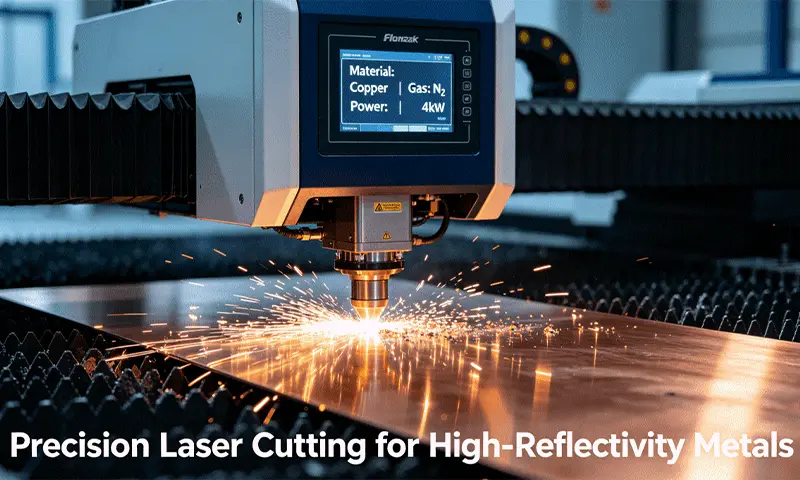
High reflectivity of copper and brass hinders laser cutting, causing defects and costs. Solution: advanced process control, automation, closed-loop quality for precision manufacturing.
Why is High Reflectivity a Major Challenge for Global Manufacturers in Metal Cutting?
Copper and brass with >90% infrared reflectivity cause laser energy waste, optic damage, and unstable cuts—spatter, dross, burrs. This lowers yield, raises costs, disrupts JIT delivery, and hurts supply chain competitiveness. Overcoming this demands a systematic solution optimizing beam characteristics, gas dynamics, and pulse modulation.
What Are the Core Control Strategies for Achieving ±0.05mm Tolerances in a Custom Metal Laser Cutting Service?
Achieving ±0.05mm tolerance on reflective metals requires an integrated precision strategy: dynamic accuracy via high-speed servos and rigid gantries, closed-loop real-time compensation for thermal/environmental errors, and specialized processes like progressive piercing and optimized pulse parameters.
Early DFM collaboration with a specialized supplier further ensures stable, oxidation-free, high-verticality cuts.For deeper insights into optimized parameters, one can refer to the expertise offered by professional copper alloy laser cutting services providers.
How to Optimize Costs Without Sacrificing Quality in Large-Scale Brass Cutting Projects?
When a brass laser cutting service project scales to high-volume production, cost control becomes a decision factor as critical as quality.
Optimizing Production Workflow & Efficiency
Achieving true cost efficiency in a brass laser cutting service requires a holistic view of the production workflow, targeting major cost drivers through intelligent optimization.
Smart Nesting for Material Savings
The first frontier is material cost. Advanced nesting software optimizes part layout on the sheet, pushing material utilization rates above 90% to dramatically reduce raw source costs.
- Automation for Enhanced Productivity
Integrating automated material handling and inspection enables 24/7 production. This multiplies output per operator and minimizes error-related scrap, significantly lowering unit processing cost.
- Process-Based Cost Elimination
The most impactful savings come from perfecting the cut itself. By precisely controlling parameters like gas pressure and focal point, dross and burrs are eliminated at the root. This first-time-right capability removes the need for costly secondary finishing, forming the core of a low-TCO (Total Cost of Ownership) strategy for global procurement.
What Key Criteria Beyond Location Should Be Evaluated When Choosing a Reliable Supplier for Reflective Metal Parts?
Searching metal cutting near me is insufficient for reflective parts. Prioritize suppliers with international certifications (ISO 9001, IATF 16949, AS9100D) ensuring traceability and batch consistency. Also assess collaborative and responsive capability for stable, long-term supply over mere location.
A proficient partner should offer rapid design feedback and a transparent quoting process. It is advisable to incorporate these standards into a supplier evaluation checklist and utilize a convenient laser cutting online quote system for an initial assessment of a potential partner’s professionalism and responsiveness.
What Are the Special Requirements for Cutting High-Reflectivity Metal Parts in Medical-Grade Applications?
Medical devices impose exceptionally stringent requirements on conductive or structural components made from materials like copper or stainless steel, elevating the standards for precision reflective metal cutting to an entirely new level.
Key Process Specifications
Medical-grade laser cutting demands distinct protocols to ensure part purity and biocompatibility. This involves critical differences in both the processing environment and the consumables used.
Oil-Free Processing Environment
This necessitates using oil-free air compressors and ensuring all mechanical lubrication systems are entirely isolated from the processing zone to eliminate hydrocarbon contamination from vapors or mist.
- High-Purity Gas Shielding
The use of ultra-high-purity shielding gas, such as 99.999% nitrogen, is essential. This prevents oxidation during cutting, ensuring chemically pure cut edges that are suitable for subsequent coatings or direct implantation.
- Controlled Environment & Quality Systems
Beyond the machine, comprehensive environmental and quality controls are paramount. For critical components, post-processing and handling should occur in a controlled cleanroom to prevent airborne particulate contamination.
Conclusion
Reflective metal cutting is now a strategic concern. An integrated solution—advanced optical control, intelligent optimization, quality certifications, and automation—enables stable, precise, cost-effective laser cutting, boosting global supply chains and competitiveness. Evaluate partners’ technical approach, certifications, and case studies.
Author Bio
This article provides insights from an expert with over a decade of experience in the precision manufacturing field. Their expertise encompasses high-difficulty material processing and this article are partially based on the engineering practices of LS Manufacturing, a leader in precision manufacturing services.
FAQs
Q: Does laser cutting copper alloys create a heat-affected zone? How is it controlled?
A: Yes, but ultra-short pulse technology and high-pressure nitrogen cooling limit HAZ to under 0.1mm, preserving internal structure and performance.
Q: For brass laser cutting, how avoid dross and burr?
A: Precise gas pressure and nozzle gap. Example: 1mm C260 brass at 16Bar, focus -0.2mm yields clean cut. Providers use empirical parameter databases.
Q: Why is laser cutting better than waterjet for precision copper?
A: Uniform kerf, higher efficiency for sheets under 5mm, dry process with no abrasive contamination—ideal for clean electronics and semiconductors.
Q: What info is needed for a custom laser cutting quote?
A: 2D/3D drawings (STEP, DXF), material grade, quantity, tolerance requirements, and surface finish. Supplier then provides analysis and quote.
Q: How important are international certifications like ISO or IATF?
A: Critical. They prove stable, repeatable quality management. IATF 16949 for automotive, AS9100D for aerospace reduce procurement risk.
