

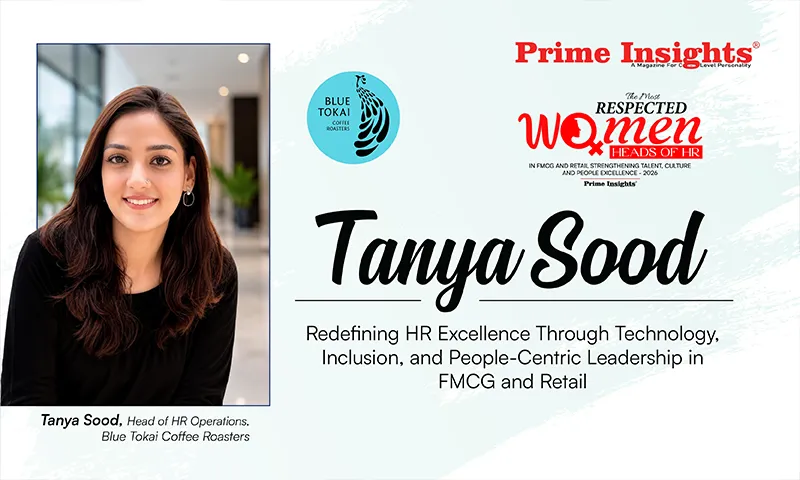
Tanya Sood | Blue Tokai Coffee Roasters
Did you know that around 70% of a customer’s experience in a retail or café setting depends entirely on the frontline staff member serving them? The FMCG and retail industries are hyper-competitive in 2026, one interaction can lose loyalty, the workforce is the brand. In a world of high turnover and digital disruption, it’s not about shelf space anymore, it’s about culture and workforce agility. Consequently HR has evolved from a back office function to a critical strategic driver of business growth.
Meet Tanya Sood, a dynamic business leader, who heads the HR operations for Blue Tokai Coffee Roasters, an enterprising brand in the speciality coffee space, set up in 2012, and is changing the way people manage people. For over a decade, Tanya has led impactful initiatives ranging from optimizing operational costs through flexible workforce strategies to launching all-women cafes and hiring from underrepresented communities. As a purpose-led leader, her philosophy is based on creating movement through empathetic communication, no micromanagement and building an organization with a culture of trust and ownership by employees.
Tanya is leading HR for café operations, quality assurance, training and maintenance in her current organisation. By using AI-powered tools to expedite recruitment, simplify the employee lifecycle, and use data-driven insights for proactive workforce planning, she easily matches HR strategies with market demands.
In the limelight, we have Tanya Sood in an exclusive interview for our prestigious “The Most Respected Women Heads of HR in FMCG and Retail Strengthening Talent, Culture and People Excellence 2026” edition- Join us as she shares her entrepreneurial journey, key learnings, and leadership insights. Watch the full feature to discover the story behind her success and the experiences that continue to inspire her.
Prime Insights: Can you introduce yourself and your role as head of HR, FMCG/retail.
I am Tanya Sood, currently heading HR operations for Blue Tokai Coffee Roasters. I’m responsible for the people function across the café operations in the organisation, partnering closely with business leaders to drive employee engagement, talent management, workforce planning and operational excellence.
My scope is broader than café teams and includes key support functions such as quality assurance, training and maintenance, all of which are essential to ensure smooth day-to-day café operations. I work at the intersection of people and business, focused on building high-performing teams, strengthening organizational culture and driving HR initiatives that contribute to employee success and business growth.
Prime Insights: What attracted you to human resources and how has your leadership style changed over the years?
My path into HR was a bit of a happy accident when I had a chat with my aunt who was then working in human resources. She talked about the field and it enlightened me how HR could impact not only organizations but also the individuals and their lives. I was really attracted to the opportunity to influence workplace culture, enhance employee experience and contribute in the overall organisational growth if ever given a chance to.
This interest led me to pursue a full-time master’s degree in human resources, including a 6 month internship with a pharmaceutical company. This experience gave me valuable exposure to the practical side of HR, as well as a deeper insight into the responsibilities and challenges that come with the role. During this period I found my true calling.
I began my professional career nearly ten years ago as a management trainee. In the past 10 years, I’ve been fortunate to learn, grow and take on more and more challenging roles, all the way up to leading HR operations for a fast-growing organization. When I look back at my journey, it’s a journey that mirrors my love for the people function, my desire to keep learning and my conviction that HR can create meaningful business and people impact.
For me, HR has never been simply a profession. It’s been a purpose-driven journey of making a difference, creating strong teams and helping people and organisations flourish.
Prime Insights: How do you interpret ‘people excellence’ in FMCG and retail organisations?
“People excellence” is more than just a corporate buzzword for me. It is a philosophy that reflects the real impact of the HR profession. It is really about building meaningful experiences that positively impact people’s careers, growth, and professional journey. This is such a rewarding role because you get to be the catalyst for programs that make a difference to people and organisations. HR is fundamental to the success of employees, from the selection and recruitment of the right talent to the training, development and creation of structured career paths. One of the most rewarding things about this profession is helping someone grow and helping them unlock their potential.
I’ve worked extensively in the retail and café operations space, and know just how dynamic and fast-paced these industries can be. In such environments, success depends crucially on the capability, motivation and engagement of frontline employees. Organisations need to continuously invest in their people with clear growth opportunities, strong training programs and the right tools and resources to succeed.
When employees see a real career path and feel supported in their development, they are more likely to stay engaged, perform better and contribute positively to the growth of the organisation. At its core, people excellence is about creating an environment for people and businesses to thrive together.
Prime Insights: How do you design HR strategies that fit the fast-paced business operations and market demands?
AI has transformed the way we work. Many people see it as a challenge or even a threat, but I see it as a great enabler that has made the HR function more efficient and effective.
Today, AI is helping us to streamline many parts of the employee lifecycle. For instance, intelligent systems can be employed in first-level resume screening, allowing recruiters to dedicate their resources to assessing the most relevant candidates. AI-powered interview tools and assessments have also helped speed up the shortlisting process, while providing a high degree of accuracy and consistency. This helps hiring teams make faster and better-informed decisions.
Technology has made HR professionals more proactive and strategic in their approach beyond recruitment. The ability to anticipate business needs and plan accordingly has become more and more important, whether it is workforce planning, hiring forecasts, training calendars, or succession planning. “AI and data-driven insights allow us to plan ahead, identify trends early and be more responsive to changing business needs.
Prime Insights: What are your tips for building and sustaining a strong, consistent organisational culture across a range of teams and locations?
Collaboration is based on mutual support, free communication and responsiveness. Regular employee engagement activities such as leadership interactions and roundtable discussions help build trust, open the door for feedback and ensure that there is alignment during organisational changes. When teams are spread across different sites, it’s important to sustain the bonds through formalized lines of communication, virtual interactions and standardized implementation of policies and practices. Employees who understand they make a difference, who are kept in the loop and who feel heard, experience a greater sense of belonging. This builds a culture of collaboration, trust and success for the organization.
Prime insights: What are the biggest workforce challenges for FMCG and retail? How do you effectively address these?
One of the most common challenges I’ve seen throughout my career is people’s inability to get outside their comfort zones. This could be new technologies, process changes, or different ways of working. Resistance often comes from uncertainty and lack of understanding of the bigger picture.
Over the years I’ve learned that the best way to manage change is to articulate the “why” of the change well. People are far more likely to accept change when they understand why it is happening, what it will achieve and how it will affect them. Implementing a new process or system alone is rarely sufficient, helping employees understand the benefit to them, the business or the customer builds alignment and ownership. I am convinced that when people understand the reason for a change, they are more willing to adapt, contribute and perform. So change management is about communication, engagement and building belief, not just implementation. A clear vision and transparent communication about the desired outcomes can significantly boost acceptance and ensure long-term success.
Prime Insights: Can you share a story about a time when your HR initiatives had a significant impact on driving organisational performance?
I am passionate about long term value and deep root cause problem solving, practical, scalable HR solutions. I addressed labor costs by introducing innovative, cost-saving strategies, including flexible hours, an expanded apprenticeship program, and flexible schedules for women returning to the workforce after a career break due to personal reasons. This greatly enhanced retention and participation.
Pioneering initiatives like all-women-run cafes and regular employment opportunities for the transgender community and specially abled people are born out of my commitment to diversity & inclusion. I show the link between inclusiveness and high business performance in a fast-paced, highly operational industry. These efforts have gone a long way in enhancing our employer brand, reflecting a progressive, inclusive and truly people-first culture, where every single employee feels truly empowered.
Prime Insights: How do you promote leadership development, succession planning and internal career progression?
Trust, empowerment and real ownership are big parts of my leadership philosophy. I am opposed to any micromanagement. Stiff oversight kills growth. I do not do that. I give clear direction, support and the operational freedom for people to make decisions, learn from experience and prove their worth.
Leadership to me is providing avenues for people to be successful. I motivate my teams by actively recognizing their hard work, fostering raw initiative and providing constructive feedback, and ensuring they have the training and tools they need. Empowerment comes with accountability, and if we want to develop future leaders, we need to trust them with real decision authority. This collaborative learning culture taps into real potential and fosters long-term professional growth.
Prime Insights: What are your HR transformation priorities and goals for 2026 and beyond?
Looking at the coming year and beyond, one of my main focus areas is to make HR more AI-enabled and data-driven. The pace of change in the world of work is accelerating faster than ever before and organisations that are not prepared to embrace this change will be left behind. I believe AI should be viewed as an enabler, not a replacement — one that empowers us to work smarter, make better decisions and deliver more meaningful employee experiences.
AI can improve efficiency, enhance accuracy and create time for HR professionals to focus on strategic and people-centric interventions, from talent acquisition and workforce planning to employee engagement and learning initiatives. With work continuing to evolve, HR needs to bring technology into its workflows in order to scale operations as the business grows.
Other than technology, another area that I am very passionate about is creating a more diverse and inclusive workplace. In the years to come, I hope to continue creating opportunities for underrepresented talent groups and to strengthen initiatives that promote equity, inclusion, and belonging. I think it’s important that organisations create workplaces where everyone feels welcome and valued by hiring more women for operational roles, creating opportunities for the transgender community or supporting people with special needs.
A truly progressive workplace is one where diversity is not just represented, but genuinely accepted and celebrated. My vision is to help build a culture within the organization that embraces innovation, leverages technology effectively and creates an inclusive culture where every individual has the opportunity to thrive and succeed.
Prime Insights: What advice would you give to women leaders who want to make a successful career in HR?
My advice to women who want to be leaders is that HR is an opportunity to impact culture and build inclusive, people-centric workplaces. Compliance is important but our real strength is in creating real change and making a difference in people’s lives.
The best solutions come when we address root causes without losing the human element. Data and goals are important, but empathy and authentic caring are what make great leaders. I urge you to remain curious, to challenge conventional wisdom and never underestimate your potential impact.
