

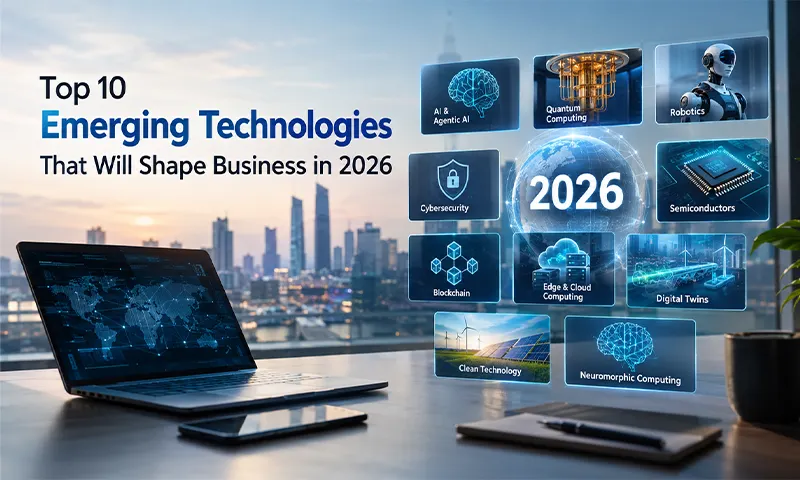
Top 10 Emerging Technologies
There have been many technological breakthroughs in recent times. The global corporate market has been strategised around Emerging Technologies in 2026. Immediate competitive advantage has led enterprise leaders to understand and acquire tech adoption and make use of core Business Technology Trends. To be determined in market survivability, it is very important to understand key Emerging Technologies. It not only ensures forward thinking but also helps to channelise capital efficiency, resilience, and high value across the global business landscape.
Agentic AI and Autonomous Decision Systems
From conversational chat interfaces, AI has matured over time, backed by autonomous agents. Sophisticated AI Technology coupled with deep workflow automation has become successful in managing real-time inventory adjustments, negotiating supply contracts, and resolving customer enquiries. Organisations can now transform these New Technologies in Business into executable and profitable results with high-level strategic governance.
Commercial Quantum Computing Milestones
Quantum advancements have shifted to pilot programs. The most outstanding Emerging Technologies in 2026 is quantum computing. Starting from financial risk optimisation, molecular modelling, and complex logistics routing, it can solve milestone hurdles in no time. Early quantum infrastructures are intractable computational bottlenecks that can calculate in seconds and unlock new formulations.
Humanoid Robotics in Modern Supply Chains
There has been a renaissance in next-generation robotics in the sectors of warehousing and manufacturing. Modern humanoid and autonomous robots work and function like human workers with much more clarity and precision. They handle repetitive problems, hazardous situations, and undergo heavy-lifting tasks. Future Technology Trends focus on hardware agility and physical intelligence.
Post-Quantum Cybersecurity Architectures
Enterprises upgrade their cybersecurity protocols with POC or Post-Quantum Cryptography. It is an urgent business mandate. Organisations actively track Emerging Technologies within cryptographic defence to secure customer data and intellectual property and protect them from prospective decryption with later threats. With a surge in computational power, traditional encryption is no longer sufficient.
Advanced Semiconductor Technology
Modern computational capability relies on chip architecture. Semiconductor Technology has revolutionized advanced 3D packaging, sub-2 nanometre fabrication, and GAA transistors. Companies can easily track Business Technology Trends to make reliable custom silicon and specialized hardware accelerators to power neural networks and ensure business scalability. They aim to sustain the global supply volatility as they directly govern digital transformation.
Decentralized Enterprise Ledgers and Smart Contracts
Blockchain in corporate applications has evolved into automated enterprise compliance and tracking. Decentralised ledgers have ranked prominently among the Emerging Technologies in 2026. They provide tamper-proof tracking across multinational supply networks and also trigger automatic vendor disbursements when sensor deliveries are made. They work beyond cryptocurrency and reduce the chance of intermediary reconciliations.
Hybrid Edge and Cloud Computing
Consumers have migrated to high-speed edge devices working consistently with synchronised data. Thus, cloud computing with low latency has been integrated with localized edge gateways that help to immediately evaluate telemetry from factory floors and offshore platforms. New Technologies in Business, when deployed, ensure that critical decisions are computed in a few seconds, reserving cloud bandwidth for historical modelling.
Industrial Digital Twins and Spatial Interfaces
There has been an expansion in digital twins from isolated machines into organisational mirrors. Emerging Technologies work on fluid dynamics, human-machine interactions, and thermodynamic stresses to cut engineering development cycles from months to days. Certain spatial interfaces do not commit to capital flow before helping engineers and operational managers run complex configurations.
Energy Storage via next-generation use of Clean Technology
Today’s regulatory necessity is based on sustainability-linked enterprise power. From grid-scale solid-state batteries to green hydrogen production and thermal storage, solutions have made Cleantech become the Emerging Technologies in 2026. Smart microgrids that work with renewable energy sources have reduced carbon taxes in businesses. The use of secure, independent grids is aiding a lot during power disruptions.
Neuromorphic and Synaptic Computing
Future Technology Trends like brain-inspired neuromorphic chips and non-invasive neural sensor interfaces have created a new horizon of frontier developments and revealed hardware equal to human minds. These open doors to always-on diagnostic wearables and edge intelligence devices that can function in remote environments as well. They work on consuming energy fractions of what is required by conventional silicon processors.
Thus, Emerging Technologies in 2026 make the market for competitive advantage clear and generate speed and precision in tech-integrated businesses. Some foundational Business Technology Trends define the future of technology. Understanding established systems with New Technologies in Business unlocks revenue horizons. These dynamic Emerging Technologies can enable one market leader to rapidly transform their business into a commercial giant. Emerging Technologies in 2026 can create a business legacy over generations.
