

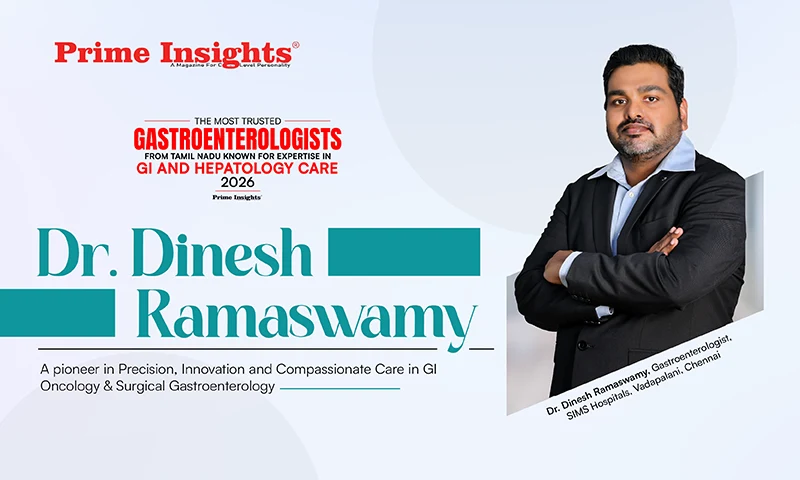
Dr. Dinesh Ramaswamy | SIMS Hospitals, Vadapalani, Chennai
Did you know that your gut is often called your “second brain”? It has over 100 million nerve cells (more than your spinal cord) and makes about 90% of the serotonin in your body. But when things go wrong in this complex system, it can be overwhelming to navigate the intensely competitive and rapidly changing healthcare landscape of today. In surgical gastroenterology and GI oncology, the margin for error is razor thin, and it requires clinicians who have both elite technical precision and a deep commitment to patient-centric care.
Dr. Dinesh Ramaswamy is working at the very forefront of this challenging field. Dr. Ramaswamy is a highly skilled surgeon with over 18 years of extensive surgical experience. He has an elite academic pedigree with a highly competitive MS from AIIMS, New Delhi and M.Ch in GI Surgery. He is available for consultation in SIMS Hospitals, Vadapalani, Chennai and in his specialized Gastro Care Clinic at Porur. A seasoned business and medical leader, his career is a testament to his unwavering commitment, having served as the Clinical Lead in Minimal Access Surgery at top-tier regional institutions prior to establishing his pioneering practice at SIMS.
Dr. Ramaswamy’s practice is based on four advanced pillars GI oncology, complex hepatobiliary surgery, advanced laparoscopic and robotic procedures and comprehensive proctological care. To enhance patient safety, he employs paradigm-changing technologies such as robotic platforms that allow for high-precision dissections, and intraoperative fluorescence imaging. He takes a patient first approach, utilizing structured multidisciplinary tumor boards and Enhanced Recovery After Surgery (ERAS) protocols to significantly shorten hospital stays, facilitate recovery, and improve long-term survival.
Get to know Dr. Dinesh Ramaswamy in our prestigious “The Most Trusted Gastroenterologists from Tamil Nadu Known for Expertise in GI and Hepatology Care 2026” edition interview. Learn from his insights and valuable lessons as an entrepreneur to be best company. Stay tuned and know his success story.
Prime Insights: Can you tell us about yourself and the journey that has led you to become one of the leading Surgical Gastroenterologists and GI Onco Surgeons in India?
I am Dr Dinesh Ramaswamy, Senior Consultant Surgical Gastroenterologist & GI Onco Surgeon at SIMS Hospitals, Chennai and Gastro Care Clinic, Porur. I did my MBBS from PSG IMS&R, MS General Surgery from AIIMS New Delhi and M.Ch in Surgical Gastroenterology from GB Pant Hospital. Good exposure to training in complex GI, HPB and cancer surgeries in AIIMS, JIPMER, Apollo Hospitals, Medanta etc. “I am committed to GI oncology, hepatobiliary surgery, advanced laparoscopic and robotic surgery and colorectal care and have more than 18 years of experience helping patients access world-class treatment closer to home.
Prime Insights: What made you choose Surgical Gastroenterology as your specialty and how has your career been so far?
During medical school I was attracted to the challenge of abdominal disease and the immediate impact surgery could have on patients’ lives. My training at AIIMS exposed me to difficult GI emergencies and cancers which helped me build a strong clinical judgment. Training at GB Pant Hospital, and further training at Apollo and Medanta helped me to specialize in hepatobiliary and GI oncology surgery. Returning to Chennai enabled me to apply these skills to treat patients with complex digestive disorders and cancers, many of whom present at advanced stages and require multidisciplinary care.
Prime Insights: What does excellence in gastroenterology and hepatobiliary surgical care look like in the contemporary healthcare landscape?
“Today, excellence has three pillars: clinical outcomes, patient experience and responsible innovation. Rates of complications, survival and quality of recovery determine the success of treatment. “It is also important that patients understand their diagnosis and feel supported through treatment. Innovation must be evidence based, whether it’s robotic surgery, minimally invasive techniques or multidisciplinary cancer care.” Real excellence is technical skill and compassion, transparency, and a commitment to continually improving patient outcomes.
Prime Insights: What are the most common gastrointestinal, colorectal, liver and pancreatic diseases you encounter?
My practice consists predominantly of gallstone disease, colorectal cancer, gastric and oesophageal cancers, pancreatic cancer and liver disorders. I also routinely treat acute and chronic pancreatitis, complex anorectal disease such as fistula and hemorrhoids, and emergency surgery like intestinal obstruction and perforation. Early diagnosis and multidisciplinary treatment are especially important for improving outcomes, as many cancer patients present late.
Prime Insights: How do you make sure you get the right diagnosis and tailor the treatment?
Good listening is the beginning of all diagnosis. Symptoms often provide important clues that guide the investigation. Depending on the condition we use endoscopy, colonoscopy, CT scans, MRI, MRCP, PET-CT and endoscopic ultrasound. In cancer patients, the treatment plans are discussed in multidisciplinary tumor boards involving surgeons, oncologists, radiologists, and pathologists. Personalization also involves age, general health, occupation and patient preferences to develop the most effective and practical treatment strategy.
Prime Insights: What are the most important recent developments in gastroenterology and GI surgery?
Minimally invasive and robotic surgery have resulted in a significant improvement in recovery with excellent cancer outcomes. Advanced endoscopy can now diagnose and treat early stage cancers without major surgery. Endoscopic ultrasound has revolutionized the diagnosis and staging of pancreatic and upper GI disease. Enhanced Recovery After Surgery (ERAS) protocols have reduced hospital stays and reduced complications. Further advances in interventional radiology have further expanded the treatment options for complex liver and pancreatic conditions.
Prime insights: How can minimally invasive and robotic technology enhance patient care?
Most of my elective procedures are done laparoscopically or robotically. These techniques lead to smaller incisions, less pain, less blood loss, faster recovery and shorter hospital stays. The robotic systems allow for greater visualization and precision, particularly in complicated cancer surgeries of the rectum, pancreas, and liver. I also use fluorescence-guided imaging to make surgery safer and reduce complications, which improves patient outcomes.
Prime Insights: Why preventive care, public awareness and early diagnosis are so important?
Early diagnosis is often the key to curability of a disease in GI cancers. Early detection of colorectal cancer results in a survival rate of more than 90%. The survival rate drops significantly in late stages of the disease. Public awareness helps people identify warning signs such as rectal bleeding, difficulty swallowing, unexplained weight loss and persistent abdominal symptoms. I want to encourage earlier consultations and improve survival rates through outreach, health camps and educational content.
Prime Insights: Do you have an interesting patient success story?
A man in his forties was told by several centers that his advanced rectal cancer was inoperable. Chemoradiation and reassessment was recommended following multidisciplinary evaluation. The tumour was very responsive to treatment, which enabled us to perform a successful minimally invasive sphincter-preserving surgery with clear margins. He is now cancer free and living a normal life with his family years later. This case emphasizes the importance of multidisciplinary care, advanced surgical techniques and the importance of not giving up on potentially curative treatment.
Prime Insights: How do you keep abreast with the latest research and technologies?
Lifelong learning is a need in surgical gastroenterology. I read regularly the leading international journals and I attend national and international conferences. Membership in professional surgical societies keeps me up to date with changes in guidelines and technology. My practice also stays on top of the latest evidence-based standards through hands-on workshops, robotic surgery training and academic contributions via presentations and publications.
Prime Insights: What are the biggest hurdles for patients to access treatment?
Late diagnosis is still the biggest hurdle. Symptoms such as rectal bleeding, jaundice or trouble swallowing are often dismissed or blamed on less serious conditions. Investigations and treatment may also be delayed by financial concerns. To address these barriers I focus on patient education, cost-effective diagnostic planning, and advocating for early specialty consultation. One of the most effective ways of improving outcomes is raising awareness.
Prime Insights: Why patient education matters for better treatment outcomes?
Teaching the patient is an important part of treatment. Patients who understand the disease process and treatment plan are active participants in their care. In consultations I use simple explanations and visual aids so you understand. I also include family members, as health care decisions are often made collectively. Educational initiatives are ongoing in Tamil and English to disseminate accurate information and encourage timely medical attention outside the clinic.
Prime Insights: What are your biggest accomplishments and milestones?
My academic journey through AIIMS and GB Pant Hospital and my advanced training at premier institutes like Apollo, JIPMER and Medanta make me proud. Major milestones have been being the Clinical Lead for Minimal Access Surgery in the major hospitals of Chennai and being awarded the fellowship of FIAGES. There are the thousands of patients treated successfully and the contributions made through teaching, research and professional forums – equally rewarding.
Prime Insights What would you say to young doctors aspiring to make a career in Surgical Gastroenterology and GI Oncology?
Select good training institutions with high surgical volumes and exposure to complex cases. Acquire early expertise in minimally invasive and robotic surgery. Know oncology. Not just surgery. Be a lifelong learner, keep up with the changing evidence, and stay humble on your journey. Most importantly, develop communication skills and empathy because not technical excellence makes a great surgeon.
Prime Insights: What is the most important message you want to get across to readers about digestive health and cancer awareness?
Don’t ignore warning signs like rectal bleeding, difficulty swallowing, persistent jaundice, unexplained weight loss or changes in bowel habits. Early detection can be the difference between cure and advanced disease. Eat a balanced diet, exercise regularly, drink alcohol in moderation and don’t smoke to live a healthy lifestyle. Regular screening, especially colonoscopy, can catch cancer before it develops in those at risk. Timely medical intervention saves lives, and modern GI surgery provides excellent outcomes when diseases are detected early.
