

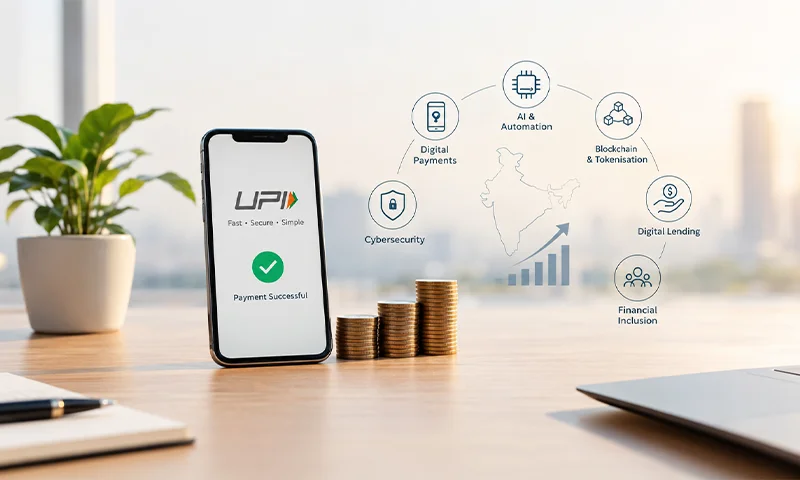
FinTech Trends Transforming India’s Financial Industry
line on UPI. It is moving directly to where people can actually pay. Integration of a pre-approved credit line on UPI has digitally transformed the lending background of banks by making them offer instant credit seamlessly. It has transformed micro and small enterprises into large capital. Embedded finance ensures that credit access and users’ daily transaction flow remain uninterrupted.
Cross-Border UPI and Global Interoperability
FinTech Innovation in India is scaling officially through cross-border UPI and interoperability, making it an international phenomenon. They now settle in seconds rather than days. Indian travelers and small businesses make use of UPI in countries that span from the UAE to France. Domestic transfers get easier with eCommerce. This has made it a trendy Financial Technology Trend.
Asset Tokenisation and Blockchain Integration
FinTech Trends in India 2026 is rapidly moving ahead of conventional retail payments into blockchain-powered asset management. Asset tokenization has become a global player at the Global FinTech Fest 2026. Real-world assets are getting converted to modern capital markets through tokenization and programmable digital units. This has enabled faster settlements with democratized access to premium investments.
Quantum-Safe Cryptography and Cybersecurity
One of the most critical FinTech Trends in India is quantum-safe cryptography. With the scaling of digital financial infrastructure, sophisticated cyber threats are also rising. Early adoption of this strategy by proactively exploring quantum technologies can safeguard systemic resilience against threats. Cybersecurity is upgrading its architecture to ensure that the huge mass of generated data remains impenetrable over the long term.
Maturation of Wealthtech Platforms
It is a broad Financial Technology Trend that has rapidly expanded the wealthtech sector from urban centres into tier 2 and tier 3 cities. Advanced algorithmic advisory and platforms of micro-investing are moving beyond basic stock trading. They offer a wider array of algorithmically managed portfolios like government bonds and mutual funds that are dynamically related to individual risk appetites.
Strict Digital Lending Guidelines and Compliance
Technological growth and advanacememt is AI have resulted in regulatory guidelines that heavily restrict the use of unnsecsaary detaila nd prevents access to unnecessary data. Accessing contact lists has been stopped, and consumer protection is enabled. This has made it a major FinTech Trend in India in 2026, ensuring that growth in the unsecured digital landscape is managed responsibly.
Digital Identity and Advanced Fraud Prevention
The new digital economy is recreated through trust. The deployment of robust digital identity solutions like Aadhaar e-KYC has removed onboarding friction at a large scale, and the establishment of the Digital Payment Intelligence Platform (DPIP) has made it easier identification of real time suspircious transactions. Thus, fraud prevention has entered a critical phase of innovation through FinTech Innovation in India, safeguarding billions of daily transactions.
Hyper-Personalised Underwriting and use of Insurtech
Insurtech in today’s world is a new concept that is shifting to a highly dynamic, usage-based insurance model by using real-time IoT data, granular health analytics, and wearable tech. This evolution within the Indian FinTech Industry is minimizing the historical protection gap, making life, health, and commercial insurance affordable and accessible. Modern insurers now offer highly personalised premiums.
Deepening Financial Inclusion Beyond Payments
FinTech Trends in India 2026 show a concentrated effort by regulators and startups to accelerate the JAM Trinity (Jan Dhan_Aadhaar-Mobile) by delivering financial tech services to the rural landscape. True financial inclusion remains an ongoing priority, and therefore in 2026, the focus has strategically shifted from account ownership to prodiving meaning credit and insurance products.
While exploring the future, understanding the interaction of macro forces is important. The current generation of FinTech Trends in India 2026 shows how a mature ecosystem can be held strictly accountable to establish the nation as a global master in digital finance. Adapting to these FinTech Trends in India can scale up real-time data efficiently and create global connectivity. The FinTech Trends in India 2026 continue to link a powerful synergy between agile startups and prudent regulators.
