

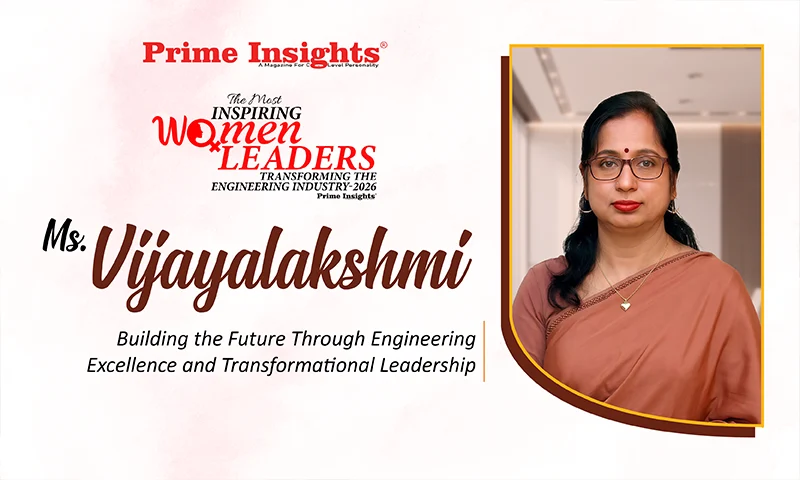
Ms. Vijayalakshmi
What do the world’s tallest skyscrapers, busiest airports, fastest metro networks, and smartest cities have in common? They all began as an idea in the mind of an engineer. In an industry where innovation, precision, and leadership converge, exceptional professionals continue to transform ambitious visions into realities that shape the future.
The engineering industry stands at the forefront of global progress, driving innovation, infrastructure, and sustainable development across every sector. As rapid urbanization, digital transformation, and smart technologies redefine the built environment, engineering leaders are expected to deliver solutions that are not only technically advanced but also efficient, resilient, and future-ready. In this highly competitive and ever-evolving landscape, success belongs to professionals who combine technical excellence with visionary leadership, adaptability, and an unwavering commitment to continuous learning.
Among these trailblazers is Ms. Vijayalakshmi, a distinguished engineering leader whose remarkable career spans more than three decades across engineering, infrastructure development, project management, real estate, and technical consulting. From beginning her journey at Larsen & Toubro’s Engineering Design and Research Centre to leading landmark projects in India and then in Middle East, she has consistently broken barriers in a traditionally male-dominated construction industry. Her expertise in MEP design, project execution, engineering innovation, and team leadership has earned her immense respect, making her an inspiration for aspiring engineers and business leaders alike.
Driven by technical precision, operational excellence, and a passion for mentoring future professionals, Ms. Vijayalakshmi has built high-performing engineering teams, established robust design processes, and successfully delivered complex, large-scale infrastructure and commercial developments. Her leadership philosophy revolves around continuous learning, collaboration, integrity, and empowering people to achieve engineering excellence while embracing innovation and sustainable practices.
In the spotlight of our prestigious “The Most Inspiring Women Leaders Transforming the Engineering Industry – 2026” edition is Ms. Vijayalakshmi Rao, who shares her extraordinary journey, invaluable leadership lessons, and vision for the future of engineering. Stay tuned as she reveals the experiences, insights, and principles that have shaped her inspiring tale of success and continue to empower the next generation of engineering leaders.
Prime Insights: For the benefit of our readers, could you introduce yourself and share your journey in the engineering industry?
My journey into engineering began with a strong foundation in academics and an innate curiosity for Mathematics and Physics. I come from a family where leadership was always valued. During my school days, I was inspired by engineering students in my neighborhood, and that exposure strengthened my interest in pursuing engineering. I consistently excelled in Mathematics and Physics, secured admission to engineering on merit, and graduated at a time when very few women chose this profession.
Unlike many of my peers who gravitated towards software, I found myself deeply interested in core electrical engineering, power distribution, and circuit design etc. My dream was always to work with Larsen & Toubro (L&T), and fortunately, I joined its Engineering Design and Research Centre. My mentor, Mr. Sridhar, recognized my enthusiasm and encouraged me to grow. However, I wanted more than a desk job. I was determined to gain field experience, just like my male colleagues, so I actively volunteered for site visits and execution assignments.
This willingness to step outside my comfort zone shaped my career. I worked on airport project, contributed to the early Delhi Metro corr, and travelled extensively across India, often under demanding conditions, to gain practical experience. Later, I moved independently to Dubai, where I worked during the early stages of the city’s infrastructure boom. Starting as a Technical Manager and later moving into real estate, I handled MEP design, execution, project management, contract management, for residential, large-scale commercial and hospitality developments.
After returning to India in the year of 2010, I joined as Vice President of largest developer in Mumbai, where I led multiple high-value residential and commercial projects and successfully handled complex commissioning and project delivery challenges. Later, I was entrusted with establishing and leading the MEP Design Department for India’s largest developer , where I built a high-performing team, introduced new engineering processes, developed design standards and policies , and worked alongside internationally renowned architects and various consultants. Today, my journey spans more than three decades across engineering design, execution, project management, real estate, and technical consulting, and I continue to contribute towards creating better engineering practices and stronger project delivery systems.
Prime Insights: What inspired you to pursue a career in engineering, and what motivated you to take on leadership roles?
My inspiration came from both my family and my academic interests. I grew up in a family that naturally encouraged leadership. Spending time with engineering students in my neighborhood further strengthened my desire to become an engineer.
When I entered engineering college in the 1991, there were very few women in the field. I was never intimidated by that. Instead, it motivated me to prove that women could perform equally well in core engineering disciplines. I was among the top students in subjects like electrical systems and power distribution, which gave me the confidence to pursue challenging roles.
Leadership came naturally because I was never satisfied with limiting myself to one responsibility. While many preferred to remain in design offices, I wanted to understand the complete lifecycle of a project. I volunteered for site assignments, execution work, coordination, and project management because I believed a true engineer should understand every aspect of the work flow.
Throughout my career, I have always been eager to learn something new, whether it was moving to another city, relocating to another country, or taking on responsibilities that others considered difficult. I never wanted to remain within predefined boundaries. I wanted to contribute, solve problems, and continuously grow, and that mindset eventually led me into leadership.
Prime Insights: As a woman leader in engineering, what challenges have you faced, and how did you overcome them?
One of the biggest challenges has been balancing design intent with practical execution at construction sites. Engineering is not only about creating designs; it is about ensuring those designs are implemented correctly. My strong technical knowledge and deep understanding of project processes have helped me bridge that gap successfully.
Of course, engineering and construction continue to be largely male-dominated industries. Initially, there is often hesitation in accepting a woman as a leader. However, I have always believed that competence speaks louder than perception. Once people realize that you understand the technical details, support your team, and help solve their challenges, they naturally begin to trust and respect your leadership.
I have never believed in authority alone. I work alongside my team, understand their difficulties, fill the gaps wherever required, and provide solutions instead of criticism. That approach has helped me earn acceptance over the years.
Even after more than thirty years in the profession, I continue to study calculations, review detailed engineering drawings, and personally verify technical data. I believe precision is non-negotiable. Whenever a project faces challenges, I move from the macro perspective to the micro level, identify the root cause, document the lessons learned, and ensure those learnings improve future projects. Every completed project should reduce the challenges faced in the next one.
Prime Insights: How do you define leadership in an industry driven by innovation, precision, and technological advancement?
Leadership in engineering requires continuous learning. A leader cannot rely only on past experience. We must constantly understand emerging technologies, evolving engineering standards, innovative construction methodologies, and global best practices.
Throughout my career, my long tenure in the Middle East gave me valuable exposure to advanced construction techniques long before they became common in India. Observing international standards helped me understand how engineering practices evolve across different countries, and that knowledge has been invaluable in implementing better systems here.
Engineering is progressing rapidly. Construction methods that once took months can now be completed in a fraction of the time because of technological innovation and improved project planning. A leader must keep an eye on global developments, understand how advanced markets operate, and continuously upgrade knowledge. Only then can we bring meaningful improvements to our own projects and contribute towards the development of our industry.
Prime Insights: What are the key trends currently shaping the future of the engineering sector?
While my expertise lies primarily in infrastructure, construction, and real estate engineering, I have witnessed remarkable transformation over the past two decades.
One of the most significant developments is the availability of world-class engineering products and materials within India. Earlier, many premium products had to be sourced internationally. Today, global manufacturers have established a strong presence in India, making advanced engineering materials and technologies much more accessible.
Another important trend is the steady improvement in the quality of locally manufactured engineering components. Whether it is systems related products, building materials, or specialized engineering products, Indian manufacturing has evolved tremendously. This transformation is enabling developers to deliver projects with higher quality, improved efficiency, and greater reliability while reducing dependence on imports.
Prime Insights: How do you foster a culture of innovation, collaboration, and continuous improvement within your organization?
I strongly believe that leadership begins with being both a team player and a team builder. No individual can successfully deliver large engineering projects alone. Success depends on assembling the right people, placing them in the right roles, and enabling them to perform at their best.
I follow a highly structured and process-oriented approach. Planning, task management, checklists, systematic reviews, and continuous monitoring help me manage multiple projects simultaneously without compromising quality and deadlines.
More importantly, I encourage my team to communicate openly. I never want problems to remain hidden until they become larger issues. If someone makes a mistake, I tell them not to fear it. Mistakes are a part of engineering; what matters is identifying them early, learning from them, and correcting them before they affect the project.
I also believe in creating ownership instead of simply assigning tasks. When people understand the importance of their contribution and feel trusted, they naturally become more committed to delivering excellence. As a leader, my responsibility is not only to guide but also to support my team whenever they face challenges. If someone is struggling, I step in to help them recover quickly rather than allowing the issue to escalate or go unnoticed.
Being a quick learner and an effective problem solver has also helped me to build confidence within my teams. People know that when they approach me with a challenge, I will analyse the root cause and work towards a practical solution instead of postponing decisions.
Prime Insights: What role does technology and digital transformation play in driving your organization’s success?
Digital transformation has become essential for every engineering organization. As technology continues to evolve, we must evolve with it. Organizations need to adopt digital processes, integrate technology into everyday operations, and continuously improve the way projects are being managed.
However, technology alone is not enough. It must be supported by a strong process-driven culture. Teams should be encouraged to keep learning, adapt to new digital tools, and continuously upgrade their skills. When organizations combine technology with disciplined processes and continuous learning, they become more efficient, competitive, and better prepared for future challenges.
Prime Insights: Could you share a significant project, innovation, or achievement that reflects your impact on the engineering industry?
Rather than highlighting a single project, I believe my contribution lies in consistently delivering value across diverse projects throughout my career.
Worked in the Middle East during its rapid infrastructure growth exposed me to international consultants, architects, contractors, and engineering practices. Those experiences significantly broadened my technical understanding and strengthened my ability to manage large multidisciplinary projects.
One habit that has helped me throughout my career is maintaining complete command over project data. I document everything carefully, maintain structured records, and remember project details with remarkable accuracy. Whether it is design coordination, budgeting, estimation, procurement, or execution, I always strive to understand every aspect of a project instead of limiting myself to one function.
During my tenure at L&T in early days of carrier, I also contributed to standardizing engineering processes by developing structured databases and templates that simplified tender preparation and engineering calculations. Those systems improved consistency, reduced manual effort, and enhanced efficiency.
My philosophy has always been simple: never stop learning. Throughout my career, I continuously upgraded my technical knowledge by studying engineering standards, attending specialized courses, and learning from experienced professionals around the world. That commitment to continuous learning has enabled me to contribute meaningfully to every organization I have worked with and has earned me the trust and respect of colleagues, consultants, clients, and project teams alike.
Prime Insights: How do you balance strategic leadership responsibilities with personal growth and well-being?
I have always been a very career-oriented person, and I truly enjoy what I do. Naturally, I spend a significant part of my day at work, often much more time than I spend on personal activities. However, I have learned that maintaining balance is less about dividing time equally and more about managing it effectively.
I follow a disciplined routine. Before leaving for the office, I ensure that my responsibilities at home are completed so that once I reach work, my focus remains entirely on my professional responsibilities. During office hours, I avoid attending to personal tasks because I believe that when you commit your time to an organization, you should give it your complete attention.
At the same time, when I return home, I dedicate myself to my family and household responsibilities. I still enjoy managing my home personally and believe that discipline, planning, and organising skills are equally important in both professional and personal life.
I have also been fortunate to receive tremendous support from my mother throughout my journey. She understood my passion for engineering and never questioned my commitment, even when my work required late nights, extensive travel, or demanding schedules. Their encouragement has played an important role in helping me build my career.
Prime Insights: What leadership qualities do you believe are essential for success in the modern engineering landscape?
The first quality is continuous learning. Engineering is constantly evolving field with technology, and if a leader stops learning, they stop growing. One must always stay updated with new technologies, engineering standards, and industry practices.
Secondly, a leader must possess strong technical knowledge. In engineering, people naturally look towards their leaders when challenges arise. If you cannot analyse problems or provide technically sound solutions, it becomes difficult to inspire confidence within your team. I always believe in understanding the root cause before arriving at any decision.
Another important quality is being a team player. Leadership is never about working alone. It is about creating capable teams, guiding people, encouraging them to perform better, and supporting them whenever they face difficulties. I never believe in hiding problems. It is always better to identify issues early, discuss them openly, and resolve them before they become bigger challenges.
Quick decision-making is equally important. Throughout my career, I have trained myself to understand problems quickly, analyse them systematically, and arrive at practical solutions. People respect leaders who are dependable and who can confidently guide them through difficult situations.
Finally, integrity, discipline, and accountability are qualities that every engineering leader must possess. Engineering projects involves thousands of people from organization level to end users, so every decision must be taken responsibly and with complete commitment.
Prime Insights: How do you mentor and encourage more women to pursue careers and leadership positions in engineering?
I always tell young women that engineering is a wonderful profession if they genuinely enjoy solving problems and learning continuously. They should never think that engineering is meant only for men. Today, opportunities are far greater than when I started my career, and women have every capability to excel in this industry.
I encourage young professionals to gain practical exposure instead of limiting themselves to one particular role. Engineering is not only about sitting in an office and preparing drawings. It is equally important to visit project sites, understand execution, interact with contractors, consultants, and clients, and learn how projects are actually delivered.
I also believe that women should continuously strengthen their technical knowledge. When your knowledge is strong, people naturally respect your opinion regardless of gender. Initially, there may be resistance, especially in a male-dominated environment, but once people recognize your competence and commitment, they begin to trust your leadership.
Most importantly, I encourage young engineers to remain confident, keep learning, ask questions, and never hesitate to take up challenging assignments. Every new responsibility becomes another opportunity to grow.
Prime Insights: What milestones or recognitions best represent your professional journey and contributions to the industry?
Rather than focusing on awards alone, I consider the opportunities I have been entrusted with throughout my career as my greatest achievements.
Being selected to work at L&T’s Engineering Design and Research Centre was an important milestone because it provided me with a strong technical foundation. Later, moving independently to Dubai and building my career during one of the region’s most transformative phases gave me invaluable international exposure and accelerated my professional growth.
Another significant milestone was returning to India and handled multiple complex high rise residential and commercial developments and successfully delivered projects under demanding timelines. Establishing and leading the MEP Department for design and project management, was another defining phase of my carrier viz. Building a department from the ground up, recruiting talented professionals, introducing engineering processes, and contributing to large-scale developments gave me immense professional satisfaction.
More than titles or positions, I value the trust placed in me by organizations, clients, consultants, and project teams. Being recognised as someone who can solve complex engineering challenges, build capable teams, and deliver projects successfully has been the most meaningful recognition throughout my journey.
Prime Insights: How does your organization contribute to sustainability, social responsibility, or community development through engineering solutions?
Today, engineering is no longer only about constructing buildings or delivering infrastructure. Every project must also consider long-term sustainability, operational efficiency, and responsible resource utilisation.
I believe engineers have a responsibility to design systems that are efficient, reliable, and future-ready.
Better planning, improved engineering standards, quality materials, and proper execution not only improve project performance but also reduce waste, avoid rework, and optimise resources throughout the project lifecycle.
Another important aspect is sharing knowledge and improving industry practices. Throughout my career, I have been focused on introducing better engineering processes, standardising systems, strengthening coordination between design and execution teams, and helping contractors and consultants improve their capabilities. These improvements ultimately contribute to delivering better projects that benefit clients, end users, and society as a whole.
Prime Insights: What advice would you give to young engineers, especially women, aspiring to make a mark in the industry?
First, build a strong technical foundation. Engineering is a profession where knowledge gives you confidence. Never stop studying, never stop learning, and always remain curious.
Secondly, do not limit yourself to one area of work. Try to understand every stage of a project—from design and planning to execution, costing, budgeting, procurement, commissioning, and project management. The broader your understanding, the stronger your career will become.
Do not be afraid of challenges. Every difficult assignment teaches you something valuable. Even mistakes should be viewed as opportunities to learn because every project leaves behind lessons that help you perform better in the next one.
For women in particular, my advice is simple: never underestimate yourself. Engineering may still be a male-dominated industry in many areas, but technical competence, dedication, and hard work eventually earn respect. Stay confident, remain committed to excellence, and never hesitate to take on responsibilities that push you beyond your comfort zone.
Prime Insights: Finally, what message would you like to share with our readers about leadership, innovation, and shaping the future of engineering?
Engineering has the power to transform societies, improve lives, and shape the future of nations. As engineers, we carry a tremendous responsibility because the decisions we make today become the infrastructure that serves future generations.
Leadership is not about position or authority—it is about knowledge, responsibility, and the willingness to continuously learn and support others. A good leader builds capable teams, encourages innovation, embraces new technologies, and ensures that every challenge becomes an opportunity for improvement.
I firmly believe that learning should never stop. As engineering industry is evolving rapidly, and those who remain curious, adaptable, and committed to excellence will continue to grow. If we combine strong technical knowledge with integrity, teamwork, and a passion for innovation, we can build not only better projects but also a stronger and more sustainable future for the engineering profession.
