

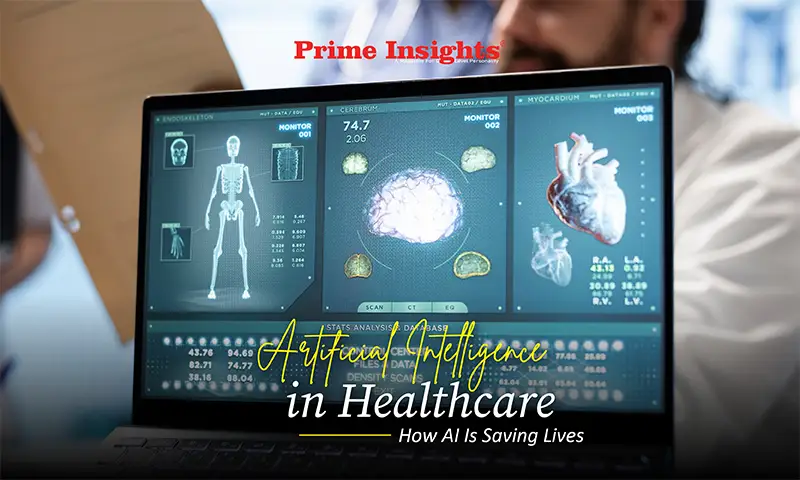
Artificial Intelligence in Healthcare
AI in healthcare is no longer something that we see—only in fictional movies; it has become a real thing that we now see in hospitals. It is transforming our healthcare system, the way we treat diseases, and how we monitor patients. These healthcare technologies are detecting serious diseases early—like identifying a heart attack before it happens. In this article, let’s look at the rise of AI in healthcare, how it’s saving lives, and some of the challenges we may face because of these technologies. So, let’s dive into the article.
The Rise of AI in Modern Medicine and Healthcare
The real and rapid growth of AI in healthcare has been seen in recent years, when modern technology became more advanced, trustworthy, and safe to be applied in the medical sector. These healthcare innovations allow doctors to make more accurate decisions and treat diseases on time through early detection.
In terms of patient benefits, it allows personalized medicines so that—since every individual is different—there are different medicines for the same disease according to their body and needs. The best example of medical AI tools can be seen in robotic surgeries, as they have become a part of our healthcare and can also be found in many states across India. This surgery gives more effective results, as machines are more precise and faster.
Key Areas Where AI Is Saving Lives
To understand it clearly, let’s break it into sub-sections and study how medical AI tools are saving life and time by effectively using this healthcare technology.
1. Early Disease Detection
In the past, it would take days, weeks, and even months to conduct a health test or get the results of their tests, and this might be a big drawback of curing the disease without time. However, thanks to these new AI hospitals and devices, numerous tests such as MRIs and X-rays are performed through these AI scans, which can provide quicker and more precise results at a lower cost of time.
2. Predictive Analytics
When we talk about treating diseases and saving lives, predicting the disease earlier can be a great advantage for fighting it. For instance, now hospitals use modern healthcare technology to predict health risks and treat diseases, like monitoring strokes using these AI tools and treating them on time. The same goes for infections in advance.
3. Robotic Surgery
As we have already talked about robotic surgery, it has become a new face of AI in healthcare. These robot-assisted operations are more accurate and reduce the chances of errors and infections, as well as allow faster recovery of the patient.
4. Virtual Health Assistants
These virtual health assistants are now becoming a new way of connecting people with modern healthcare technology by allowing 24/7 access to these chatbots, where users can talk about their health , symptoms and even get proper guidance about whether to go to the doctor or not, and sometimes even receive medicine guidance.
Challenges and the Future of AI in Healthcare
Even though AI in healthcare is improving our medical sector and developing the way we treat diseases, these advancements have also brought challenges that need to be solved. So, in this section, let’s understand what challenges we are facing with healthcare technology and how to solve them.
1. Data Privacy Issue
The main issue or challenge with this healthcare technology is that the patients’ health records are stored online, which leads to fear among people that their information can be leaked because of any hacking, and there can be misuse of their health information. To solve this, hospitals must have a strong security system so that all the information is safe from any viruses or hacking.
2. Ethical Concerns
AI might not understand emotional or personal situations like a doctor can. Even though AI gives faster and more accurate results, there is still a chance of unfair results if data is biased. This is the reason for concern among people, as machines can’t replace human emotions or understanding.
3. Need for Human Oversight
Even though these AI healthcare innovations are saving time and energy for doctors and giving more accurate results, the final decision should always be taken by doctors in every healthcare system. AI is only there to support the doctor, not replace them. Similarly, when we talk about robotic surgery, doctors are fully controlling the machines, so it only supports the doctor’s work and does not replace them.
AI in healthcare has proved to us why changes are required to grow, and with these modern innovations and AI medical tools, the future of our healthcare looks in bright hands. With every challenge we are facing right now, we are learning something new and developing it into a better version for our future.
