

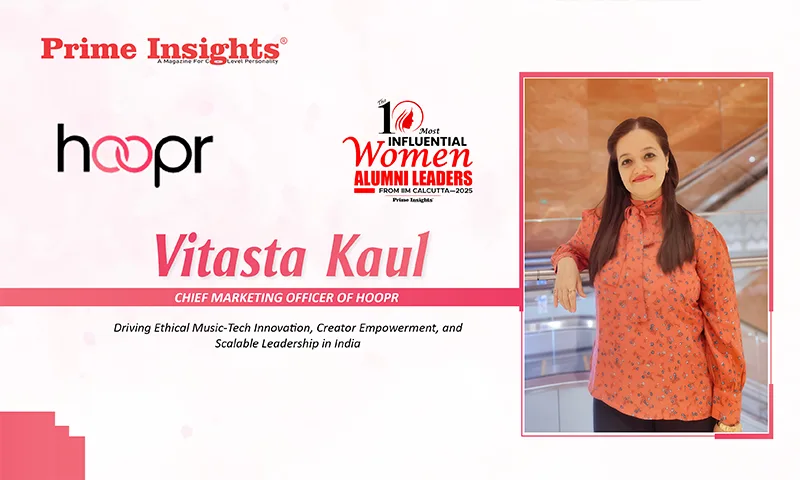
Vitasta Kaul | Hoopr
Did you know that a mere 10-second clip of the “wrong” song can instantly silence a creator’s masterpiece? In the booming creator economy, a “copyright strike” is the digital equivalent of a ghost story—feared by many, understood by few, and often the only thing standing between a viral hit and a total takedown.
The creator economy is currently witnessing an unprecedented boom, transforming the music-tech industry into a high-stakes arena of innovation and intellectual property. In this rapidly evolving digital landscape, the competition is no longer just about content volume; it is about navigating the confusing web of music licensing, transparency, and compliance. As brands and creators strive to capture attention, the need for ethical, technology-driven solutions has become the cornerstone of sustainable growth in a crowded market.
At the forefront of this evolution is Vitasta Kaul, the Chief Marketing Officer of Hoopr, India’s leading music-tech and licensing platform. An alumna of IIM Calcutta and INSEAD, Vitasta brings nearly two decades of experience across diverse sectors, including edtech, automotive, and F&B. Her journey is a testament to the power of “thinking global and acting local.” A seasoned leader who once scaled a digital footprint by 30x and co-founded a successful bootstrapped venture, Vitasta’s message to the business world is clear: leadership requires a balance of bold vision and practical frugality. She believes in “sense-making before decision-making,” ensuring that substance always triumphs over optics.
Hoopr functions as a vital bridge between culture and commerce, providing a transparent, creator-first ecosystem for music licensing. By leveraging data and technology, the platform allows brands, agencies, and content creators to access high-quality, copyrighted music without legal hurdles. It simplifies the “messy” context of intellectual property, offering a scalable solution that empowers both the artists who create the music and the businesses that utilize it.
In the spotlight is Vitasta Kaul, Chief Marketing Officer, Hoopr, in an interview for our prestigious “The 10 Most Influential Women Alumni Leaders from IIM Calcutta—2025” edition. Learn from her insights and valuable lessons as a professional and entrepreneur. Stay tuned and learn her tale of success.
Prime Insights: For the benefit of our readers, could you briefly introduce yourself and your current professional role?
I’m a marketing leader with nearly two decades of experience working at the intersection of brands, media, and technology. I currently serve as the Chief Marketing Officer at Hoopr, India’s leading music-tech and licensing platform, where I lead brand strategy, growth marketing, partnerships, and thought leadership across the creator and brand ecosystem. My role focuses on building Hoopr as a transparent, compliant, and creator-first platform in a rapidly evolving digital economy.
I’m an alumna of IIM Calcutta and INSEAD, which has shaped my strategic and global outlook. Over the years, I’ve worked across startups and established organizations, helping scale brands, build markets, and drive sustainable growth. At Hoopr, I’m particularly passionate about bridging culture and commerce—using data, creativity, and technology to create solutions that work for creators, brands, and rights-holders alike.
Prime Insights: How did your time at IIM Calcutta shape your leadership mindset and professional journey?
I’ve spent my career working across Indian startups, and I deeply understand the mindset that comes with it—you have to think global but act local. My time at IIM Calcutta and INSEAD gave me strong global exposure and helped shape a critical worldview when you’re building for scale in dynamic, high-growth markets.
I’ve worked across sectors like edtech, automotive, design, and consumer tech—all in startup environments—and that experience has taught me how scale and frugality must coexist. You learn to move fast, prioritize sharply, and build with constraints, without losing sight of long-term ambition. These experiences have shaped how I approach growth today: balancing bold vision with practical execution and building systems that are resilient, efficient, and designed to last.
Prime Insights: What inspired you to pursue your chosen career path after graduating from IIM Calcutta?
What really shaped my career choices after IIM Calcutta was a desire to work as close to the action as possible—building, experimenting, and seeing ideas turn into real impact. While I had the option to follow more traditional, linear paths, I was drawn to the energy of startups and high-growth environments, where you’re forced to think on your feet and take ownership early.
Roles at the intersection of strategy, creativity, and execution particularly piqued my interest. Working across Indian startups allowed me to apply the frameworks I learned at IIMC in very real, often messy contexts—where scale, frugality, and speed have to coexist. Over time, I realized I was most motivated by helping young businesses find their voice, build markets, and grow responsibly. That instinct—to build rather than just advise—has consistently guided my career choices.
Prime Insights: Can you share key milestones or defining moments that contributed to your growth as a leader?
A few phases of my career stand out not just for their outcomes, but for the depth of learning and value creation they enabled. Between 2007 and 2013, I led content operations at an edtech company when digital learning was still emerging in India. Managing a 200+ creator ecosystem, I restructured the production model by investing in systems over specialization—building scalable design libraries and opening execution to freelancers and partner agencies. This approach drove a fivefold increase in output while reducing costs by nearly 80%.
From 2013 to 2015, I co-founded Wannabe Foodies, a bootstrapped food venture that grew from a small kitchen into a recognized name across major cultural and corporate events nationwide. Achieving strong first-year revenues and a successful exit within 18 months was a formative entrepreneurial experience that reshaped my confidence as an operator.
From 2015 to 2023, I led pan-India branding and marketing for a fast-growing used two-wheeler platform, building disciplined, data-led growth frameworks that delivered a 30x expansion in digital footprint and an 82x return on marketing investment.
In 2024, I joined Hoopr to help scale India’s music-tech ecosystem—bringing structure, ethics, and intelligence to how brands and creators license and use music. This chapter feels like a natural culmination of everything I’ve built toward.
Prime Insights: As a woman leader, what challenges have you faced, and how have these experiences strengthened your leadership approach?
As a woman leader, the biggest challenge I’ve faced is not a lack of capability but the constant need to prove credibility repeatedly—especially in high-growth, male-dominated environments. People often unspokenly expect you to be more prepared, measured, and consistent in order to gain their respect. Early on, I also encountered moments where assertiveness was misread as aggression, or ambition was questioned rather than encouraged.
These experiences forced me to become obvious in my thinking and decisive in my execution. I acquired the skill of precise communication, substantiating my opinions with data, and strategically selecting my battles. They also strengthened my ability to stay calm under pressure and lead without needing validation.
Most importantly, they shaped a leadership style that values substance over optics. I lead with conviction, empathy, and accountability—and I intentionally create environments where competence surpasses stereotypes.
Prime Insights: How do you balance professional responsibilities with personal life while leading at a high level?
I don’t believe in the idea of a perfect balance—especially when you’re leading at a high level. What I do believe in is intentional alignment. There are phases where work demands more of me and phases where life does, and I’ve learned to move fluidly between the two without guilt.
I’m deliberate about where I spend my energy. I focus on impact over activity and clarity over chaos, and I build teams I trust so I don’t need to be everywhere at once. That trust is not just operational—it’s emotional. It allows me to step back when I need to and step in when it truly matters.
On a personal level, I’ve learned that rest, health, and boundaries are not indulgences; they are leadership tools. Showing up fully at work requires showing up for myself first. Leading with empathy—for others and for myself—is what makes sustained, high-level leadership possible.
Prime Insights: What industries or sectors have you primarily worked in, and what impact have you created through your roles?
Throughout my career, I have built across diverse categories such as edtech, design, food & beverage, automotive, and now music-tech, all of which shared a common trait: they were all early-stage startups. I’m drawn to the chaos and possibility of zero-to-one journeys, where structure doesn’t yet exist and impact is created from first principles.
Across roles, my focus has been on building systems that scale—whether that meant reimagining content production in edtech, bootstrapping an F&B venture from scratch, driving frugal yet exponential growth in automotive, or now shaping ethical, technology-led growth in music-tech. I enjoy operating at the intersection of creativity, data, and business, where decisions are both intuitive and measurable.
Creating businesses that outlast individuals, respect the ecosystems they operate in, and elevate industry standards is what truly excites me. Scaling something meaningful from nothing is what gives me energy, and it’s the thread that connects every chapter of my career.
Prime Insights: How do you approach decision-making and strategic thinking in complex and dynamic environments?
In complex and fast-changing environments, I focus on sense-making before decision-making. I spend time understanding what’s actually shifting beneath the surface—user behavior, incentives, power dynamics, and second-order effects—rather than reacting to noise.
I’m comfortable taking calls when the picture is incomplete. Experience has taught me that waiting for certainty often slows progress more than it prevents mistakes. I prefer to move forward with a strong hypothesis, test quickly, and refine in motion.
I also believe strategy today isn’t about rigid plans; it’s about staying directionally right while remaining flexible in execution. I listen carefully, encourage differing views, and then commit fully once a path is chosen. For me, strong leadership in dynamic environments is less about control and more about decisiveness, adaptability, and the confidence to evolve as conditions change.
Prime Insights: Who have been your greatest mentors or influences—during or after IIM Calcutta—and what leadership lessons did they impart?
I’ve been fortunate to learn from a mix of formal and informal mentors rather than one single figure. At IIM Calcutta, the rigor of thinking, intellectual honesty, and respect for data shaped how I approach decisions even today. Post IIM, my primary influences have been founders and operators I’ve worked closely with—people who built under constraints, made significant trade-offs, and took full ownership of outcomes. Equally, I’ve learned from teams on the ground—because humility, listening, and trust are often the most underrated leadership skills.
Prime Insights: How do you mentor, support, or inspire young professionals, especially women aspiring to leadership roles?
I mentor and support young professionals, especially women, by being deeply intentional about access, confidence, and visibility. I believe empowerment starts with opportunity—being invited into rooms where decisions are made, being trusted with responsibility early, and being encouraged to speak without self-editing. Whenever possible, I create opportunities, provide context, and make leadership feel approachable rather than intangible.
I’m honest about the realities of leadership—the trade-offs, the self-doubt, the resilience it demands—because I don’t believe in glossing over the journey. At the same time, I’m vocal about ambition being valid. Women shouldn’t have to soften their goals or shrink themselves to fit expectations.
Above all, I strive to set a positive example for others. When young professionals see women leading with conviction, building at scale, and staying true to their values, it changes what they believe is possible. Equality, to me, isn’t symbolic—it’s structural, and it’s something leaders must actively build every day.
Prime Insights: What values or leadership principles guide you in driving organizational or societal impact?
The values that guide my leadership are rooted in responsibility, clarity, and long-term thinking. I strongly believe that impact—whether organizational or societal—comes from building systems that are fair, transparent, and designed to scale without cutting corners. Growth should never come at the cost of trust.
The principle of ownership also guides me. I believe leaders must stay close to the work, make informed decisions, and take accountability for both outcomes and culture. Equally important to me is empathy—understanding the realities of teams, creators, partners, and users, and designing solutions that work for them, not just for the business.
Finally, I value resilience and consistency over short-term wins. Real impact is rarely instant; it’s built through steady execution, ethical choices, and the patience to stay the course. These principles shape how I lead teams, build partnerships, and contribute to the broader ecosystem I operate in.
Prime Insights: How do you believe women alumni from premier institutions can contribute to shaping India’s future leadership landscape?
Women alumni from premier institutions are uniquely positioned to shape India’s future leadership landscape because they combine access, training, and influence with lived experience. Beyond strong academic grounding, they bring perspectives shaped by navigating complexity, bias, and rapid change—which often translates into more inclusive and resilient leadership.
I believe their contribution lies not just in occupying leadership roles, but in redefining how leadership looks and functions. Women alumni can build organizations that prioritize long-term value over short-term optics, foster diverse teams, and create cultures rooted in trust and accountability. Equally important is their role as mentors and sponsors—opening doors, sharing hard-earned lessons, and normalizing ambition for the next generation of women leaders.
As more women from premier institutions choose to build, lead, and stay the course, they will collectively raise the bar for leadership in India—making it more balanced, empathetic, and future-ready.
Prime Insights: What accomplishments or recognitions are you most proud of in your career so far?
There are, of course, several obvious’ professional milestones I could point to—being recognized among the top marketing leaders in Asia, receiving multiple industry accolades, speaking on panels, and knowing that my work has inspired many young professionals to pursue careers in marketing and leadership. Those moments matter, and I’m grateful for the recognition.
But the accomplishments that mean the most to me are far more personal. They are the ones who quietly changed how I see myself and how I lead.
One such chapter was my time in the automotive sector, a space that is still largely male-dominated. I spent extensive time in dealer markets, understanding user behavior and working closely with dealer networks that often came from deeply patriarchal mindsets. Receiving respect wasn’t a given. What I’m most proud of is that I held my ground, earned respect through insight and consistency, and delivered results without compromising who I was. That experience gave me a lasting sense of empowerment—and it continues to inform how I lead today.
Prime Insights: What advice would you give to current IIM Calcutta students and young women professionals aiming for leadership positions?
My advice to IIM Calcutta students and young women professionals is to optimize less for perfect career paths and more for meaningful learning. Early in your career, choose roles that put you close to real problems, real decisions, and real outcomes—that’s where leadership instincts are built.
Don’t wait to feel “ready” before taking on responsibility. Action often precedes confidence, rather than the opposite. At the same time, invest in building strong fundamentals—clear thinking, communication, and the ability to execute consistently matter far more than titles.
For women in particular, I’d say: be deliberate about staying in the game. Careers aren’t linear, and leadership is a long journey. Seek mentors, but also back yourself, set boundaries that protect your energy, and don’t shrink your ambition to fit expectations. Leadership today needs clarity, resilience, and conviction—qualities you build over time by showing up and staying the course.
