

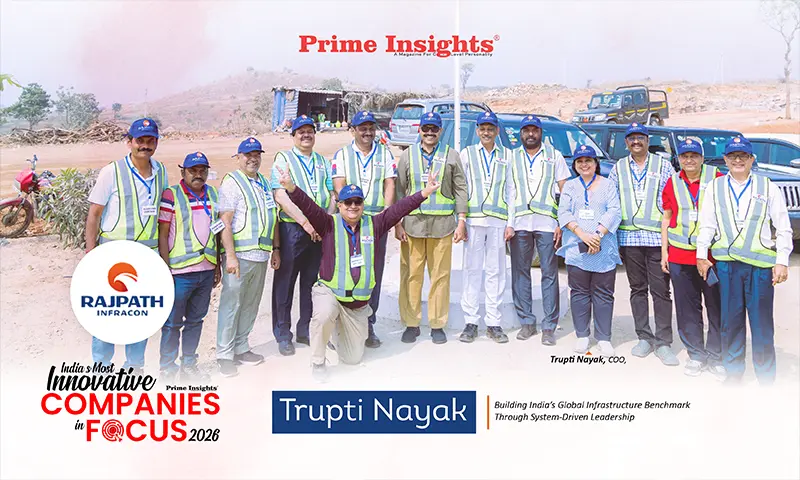
Trupti Nayak | Raj Path Infracon Pvt. Ltd.
Did you know that building a modern highway is less like a construction project and more like conducting a high-stakes, 24-hour orchestra? If a single asphalt truck is delayed by just ten minutes, it doesn’t just stall a machine—it can trigger a “harmonic bottleneck” that costs thousands of dollars and ripples through an entire supply chain. In the world of massive infrastructure, every second is a line of code in a physical landscape, where the difference between a “road” and a “world record” is often just a matter of extreme, caffeinated discipline.
The global infrastructure landscape has transitioned from a race of “bricks and mortar” to a sophisticated battle of execution intelligence. In an era where urbanization demands rapid connectivity, the competition is no longer defined merely by the lowest bid, but by the ability to manage extreme complexity with surgical precision. Today’s industry leaders must navigate fragmented land availability, volatile environmental conditions, and the integration of real-time digital monitoring. In this high-velocity environment, the margin between a standard project and a global benchmark is razor-thin, requiring a shift from reactive site management to institutionalized, data-driven frameworks.
At the forefront of this evolution stands Rajpath Infracon Pvt. Ltd., an infrastructure powerhouse that has redefined what is possible in Indian engineering. Founded on a culture of “performance excellence,” the company recently catapulted into the global spotlight by creating four world records on a massive six-lane greenfield highway project in Andhra Pradesh. Guiding this operational marvel is Trupti Nayak, COO, a leader whose background is rooted in 18 months of invisible preparation and “micro-level” planning. Under her stewardship, Rajpath Infracon has moved beyond traditional construction to adopt Jawli Sutra, a real-time monitoring software, and Six Sigma protocols.
The company operates on a “synchronous delivery framework” where contingency is engineered into the daily leading operations rather than treated as a fallback. By deploying parallel logistics, alternative crews, and buffer stocks, Rajpath Infracon ensures that critical tasks—such as continuous paving for the Guinness World Records—never halt. Their methodology relies on de-layering traditional hierarchy and empowering “on-ground” decision-making, allowing for adjustments in minutes that would typically take weeks. This blend of technical rigor and human-centric leadership ensures that even the most remote, infrastructure-constrained environments are conquered through standardized protocols and relentless Daily Progress Reports (DPRs).
In the spotlight is Trupti Nayak, COO, in an interview of our prestigious India’s Most Innovative Companies In Focus – 2026 edition. Learn from her insights and valuable lessons as an entrepreneur to excel and make it the best company. Stay tuned and know his tale of success.
Prime Insights: Recently, Rajpath created four world records on the Andhra Pradesh project. When you first realized this record was achievable, did the goal change the way the project was executed, or did the execution itself lead to the record?
It’s an intriguing question that required some reflection. To be honest, breaking records was never our initial objective; they were simply the consequence of incredibly disciplined execution.
Our mission for the Andhra Pradesh project was clear: deliver a six-lane, access-controlled greenfield highway. This was entirely new territory for Rajpath, as we had never handled a greenfield project before. We relied on our prior experience while remaining prepared for the unknown.
As execution gained momentum, the sheer scale and precision we achieved began exceeding conventional benchmarks. It became evident that our micro-level planning and resource deployment were operating at extraordinary levels. Only then did we realize these outcomes could translate into a Guinness World Record. We didn’t set out for four records—or even one—but we saw the possibility and decided to give it a chance.
Ultimately, these records emerged organically from a culture of performance excellence. They weren’t isolated accolades, but the byproduct of a synchronous delivery framework that prioritized accountability and high-quality outcomes over trophies.
Prime Insights: Many organizations chase record milestones. In your case, what was more challenging—achieving a record-worthy scale, or sustaining consistency across every small operational detail over such a long period?
Sustaining consistency across thousands of operational details was the true challenge. Achieving record scale is a function of mobilizing resources, but sustainability is about reliability and discipline. What tests an organization is maintaining uniform standards—from earthworks to safety—day after day.
At Rajpath, the differentiator was institutional discipline. We utilized ISO standards, Six Sigma, and a unique real-time monitoring software called Jawli Sutra. Developed by COEP engineering students, this system tracked activities around the clock. Beyond technology, seamless alignment between site and head-office leadership ensured zero communication breaks. The Guinness World Record wasn’t about momentary peaks; it was about sustained operational excellence for seven days, 24 hours a day.
The record was never the original agenda. We simply wanted a greenfield project for our portfolio. During NHAI review meetings for the NH-544G expressway, we realized that despite being new to greenfield work, our packages were second in progress. Being ahead of twelve other reputed firms sparked the idea: why not convert this progress into something more meaningful?
Having one record already, we knew the stringent documentation and 7% global success rate involved. Choosing to attempt this in a different geography—dealing with connectivity, language barriers, and cultural differences in Andhra Pradesh while based in Pune—was like choosing a difficult “question paper.” We decided to test our limits, and that made the achievement special.
Prime Insights: Media attention focuses on the final execution window, but you’ve mentioned the real story spans nearly 18 months. What were the three most underestimated challenges during this preparation phase?
The first brainstorming for this journey began in October 2024. The underestimated challenges weren’t operational; they were different.
First was local integration. Entering a new region meant aligning with unfamiliar administrative systems, cultural norms, and labor dynamics. Establishing trust with local communities and authorities was essential for execution at this scale.
Second was execution resilience in an infrastructure-constrained environment. With zero internet connectivity and no proper approach roads in a remote forest stretch, we had to redesign processes so the project never stopped.
The third challenge was standardization. The hard task was standardizing quality and safety across teams—80% of whom were local to Andhra Pradesh. Asking them to imbibe the Rajpath culture didn’t happen overnight. These invisible preparatory challenges only surfaced once the project gained momentum.
Prime Insights: Was there a moment during those 1.5 years when the team genuinely felt, “This might not work”? How did leadership respond at that point?
I had many sleepless nights. During the early preparation phase, the risk of failure felt very real. Unfamiliar regional dynamics and logistical challenges loomed over us daily. To make matters worse, the 2025 monsoon was untimely and disruptive in the normally arid Puttaparthi–Anantapur region.
Our response was deliberate, not reactive. We acknowledged the reality without masking it with unnecessary optimism. We recalibrated the plan at a granular level, resequencing work fronts and building redundancies. Senior leadership physically visited the site to address concerns directly.
We shifted focus from chasing records to stabilizing fundamentals and regaining predictability. Once the teams saw leadership prioritized clarity over pressure, uncertainty transformed into control. That became the defining point where I knew we would overcome the challenges.
Prime Insights: Large infrastructure projects often look perfect on paper but chaotic on ground. Which assumptions in your original plan were proven wrong during execution—and what did you change because of that?
As a 38-year-old execution company, our processes are seasoned, but greenfield projects were new to us. We knew surprises would crop up; we just had to be ready.
The first assumption was the linear availability of land. On paper, it looked easy, but reality was fragmented. We encountered massive granite mountains—some requiring blasting and cutting up to 90 meters. Moving these boulders and refilling land to meet alignment was an enforcing operation. Sometimes normal blasting failed against the hard rock, forcing us to create multiple micro-fronts. Even setting up campsites and finding water resources in the middle of nowhere was a struggle.
The second misfired assumption was that inefficiencies would cancel out; instead, at extreme scale, they multiplied. Finding manpower willing to work in such remote conditions was tough. People promised to join and never turned up. Building a full team—from lab staff to operators—was a significant hurdle.
Third, we assumed systems would naturally integrate. However, intercultural teams from different backgrounds had to be brought under the Rajpath umbrella. This required a process of de-learning and then relearning our way. We learned that plans cannot remain only on paper; they must be validated by ground realities.
Prime Insights: How did Rajpath Infracon approach contingency planning differently, knowing that even a minor delay could derail a world-record attempt?
Contingency planning is a default setting for any project, but we treated it differently due to our experience at this specific site. We didn’t view it as a fallback or a failback mechanism. Given the compressed timelines and the cascading impact of minor delays, we chose to engineer contingency into our leading operations. It became an integral part of daily activities rather than a separate system.
For every critical activity, we mobilized additional equipment, alternative crews, buffer stocks, and parallel logistics routes. These were not merely conceptual standbys; they were physically present and practiced every day.
Secondly, we mapped teams for specific failure modes or weather disruptions. This wasn’t just Plan A and Plan B—it was a workable Plan B. If any aspect of Plan A slipped, Plan B and its dedicated team stepped in immediately to ensure the work process continued seamlessly. With the Guinness World Records, there was no other option. The criterion was strict: all paving had to be completed without a single second’s break. No halts, no stopping. Failure was not an option.
Prime Insights: Managing resources at this scale is not just technical—it’s human. What was the hardest people-management decision you had to make during this project?
Managing resources at this scale is human, not just technical. We faced many difficult, real-world decisions.
One of the hardest was restructuring roles midstream. There were moments when certain leaders, despite strong intent, couldn’t keep pace with the project’s execution rhythm. These weren’t performance failures, but misalignments in operating styles. We had to redeploy resources to maintain the flow.
We also had to resist the urge to overdrive high performers. The easy option is to overload those who consistently deliver, but we chose sustainability. We enforced rest cycles and built a “second line” of leadership to take over tasks, preventing burnout at the top. This was a critical part of our contingency planning.
The most sensitive area was emotional discipline. Under immense media and public pressure, HODs and leaders had to remain calm. Our teams took their cues from us; if we stayed grounded during setbacks, they did too. Ultimately, we chose system over sentiment. That discipline ensured clarity, fairness, and resilience, proving that our success was built on a stable human foundation.
Prime Insights: How did you keep teams motivated and aligned when the pressure wasn’t just project success, but global visibility and national pride?
Media pressure was immense, but we were careful not to let visibility distort our judgment. We kept the narrative internal, emphasizing professional excellence—doing today’s work correctly—over headlines. Alignment came from micro-level clarity; every team knew exactly what “good” looked like for the day. We focused on the Marathi phrase – “apla gad sambhala”- look after your own fort first. This converted abstract pressure into controllable objectives, ensuring that by the time global attention arrived, we were already in a stable rhythm.
Prime Insights: During execution, what kind of decisions had to be taken in minutes, even though they normally require weeks of approval in large organizations?
Planning was precise; we discussed every scenario with Plans A, B, and even C. In traditional setups, hierarchy and paperwork delay decisions for weeks, but we laid everything out clearly. Resource deployment and administrative decisions were finalized in advance, empowering people to act.
At the site, our mantra was: “Pass the baton.” If a situation became too difficult to handle, teams were instructed to pass it to a senior immediately rather than holding onto it. This allowed us to make critical decisions in minutes.
When design or method adjustments required authority approvals, our team explained the stakes—if we didn’t act, the entire “pack of cards” would collapse. We received immense, proactive support from NHAI. They understood our challenges and provided quick clearances, working hand-in-hand with us. Success is always a product of teamwork; many factors and people contributed to this achievement.
Prime Insights: As COO, how do you personally balance speed vs accountability when stakes are this high?
Managing the project was like conducting an orchestra; while it looks like just waving a stick, many overlapping activities happen simultaneously. Our coordination within the Apex Committee was spot on. We avoided “reckless accountability” by building a support system where everyone, including our Managing Director, took specific ownership.
I followed three core principles. First, clarity for decision rights. We defined who decides what within technical and commercial boundaries. This ensured speed was both expected and protected, preventing hesitation. Second, I practiced upfront accountability. Once the framework was set, I resisted second-guessing in real-time. This restraint allowed people to step forward, take responsibility, and find solutions.
Third was evidence-based oversight. Instead of chasing every activity, I tracked leading indicators like cycle times and process variances to ensure speed came from discipline, not shortcuts. Most importantly, I maintained personal discipline. Under pressure, the temptation is to be reactive, but I reminded myself to respond, not react. I deliberately slowed down to ensure fast didn’t become impulsive. This habit filtered down to the team; they learned to take a breath and understand the situation before acting. Success wasn’t a one-person job—it was a collective commitment to system over sentiment.
Prime Insights: What internal systems or execution frameworks at Rajpath Infracon played a decisive role in making these records possible—but may never be visible to the outside world?
After our 2022 record, dozens of organizations globally tried to break it, but failed. They wondered what “magic element” a mid-sized company like Rajpath possessed. I believe the differentiator lies in invisible frameworks.
First is top management involvement. Our CMD, Mr. Kadam, doesn’t sit in offices; he stands at the site, gaining a first-hand understanding of terrain and machinery. This presence is rare in large organizations. Second is relentless monitoring. We didn’t track monthly outputs; we tracked Daily Progress Reports. This transparency made our communication predictive rather than reactive.
Third is standardized execution protocols. There were no grey areas; every activity—from batching to paving—was repeatable and benchmarked. Finally, we destroyed the fear of failure. Our Apex Committee acted as a stress-testing cell, encouraging teams to “pass the baton” and offload problems. Together, these systems created execution certainty, allowing us to succeed where others couldn’t.
Prime Insights: Did this project force Rajpath Infracon to break or redesign any long-standing internal processes? If yes, which ones?
Oh yes. This was a high-velocity greenfield project. Rules were not broken, but processes were definitely reengineered. Traditional multilayer approvals and paperwork were removed. Governance was moved up instead of downstream.
Reporting cycles shifted to daily DPRs. Execution became fully integrated and concurrent. Risk management was critical—we could not afford failures, outages, or breakdowns. Machines, manpower, fatigue—everything had to be managed.
All these redesigned processes evolved during execution and are now part of Rajpath’s execution culture. This has become our new baseline.
Prime Insights: In moments of extreme pressure, what matters more—hierarchy or trust? How was this reflected on-ground during the project?
Hierarchy is administrative. Trust is people-driven. In extreme pressure, trust matters far more—but it has to be earned and structurally supported.
Hierarchy defines authority, but trust determines whether authority can be exercised with speed and without friction. Hierarchy acted like a safety net, not a throttle. Escalation paths were clear and fast—not bureaucratic.
Leadership stepped in not to overrule, but to resolve. Hierarchy provided structure; trust provided velocity. Rajpath evolved not because of authority, but because of trust.
Prime Insights: How did this experience personally change you as a leader, not just as a professional but as a decision-maker under scrutiny?
This was a life-changing experience. It reinforced that when visibility is high and margins are wafer thin, my role is not to be decisive—but to create decisiveness in the system.
It’s better to be a kingmaker than sit on the throne. It deepened my respect for restraint—respond, not react. I became more comfortable standing behind decisions taken by my team, even if they weren’t perfect, as long as they aligned with the framework.
This experience calibrated how I view pressure—through clarity, consistency, and calmness. If I remain steady, it mirrors organizational stability. It refined my leadership philosophy completely.
Prime Insights: These records have been acknowledged globally. What do you think they signal about India’s evolving capabilities in infrastructure — beyond just numbers and scale?
Beyond the numbers, these records signal a structural shift in how Indian projects are conceptualized and executed. We are no longer relying solely on scale; today, we deliver mature processes with precision and predictability. This changes the perception of Indian infrastructure, proving that complexity can be absorbed and sustained under pressure.
A decade ago, this level of systemic execution did not exist. Now, large projects are driven by data, standardized frameworks, and digital integration—not reactive site leadership. We are seeing a cultural evolution where data is becoming the new master, with widespread acceptance of AI and digital monitoring. These records are less about what was built in a short window and more about our readiness to execute reliably, transparently, and at global benchmarks repeatedly.
Prime Insights: Do you believe Indian infrastructure companies are now competing on execution intelligence, not just cost? And how does Rajpath InfraComp fit into this shift?
Cost advantage is important, but it’s no longer enough. Today, stakeholders value certainty, compliance, and reliability over the lowest bid; execution intelligence is the new differentiator.
Rajpath fits this transformation. Our records weren’t achieved through brute force, but through institutionalized frameworks and micro-planning. We knew exactly how much we would spend and how resources would be deployed—nothing was reactive. Once embedded in leadership, this intelligence becomes replicable across all projects. As healthy competition pushes the entire sector to elevate standards, it’s a win-win for the industry.
Prime Insights: After achieving something of this magnitude, how do you prevent the organization from falling into the trap of “record-chasing” instead of sustainable excellence?
Records are evidence of capability, not a template for behavior. Our focus is on repeatability, not optics. We are institutionalizing the frameworks and decision-making patterns that enabled these records so they become the baseline for all projects. If systems deliver predictable outcomes, exceptional results follow naturally.
Leadership has reset our success metrics. Instead of asking if it can be done faster, we ask if it can be done more reliably and safely. Culturally, records are retrospective recognitions—they cannot be forward targets. Tomorrow is always a fresh slate. Like an elite athlete, success comes from invisible preparation and disciplined training patterns. Our strategy is to convert a peak achievement into a higher execution standard. Sustainable excellence comes from a flawless system where even ordinary delivery can turn into an exceptional outcome.
Prime Insights: If another infrastructure leader wants to replicate what you’ve done, what is the one thing they are most likely to underestimate?
The human element. Systems and quality are important, but what’s most underestimated is the invisible foundation—the work and leadership alignment that happens long before execution accelerates. What happens behind the scenes determines what happens on stage.
The second factor is psychological discipline—the restraint to let systems work without constant intervention. When scrutiny increases, the temptation to push harder grows, but excess pressure erodes transparency and forces defensive work. Systems matter, but human connection and commitment matter even more. Extraordinary leadership is the quiet groundwork that makes the standing ovation possible.
Prime Insights: When you look back at this project years from now, what part of the journey—not the records—do you think will matter most to you personally?
What will stay with me isn’t the seven days of records, but the unseen phase—learning to act differently under uncertainty. I’ll remember when plans failed and we chose dialogue over pressure. Trust was built incrementally, conversation by conversation.
I saw young leaders emerge and individuals become confident decision-makers who remained uncompromising on quality. The records mark what was achieved, but the real journey was becoming capable of achieving it. That capability will outlast any project; it is a legacy no certificate can capture.
If you had to describe this entire journey in one sentence — something the public hasn’t heard yet — what would it be?
This was not a story of breaking records. It was about quietly building discipline, trust, and execution intelligence.
It was extraordinary work done by ordinary people. None of us are gold medalists. But together, we showed what a focused, aligned team can achieve — and how powerful the human element truly is in delivering extraordinary outcomes.
