

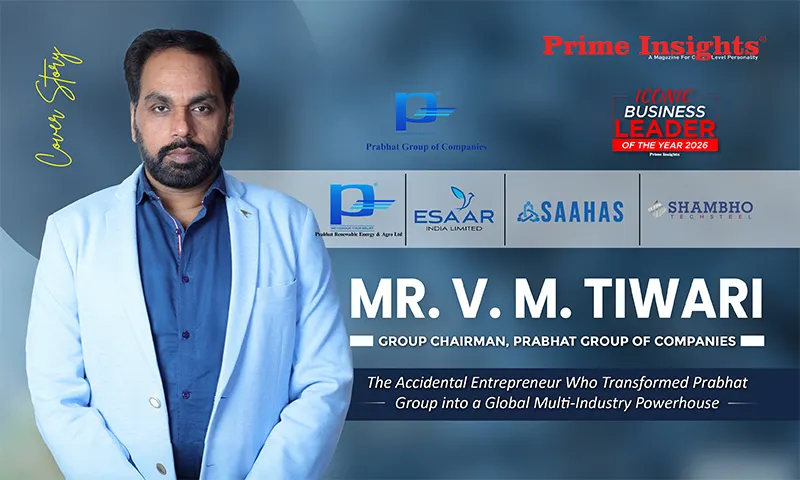
Mr. V. M. Tiwari | Prabhat Group of Companies
The business world can feel a lot like a high-stakes video game. You’re regularly leveling up and battling competitors, and just when you think you’ve mastered the game, a new “boss” appears—a disruptive technology, a global crisis, or a sudden shift in consumer tastes. The companies that win aren’t necessarily the biggest or the fastest, but the ones that can adapt, pivot, and find a way to keep playing, no matter what. It’s a game of strategy, resilience, and knowing when to hit reset. The journey of an enterprise from a fledgling startup to a multi-industry conglomerate is a testament to this resilience and strategic foresight.
This is the story of Prabhat Group of Companies—an organization defined by its spirit of entrepreneurial metamorphosis. Founded in the year 1997 by Mr. V. M. Tiwari, the company began its journey as a telecommunications firm specializing in network design, and maintenance. A true “accidental entrepreneur” Mr. V M Tiwari’s path unfolded after a fruitless job search, shaping him into a leader who still refers to himself as the company’s first employee, a reminder that he worked every role before building an empire. His mechanical engineering background, combined with values shaped through his public-school education, prepared him to persist, innovate, and excel against all odds.
Under his leadership, Prabhat evolved into one of the pivotal pillars in the growth of India’s handset industry. The company emerged as the leading distribution partner for major Indian brands such as Micromax and Fly across Western India. Prabhat was also among the very few Indian companies to collaborate directly with global technology giant like Qualcomm, successfully designing, developing, and launching CDMA OMH handsets in India—devices that were not only advanced for their time but also approved and adopted by major telecom operators including Tata, Reliance, MTS, and Virgin. At its peak, Prabhat became India’s second-largest brand for CDMA devices and proudly earned the distinction of being the first Indian company to receive the prestigious OMH certification from Qualcomm, reflecting world-class excellence in mobility solutions.
Beyond handsets, the company expanded its footprint across the telecom ecosystem. Prabhat served as the master distributor for Tata Sky in Mumbai and played a crucial technical role with operators such as TTML, Reliance, MTS, HFCL, Nepal Telecom, BE Mobile, and PNG Telecommunication. The organization also demonstrated innovation beyond telecom by designing and developing a patented school bag equipped with a unique remote location–tracking feature and an emergency voice messaging system for children—an initiative driven by safety, creativity, and social responsibility.
However, with the advancement of time CDMA technology became obsolete, Prabhat Group demonstrated its resilience by successfully diversifying into other promising businesses like renewable energy (solar), finance, and steel. This strategic pivot highlights Mr. V M Tiwari’s ability to navigate challenges and his inspirational message to budding entrepreneurs: never fear failure, be consistent, and always give back to society.
Today, the Prabhat Group of Companies is diversified into three core verticals. In the solar sector, they focus on the promising future of renewable energy, particularly through unique propositions under RESCO (Renewable Energy Service Company) model where they build, own, and operate captive power plants for corporate clients. The finance vertical, meanwhile, addresses the constant demand for funding, and the steel business manufactures tubes and pipes for industrial sectors like “automobile, oil & gas, chemical industries, heat exchangers, instrumentation etc. A commitment to innovation and technology underpins the company’s operations, using tools such as real-time monitoring apps and AI-driven solutions for risk analysis.
Across its multi-industry footprint, the Prabhat Group today operates several strong business verticals. Prabhat Renewable Energy and Agro Ltd (PREAL) drives the Group’s initiatives in sustainable energy. Shambho Techsteel Pvt Ltd anchors its presence in the stainless steel tubes and pipes sector, while Esaar India Ltd, the Group’s NBFC arm, supports financial inclusion through responsible lending. The international arm, Prabhat Overseas LLC FZ, extends the company’s reach into global markets, and Prabhat Capital Investments Ltd strengthens its portfolio in financial and strategic investments.
Beyond business, the Group is equally committed to social responsibility. Its dedicated CSR wing, Saahas Trust, along with the Saahas Medical & Educational Foundation, leads impactful initiatives in education, healthcare, and community empowerment. Together, these efforts reflect the Group’s belief that true growth must uplift not just industries—but society as a whole.
In this edition, the spotlight is on Mr. V. M. Tiwari, Group Chairman, Prabhat Group of Companies, in an exclusive interview for our prestigious “Iconic Business Leader of the Year 2026” edition. His insights and valuable lessons as an entrepreneur will inspire you, teaching you how to excel and build the best company. Stay tuned and get ready to listen to his incredible tale of success.
Prime Insights: Can you introduce your company and share its core mission and vision with our readers?
I’m serving as the Chairman for Prabhat Group of Companies, founded in the year 1997. I always call myself the first employee of the company rather than the owner, because I believe everyone contributes equally to the growth of an organization. Initially, we started with a business in the field of telecommunication, focusing on network designing, implementation, and maintenance. Later, around the year 2003–04, we moved into mobility, and I proudly say we became India’s number two brand for CDMA devices. In the year 2014, with the introduction of OMH Handsets, we entered into the manufacturing of CDMA devices and soon reached the No. 2 position. Gradually, we transitioned into GSM handsets, becoming device suppliers for all major brands and developed our distribution and service PAN India.
With advancements of time and technology, the CDMA Technology went through a major hit and operators started surrendering Licenses; Prabhat Group being part of the same arena went through one of the toughest survival phase. For almost a year, we had no clear direction regarding our future. Then, around the year 2018–19, we entered renewable energy, particularly solar and We became a prominent Solar EPC Player among govt. and private renewable projects. Later, We envisioned ease of finance is one of the key players thus entered finance industry by acquiring a NBFC in 2024-2025, and in the year 2024, we also entered the steel industry, manufacturing tubes and pipes. Today, I’m proud to say that all three verticals—renewable energy, finance, and steel—are doing well. That’s the journey of Prabhat Group so far.
Prime Insights: Could you please tell us a bit about your personal journey—your education and background?
I’m proud to say I’m a man made by my parents’ values. I was born in Jaunpur, Uttar Pradesh.I have completed my graduation in mechanical engineering from Mumbai. After completing my studies in the year 1997, after my graduation I was in search of a suitable job, but unfortunately, I couldn’t find one. That’s how, by chance , I stumbled upon an opportunity to start my own business —I call myself an accidental entrepreneur.
I studied at B. L. Ruia High School, Mumbai, which had a strong influence on my life and character. My Principal, I. B. Singh left a deep impression on me and many others who went on to succeed in life. His discipline and guidance shaped much of my early thinking.
Prime Insights: Could you briefly highlight your professional journey and your current role as a business leader?
Currently, I’m serving as the Chairman for Prabhat Group of Companies, which has seven companies under it which serve across different sectors. Alongside business, we also run a charitable trust called “Saahas Trust,” founded in the year 2007. Every year, we spend approx ₹2 crore on education—especially girl child education—healthcare, spirituality and fighting malnutrition.
Prime Insights: What made you a leader, and what makes you a great one?
Honestly, it was all circumstances. I never planned to be a businessman. My only aim was to complete my education, secure a lucrative job, and own a two-wheeler and a small flat. But destiny had different plans. Circumstances made me an entrepreneur.
It’s not just that I faced adversities, as every entrepreneur does, that sets me apart, but rather my consistent ability to overcome challenges, particularly those related to policy within India’s business ecosystem.
Great leaders like Ratan Tata, Jamshedji Tata, Jamnalal Bajaj, and Rajeev Bajaj have been my inspirations. And on a personal level, my school principal I. B. Singh played a crucial role in shaping my values and leadership style.
Prime Insights: Balancing personal and professional responsibilities can be tough. How do you manage it?
Managing personal and professional responsibilities is all about partnership for me. My wife takes care of our personal responsibilities, while I focus on the professional side. This balance works for us because we fully support and respect each other’s roles.
Prime Insights: What defining challenges have shaped your leadership journey so far?
Government policies and circumstances have played a significant role in shaping my leadership journey thus far. In telecom, renewable energy, steel, and finance—every industry is heavily policy-driven. Policies that favor only large corporations often leave us feeling like orphaned children. Still, I believe SMEs contribute significantly to India’s revenue and taxes, and they deserve more support.
Prime Insights: Which industries or sectors do you see as highly promising for the future?
Renewable Energy Industry is a very promising one for a developing country like India because India is a power-deficit country. Over the next 20 years, the demand for energy will only rise, especially along with target for all the major countries going net carbon zero will increase the focus to this sector. Wind energy isn’t suitable for India, and nuclear power is too costly—so solar is the future.
In solar segment, we have a unique proposition under RESCO Model—where we’re building a bouquet of captive power plants and sell electricity to corporate clients. Our clientele include Tata Teleservices, Metro Cash and Carry, Pune Municipal Corporation, and others.
Our steel division produces premium tubes and pipes that cater to industrial as well as retail requirements. In finance, the need for dependable funding is evergreen. These three verticals stand among the most resilient and future-ready sectors.
Prime Insights: How do you ensure your company adapts to evolving market changes and consumer needs?
Since we are into B2B, not B2C, our businesses are less prone to sudden disruptions. We focus on medium-and small-scale industries, and competition is present but manageable. With consistency, we see ourselves growing into a ₹2,000–3,000 crore group within the next 3–5 years.
Prime Insights: What role do research, innovation, and technology play in driving your company’s growth?
This is crucial. Unfortunately, in India, most entrepreneurs hesitate to invest in innovation and prefer acquiring innovative companies instead. At Prabhat, however, we believe in building and supporting innovation internally. For example, in our solar business, we use an app that provides real-time technical monitoring of plants across different geographies. Similarly, in finance, we are working on innovating AI-driven solutions for risk analysis and customer profiling. Technology is not just a support function anymore—it’s a growth driver.
Prime Insights: That’s insightful. Could you highlight your future plans and the long-term vision for Prabhat Group of Companies?
My long-term vision is simple: I want Prabhat Group to be known for trust and consistency. Profit is important, but building a reputation that lasts beyond us is more important. In solar, our goal is to reach 500 MW of installed capacity in the next five years. In finance, we want to expand our reach to Tier 2 and Tier 3 cities, where people really need accessible funding. In steel, we aim to become a top player in tubes and pipes in Western India.
Overall, the dream is to build a ₹5,000 crore group in the next decade while creating employment, contributing to nation-building, and giving back to society through our trust.
Prime Insights: What message would you like to share with aspiring entrepreneurs and leaders who look up to you?
My message is very clear: do not fear failure. Failure is only the first step toward success. I failed in multiple businesses—first in telecom, then in mobility—but I never gave up. Every downfall taught me something and prepared me for a bigger rise.
Second, consistency is key. If you keep shifting focus too often, you won’t grow. Stick to your vision, fight through adversities, and keep faith in yourself. And third—never forget society. Whatever you earn, always keep aside something for those in need.
