

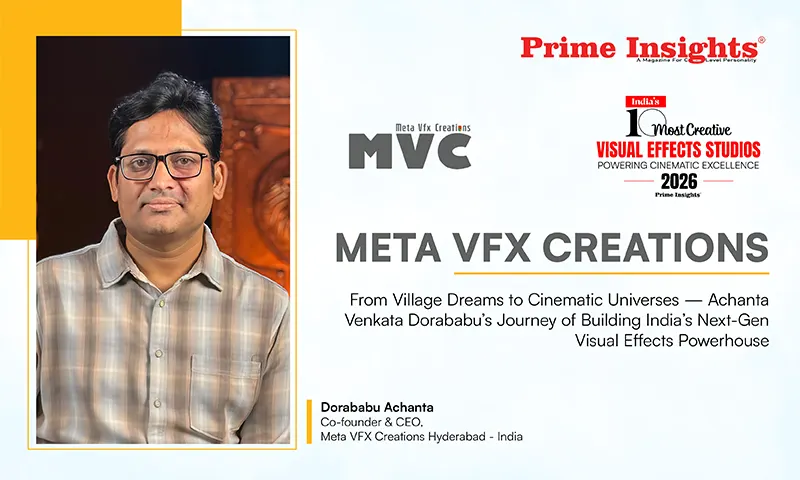
Meta VFX Creations
Did you know that the “secret” to the most heart-pounding action scenes in modern cinema often has nothing to do with a camera? In today’s blockbuster landscape, nearly 90% of what you see on screen—from the sweeping vistas of ancient kingdoms to the subtle reflection in a hero’s eye—is meticulously crafted in a digital darkroom long after the actors have gone home. It is an industry where artists are part-magician and part-architect, turning “impossible” into “available by next Friday.”
The visual effects industry has transformed from a technical afterthought into the very heartbeat of modern cinema, where the line between reality and imagination is perpetually blurred. In an era defined by cutthroat competition and rapidly evolving technologies like AI and real-time rendering, studios must transcend mere technical execution to survive. Success in this high-stakes landscape requires a rare blend of artistic craftsmanship and industrial-scale efficiency, as filmmakers increasingly demand seamless world-building that anchors even the most fantastical stories in tangible realism.
At the forefront of this evolution is Meta VFX Creations (MVC), a studio founded in 2023 that specializes in complex 3D environments and intricate simulations. The studio is the brainchild of Dorababu Achanta, a visionary leader whose journey is a testament to sheer persistence.
A self-taught artist from the village of Palakollu in Andhra Pradesh, nearly 500 kilometers from Hyderabad, Dorababu rose from a background with no access to formal training. Before establishing his own venture, he served as the VFX head & VFX Supervisor at Makuta VFX, the powerhouse behind the monumental visual effects of films like Eega, Baahubali, RRR, and Pushpa: The Rise.
By dedicating up to 16 hours a day to mastering his craft, he transitioned from a rural background to shaping some of India’s biggest cinematic landmarks—driven by a clear message to aspiring entrepreneurs: “Don’t wait for the perfect opportunity—create it.”
Meta VFX Creations (MVC) operates on a sophisticated hybrid pipeline where creativity meets technical rigor. Unlike many domestic studios that focus solely on 2D Compositing, Meta VFX excels in high-end 3D production, handling everything from fire and water simulations to massive digital kingdoms. By integrating AI for conceptual storyboarding and motion capture for action sequences, the studio ensures cinematic consistency through a “rough-to-refined” workflow that prioritizes clarity and director collaboration.
In the spotlight is Dorababu Achanta in an interview of our prestigious “India’s 10 Most Creative Visual Effects Studios Powering Cinematic Excellence – 2026” edition—learn from his insights and valuable lessons as an entrepreneur to excel and make it the best company. Stay tuned and know his tale of success.
A self-taught artist from a remote village rises to shape cinematic spectacles like Eega and Baahubali, and now builds the future of visual storytelling through innovation, scale, and fearless creativity.
Prime Insights: To begin with, could you introduce yourself and share a bit about your background?
I completed my education with a Bachelor of Arts degree, during which I developed a strong inclination toward art and creativity. Although there were limited structured opportunities to formally pursue creative fields at the time, my interest in visual storytelling and design continued to grow.
Over time, I found myself increasingly drawn to cinema and the evolving media landscape. I was particularly fascinated by how storytelling was being enhanced through technology, especially in areas like visual effects and digital production.
This curiosity eventually motivated me to explore opportunities in a more dynamic environment, where I could learn, experiment, and build a career around creative and technical expression.
Prime Insights: What were your initial experiences in Hyderabad like, especially in the multimedia space?
When I arrived in Hyderabad in 2000, the multimedia industry was still in its early stages. Most institutes focused only on basic web or graphic design, and there was a clear lack of industry-oriented training for film-based visual effects.
I chose a different route. I found a mentor who had strong technical knowledge of 2D and 3D tools. While he wasn’t directly from the film industry, his understanding helped me build a solid foundation.
At that time, resources were extremely limited—I didn’t even have proper internet access or high-end systems. I relied heavily on manuals, what we used to call “software bibles,” for tools like Adobe Photoshop, 3ds Max, Maya. I would spend 16 to 18 hours a day practicing and experimenting. This self-learning phase lasted nearly 2 to 3 years and became the backbone of my career.
“I didn’t have internet, infrastructure, or guidance—only curiosity and the willingness to work 18 hours a day.”
Prime Insights: How did your professional journey in the VFX industry begin?
My professional journey started around 2003 when I got my first opportunity to work on a film. Soon after, I joined Color Chips and later moved to Prasad EFX, which became a turning point.
At Prasad EFX, I gained hands-on experience working on films and learned how to integrate VFX with live-action footage. It helped me understand filmmaking from a practical perspective—working with directors, adapting to different visions, and managing real production challenges.
Prime Insights: You’ve worked with renowned filmmakers. Could you share your experience collaborating with them?
One of the most defining collaborations was with director S. S. Rajamouli. My first project with him was Sye – 2004 year, which gave me exposure to large-scale filmmaking.
Working with him taught us the importance of using real-world references. Instead of relying purely on imagination, we captured real lighting, camera angles, scale, and object behavior directly from the set. This approach helped us create VFX that felt natural and seamlessly blended with live-action footage.
“Great VFX is not about imagination alone—it’s about grounding imagination in reality.”
Prime Insights: Projects like Eega were widely appreciated. What made them unique from a VFX perspective?
Eega was one of the most challenging yet rewarding projects of my career. The story revolved around a housefly, which made scale, movement, and expression extremely complex.
We invested heavily in pre-visualization, building rough versions of scenes before final production. The director was deeply involved—he would act out expressions and body language, which we translated into animation.
The level of detail was intense. Rendering could take hours per frame due to intricate textures and close-ups. For months, the team worked almost around the clock. It was demanding, but the final result made it worthwhile.
“For Eega, we weren’t just animating a fly—we were building emotion at a microscopic scale.”
Prime Insights: You were also involved in Baahubali. How did that project push boundaries?
Baahubali was monumental in every sense—scale, complexity, and ambition. Initially planned as a single film, it eventually expanded into two parts.
We had to build entire worlds—kingdoms, environments, and cultures—from scratch. Every detail, from architecture to lighting, was designed in 3D. We followed a structured pipeline in which rough previews, postviews, and pre-comps were created, reviewed, and approved by the director and DOP before moving to final production.
The second part raised expectations significantly, with complexity increasing nearly tenfold. We expanded teams and collaborated with multiple studios to meet those demands.
“Baahubali wasn’t just a film—it was world-building at a scale India had never seen before.”
Prime Insights: Your work has received national recognition. What does that mean to you?
It has been an incredibly fulfilling journey. Being part of landmark films like Eega and Baahubali: The Beginning and Baahubali: The Conclusion, and collaborating with visionary artists such as Pete Draper and Adel Adili during my time at Makuta VFX has been both inspiring and rewarding. I also had the opportunity to collaborate on several notable projects with R. C. Kamalakannan and Srinivas Mohan, which further enriched my experience.
Seeing these projects go on to receive prestigious honors such as the National Film Award for Best Special Effects was more than just recognition, it was a powerful validation of the passion, innovation, and relentless effort put in by the entire team. Moments like these reaffirm the value of pushing creative boundaries and striving for excellence, while also highlighting the collaborative spirit that drives truly exceptional visual storytelling.
Prime Insights: After such a successful career, what inspired you to start your own studio?
After years of collaborating with creative directors and established studios like Makuta VFX, I felt the need to build something of my own. Along with my friend Mike Yatham, who shares the same vision, we decided to collaborate and create our own IP.
Our goal is to deliver high-quality work for creative directors and content creation, and that’s how we began this journey.
In 2023, I co-founded Meta VFX Creations with Mike Yatham. Our primary goal was to create a space that balances creativity with efficiency while nurturing new talent.
We started with around 20 fresh artists, training them internally, along with a few senior creative artists from my previous studio. Today, we’ve grown into a team of about 45 artists—many of whom have been developed from scratch.
Prime Insights: What kind of projects is Meta VFX currently working on?
We’ve contributed to several films, including portions in projects like Kalki, Jailer and PS2, Game Changer, along with other hollywood fills & commercials and regional cinema.
While we may not always handle entire films, our focus is on delivering high-quality work in the segments we contribute to.
Prime Insights: What inspired the founding of your studio, and how has your creative journey evolved in today’s rapidly changing industry?
My journey has always been driven by a passion for visual storytelling. Today, the industry is undergoing a major shift with the rise of artificial intelligence (AI).
VFX is no longer a standalone process—it’s becoming a hybrid pipeline integrating AI. While AI cannot replace traditional workflows, it plays a crucial role in pre-production—like storyboarding, matte painting, and visual exploration.
What has changed the most is accessibility. When I started, there were no tutorials or online resources. Today, platforms like YouTube allow anyone to learn at their own pace.
However, fundamentals still matter. Complex simulations—like fire, water, and destruction—require deep technical knowledge and hands-on experience. AI can assist, but it cannot replace craftsmanship.
Prime Insights: What key challenges did you face while building technical expertise and credibility in the industry?
The biggest challenge was the lack of resources. Coming from a small village, I had no access to proper training or infrastructure.
Another challenge was bridging the gap between technical skills and artistic execution. VFX is not just about software—it’s about storytelling, realism, and emotion.
Credibility also takes time. It comes from consistent work, collaboration, and delivering under pressure. What helped me overcome these challenges was persistence and curiosity. I was always willing to learn, experiment, and adapt.
Prime Insights: How does your studio blend creativity, technology, and innovation?
Interestingly, the tools remain largely the same across films, OTT, gaming, and animation. What changes is the creative vision.
For fully 3D projects, the pipeline becomes more complex, but the foundation remains consistent. It’s always about how effectively you apply the tools to serve the story.
Prime Insights: What differentiates your studio in the VFX industry?
In India, about 70% of studios focus on 2D work like roto and compositing. Only a small percentage specialize in full-scale 3D production because it’s resource-intensive.
Our strength lies in handling complex 3D environments and simulations—like waterfalls, fire, and large-scale destruction. This specialization sets us apart.
Prime Insights: How do you ensure cinematic realism and consistency?
It starts with closely aligning to the vision of the Director and the DOP. We are present on set during shoots to study lighting, shadows, and overall environmental conditions. For daytime shoots, blue matte works well for keying and rotoscoping, and natural sunlight helps integrate CG lighting seamlessly.Outdoor shoots are generally easier due to consistent natural light.
Indoor shoots, however, are more complex because of multiple light sources. Without proper lighting reference (witness) images, indoor shots become more time-consuming, as identifying the light sources is challenging. This often leads to more grain and less usable information for keying.
Prime Insights: What role do emerging technologies like AI and real-time rendering play in your workflow?
AI is extremely useful in the conceptual stage—it helps generate ideas and references quickly.
We also use motion capture for complex sequences like crowds or action scenes. Real-time tools like Unreal Engine are evolving, but for high-quality cinematic output, we still rely on offline rendering.
Prime Insights: How do you collaborate with directors and production teams?
Collaboration is critical. We work closely with directors, DOPs, and even stunt teams.
Pre-production planning is key—deciding camera angles, layers, and execution strategies beforehand. Being present on set as a VFX supervisor also helps us guide decisions in real time, saving time and cost later.
Prime Insights: What quality control processes do you follow to meet tight timelines?
We categorize sequences based on complexity. Critical shots are handled in-house, while simpler ones may be outsourced.
We conduct daily review meetings and follow a structured pipeline—first delivering rough versions of all shots, then refining after approval.
About 50% of 3D Involved shots go through multiple iterations. Instead of perfecting a few shots, we first build a rough version of the entire film, ensuring clarity of sequence before final detailing.
“In VFX, clarity of process is what protects quality under pressure.”
Prime Insights: How do you nurture talent within your team?
I focus more on mindset than academic background. Passion, adaptability, and openness to feedback are what matter most.
Collaboration is essential. Artists must be open to critique and team input. When they remove self-imposed limitations, their creativity grows significantly.
Prime Insights: How do you maintain global quality standards?
There’s no real difference between local and global standards—the pipelines and processes are the same.
What matters is the quality of input—direction, cinematography, and planning. Strong input naturally leads to high-quality output.
Prime Insights: What are your future plans?
AI will continue to transform the industry, making production faster and more efficient.
However, storytelling must evolve alongside technology. In the coming years, we’ll see more fully digital films and original IPs, especially inspired by Indian mythology.
AI will assist—but human creativity and emotion will always remain at the core.
“Technology will evolve—but storytelling will always remain human.”
Prime Insights: What advice would you give to aspiring VFX artists and creators?
Be patient. This industry demands persistence.
Focus on creativity—whether it’s natural or developed through practice. Today, there are no barriers. With available tools, you can create your own content independently.
Don’t wait for opportunities—start creating. The scope in this industry is massive, and storytelling will always remain essential.
If you stay consistent, curious, and proactive, the possibilities are endless.
Final word, Running a VFX show is not a one-man journey, it takes a dedicated team of skilled and creative artists to bring every vision to life.
“Don’t wait for the perfect opportunity—create it.”
Meta VFX Creations now calling as MVC
