

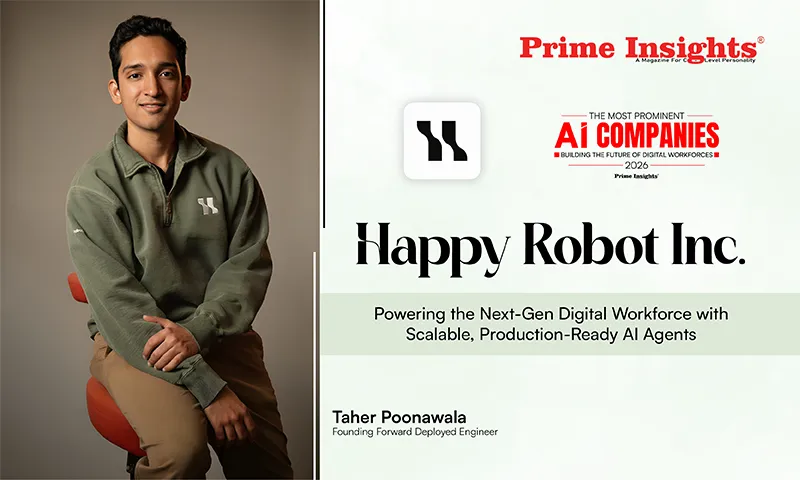
Happy Robot Inc.
“Did you know that the average office worker spends nearly 60% of their day on ‘work about work’—answering routine emails, chasing status updates, and manually data-entering information—rather than the actual job they were hired to do? It’s the modern corporate paradox: we have more technology than ever, yet we’ve never been busier doing things that a machine should handle.”
The global industrial landscape is currently navigating a seismic shift driven by the rapid maturation of artificial intelligence. We are moving past the era where AI was a “cool party trick” and into a reality where it is a functional necessity. In an era defined by cutthroat competition, traditional automation is no longer sufficient. Today’s enterprises are grappling with “proof-of-concept” fatigue, seeking robust systems capable of handling complex, multi-channel business processes. As the demand for scalable, intelligent solutions skyrockets, the focus has shifted from simple chatbots to the creation of a sophisticated “digital workforce”—coordinated AI agents that operate with the nuance and reliability of human teams.
At the forefront of this revolution is Happy Robot Inc., an enterprise AI powerhouse founded in 2023. The company has rapidly evolved from a specialized solution for supply chain frustrations into a comprehensive platform for deploying production-ready AI workers at scale. Central to this journey is Taher Poonawala, a Founding Forward Deployed Engineer and the company’s fifth employee. With a background rooted in architecting production systems from the ground up, Taher has been instrumental in Happy Robot’s meteoric growth. His entrepreneurial philosophy is built on the “forward-deployed” model—embedding engineers directly within client operations to ensure that AI solves real-world problems rather than theoretical ones.
How the Future Operates: Happy Robot’s platform functions as the essential infrastructure for the modern enterprise. By combining special text-to-speech models, natural language processing, and advanced organization methods, the system creates AI workers that can handle phone calls, emails, and internal tools all at the same time. Whether it is handling carrier sales or complex scheduling, these AI workers understand unstructured data and execute multi-step workflows autonomously, allowing human teams to focus on high-level decision-making while the “digital workforce” manages the heavy lifting.
Exclusive Insights In the spotlight is Taher Poonawala in an interview in our prestigious “The Most Prominent AI Companies Building The Future of Digital Workforces – 2026” edition. Learn from his insights and valuable lessons as an entrepreneur to excel and make it the best company. Stay tuned and know his tale of success.
Prime Insights: Can you introduce your company and share its core mission in the AI and digital workforce ecosystem?
Happy Robot is an enterprise AI company building the infrastructure for organizations to create, deploy, and manage AI workers at scale. Founded in 2023, our mission is to give enterprises the tools to stand up AI-powered workforces that handle real operational tasks — not demos or proofs of concept, but production systems that run day-to-day business processes. I joined as a founding forward-deployed engineer and the fifth employee and have been responsible for architecting and shipping our earliest production systems from the ground up.
Prime Insights: What inspired the foundation of your organization, and how has your journey evolved in the AI space?
Our co-founder Javier Palafox had served as CFO of a US-based consumer goods company, where he was hiring interns just to call truck drivers and ask for shipment ETAs — a task that was clearly automatable but had no viable solution. That frustration became the founding insight. We started off building AI workers for the supply chain and have now become the platform where all enterprises can build, deploy, and manage their AI workforces.
Prime Insights: How do you define a “digital workforce,” and what role does AI play in shaping it?
A digital workforce is a coordinated set of AI agents—each specialized for a distinct operational function—that together handle work traditionally performed by human teams. AI is the enabling layer: it allows these workers to understand unstructured inputs like phone calls or emails, make contextual decisions, and execute multi-step workflows autonomously. The critical distinction is that these aren’t chatbots or simple automations—they operate across voice, email, and internal tools simultaneously.
Prime Insights: What key AI solutions or platforms do you offer to enable intelligent automation and workforce transformation?
Our platform lets enterprises build AI workers for specific operational roles—carrier sales, track-and-trace, appointment scheduling—and orchestrate them across full workflows. I personally designed and built our first voice-powered and email-powered AI workers, which together formed a multi-channel system now handling a significant share of our first client’s operations. We’ve also developed a proprietary text-to-speech model purpose-built for real phone conversations and more recently launched a meta workflow builder that lets non-technical users configure and deploy AI workflows without engineering support.
Prime Insights: What differentiates your company from other players in the AI and automation landscape?
Three things. First, we deploy AI workers into live production environments — not sandboxed pilots. Second, our forward-deployed engineering model means our engineers embed on-site with clients, sometimes for months, to understand how that specific business operates before we build anything. Third, we invest heavily in in-house evaluations and auditing—we’ve built a suite of AI agents specifically designed to stress-test our workers with unexpected questions, edge cases, and hostile inputs. We run hundreds of thousands of simulations before any system goes live.
Prime Insights: Can you highlight a major milestone or achievement that reflects your company’s growth and innovation?
One of the milestones I’m most proud of is the system I built for one of the largest freight brokers in the US. The voice and email AI workers I designed and deployed for their inbound carrier sales operation now drive over $1 million in annualized savings for that client. Beyond the AI workers themselves, I also built a custom operations platform — one of the first we’d created for any client — that gave their team a single interface to manage their full load lifecycle. When I joined, we were five people. Today the team has grown to 100+ people.
Prime Insights: How do you integrate technologies like machine learning, NLP, and robotic process automation into your solutions?
Our stack is built around large language models, augmented with purpose-built components for specific challenges. For voice, we developed a proprietary text-to-speech model that handles real phone conversations—filler words, interruptions, and background noise. If a driver says “mm-hmm” mid-sentence, the system needs to distinguish that from an interruption attempt. OCR, or Optical Character Recognition, drives our email workers’ ability to parse documents and images and extract actionable data. The orchestration layer sequences multiple specialized workers across a workflow, managing handoffs automatically.
Prime Insights: What industries do you primarily serve, and how do you customize AI solutions for different business needs?
We started in logistics and freight brokerage, which remains our deepest vertical. We now work with enterprises including DHL. Our customization approach is rooted in the forward-deployed model—engineers spend extended time on-site understanding each client’s specific operations, data structures, and edge cases before building anything. Every AI worker is configured for that organization’s processes, not offered as a generic product.
Prime Insights: Can you share a success story where your AI solutions significantly improved operational efficiency or productivity?
Our first enterprise deployment is a strong example. I worked directly with this client—one of the largest freight brokers in the US—to build a multi-channel AI system handling inbound carrier sales via phone and email. That system now manages 20% of their load operations end-to-end and has generated over $1 million in cost savings. The key was spending time embedded with their operations team before writing a single line of code. I presented this work at the FreightWaves F3 conference last November, where the industry response validated the approach.
Prime Insights: What challenges do organizations face when adopting AI-driven digital workforces, and how do you address them?
The greatest challenge is data readiness. Before we deploy anything, we work closely with the client to ensure their data is clean, accurately structured, and in a format the AI can consume — that’s where most enterprise AI projects fail. The second challenge is trust. Operations teams need to see exactly what the AI is doing and why. We address that with full observability: every decision an AI worker makes is logged, every tool call is visible, and exceptions are surfaced to humans in real time.
Prime Insights: How do you ensure ethical AI practices, data privacy, and responsible automation?
Observability and human oversight are central to our design philosophy. Every action an AI worker takes is logged and auditable. When a workflow deviates from expected patterns, it’s flagged for human review—our model isn’t full automation; it’s AI handling routine work while humans are looped in to handle the exceptions. We also run extensive adversarial testing before any deployment, specifically to identify failure modes and ensure the system behaves reliably under real-world conditions.
Prime Insights: How do you foster a culture of innovation, research, and continuous learning within your organization?
We’ve built the company around a forward-deployed engineering model, meaning our engineers are constantly exposed to real operational environments—not building in isolation. That feedback loop between deployment and product development drives innovation. We also invest in proprietary technology where existing tools fall short, such as our custom text-to-speech model, which enhances user interaction and accessibility in our applications. I’ve seen the team grow from five to a hundred-plus, and the culture has remained focused on solving problems in production, not in theory.
Prime Insights: What emerging trends do you foresee shaping the future of AI and digital workforces by 2026 and beyond?
The shift from single-purpose AI tools to coordinated multi-agent systems is already underway. Enterprises will move from asking, “Can AI do this one task?” to deploying entire workflows where multiple specialized AI workers collaborate—handling a process from start to finish with human oversight only at decision points. The companies that build the orchestration and observability infrastructure for these systems will define the next era of enterprise operations.
Prime Insights: What are your future plans for scaling your AI capabilities, global presence, or product offerings?
We’re continuing to go deeper with enterprise clients, including DHL, and expanding the platform’s capabilities. Our recently launched meta workflow builder is a major step — it allows non-technical business users to configure and deploy AI workflows independently, which significantly lowers the barrier to standing up new workers. We’re also expanding beyond logistics into adjacent verticals where the same pattern of high-volume, multi-channel operational work creates clear value for AI-driven workforces, such as customer service, retail, and manufacturing, where efficiency and scalability are critical.
Prime Insights: What advice would you give to businesses looking to adopt AI and build future-ready digital workforces?
Don’t look for plug-and-play—the most impactful deployments come from deeply understanding your operations and building AI workers that fit naturally into your existing workflows. Secondly, invest in observability from day one. If your team can’t see what the AI is doing and why, they won’t trust it — and without trust, adoption won’t stick.
