

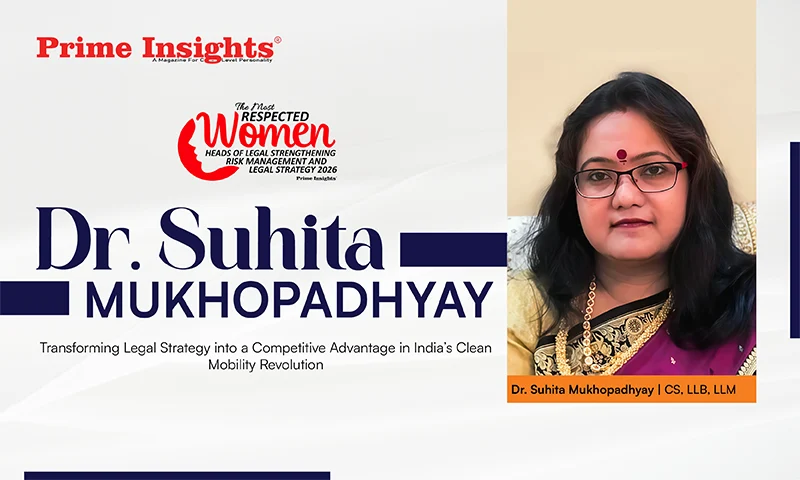
Dr. Suhita Mukhopadhyay
Did you know that in the high-stakes world of heavy-duty transport, a single long-haul truck can emit as much carbon as dozens of passenger cars? This stark reality has turned the clean mobility sector into a modern-day “Gold Rush,” where the competition is no longer measured in horsepower but in “green power.” In this quickly shifting landscape, the greatest challenge isn’t just engineering—it is navigating a labyrinth of global ESG mandates and evolving environmental laws. To survive, an organization needs more than just a legal expert; it needs a visionary who can turn regulatory complexity into a competitive edge.
Stepping into this pivotal role is Dr. Suhita Mukhopadhyay (CS, LLB, LLM), a leader whose career has been defined by the transition from compliance professional to governance architect. Currently serving as the head of Legal & Compliance and company secretary at Blue Energy Motors Limited, Dr. Mukhopadhyay’s journey is a masterclass in professional evolution. From her early days grounding herself in corporate governance with listed entities to her defining tenure as the company secretary of the Calcutta Stock Exchange, she has consistently proven that resilience and strategic judgment are the hallmarks of a true business leader. Her experience appearing before India’s dedicated corporate law tribunals, the NCLT and NCLAT, has sharpened a unique ability to handle high-stakes restructuring and crisis management with surgical precision.
As an entrepreneurially minded leader, Dr. Mukhopadhyay views the legal domain not as a restrictive control function but as a strategic enabler of innovation. Her leadership at Blue Energy Motors—at the intersection of Mumbai’s financial strategy and Pune’s manufacturing excellence—focuses on building “future-ready” frameworks. Whether she is structuring complex M&A risk allocations, navigating SEBI compliance for fundraising, or integrating AI-driven LegalTech to streamline operations, her goal remains the same: making sure that growth is resilient, ethical, and commercially aligned. She stands as a bridge between rigid law and agile business, proving that a strong legal voice is essential for any company aiming to lead the sustainable revolution.
In the spotlight is Dr. Suhita Mukhopadhyay (CS, LLB, LLM), featured in our prestigious “The Most Respected Women Heads of Legal Strengthening Risk Management and Legal Strategy—2026” edition. Learn from her insights and the valuable lessons she has gathered as a leader to help your organization excel and reach its peak. Stay tuned to discover her remarkable tale of success.
Prime Insights: Can you share your professional journey and what inspired you to pursue a leadership role in the legal domain?
I began my professional journey with listed companies as a company secretary and compliance officer, where I developed a strong grounding in corporate governance, regulatory compliance, and board processes. Working closely with senior management and boards early in my career gave me deep insight into how legal strategy directly influences business direction and risk management.
Over the years, my career evolved across leading legal firms and major listed entities, allowing me to experience both advisory and litigation roles. I practiced corporate law and appeared before key tribunals, including the National Company Law Tribunal (NCLT) and the National Company Law Appellate Tribunal (NCLAT). Appearing before India’s first dedicated corporate law tribunals enriched my legal perspective and strengthened my ability to handle complex corporate restructuring, insolvency, and governance matters. It also sharpened my courtroom strategy, analytical thinking, and crisis-management skills—capabilities that are essential for legal leadership.
A defining leadership milestone in my journey was serving as the company secretary of the Calcutta Stock Exchange for nearly three years. In this role, I was not merely ensuring statutory compliance; I was entrusted with institutional governance, regulatory interface, policy advisory, and stakeholder confidence. Managing regulatory scrutiny, board-level decision-making, and market integrity responsibilities required strategic judgment, ethical leadership, and resilience. It was here that I transitioned from being a compliance professional to becoming a governance leader.
My aspiration to contribute at a larger strategic platform brought me to Mumbai, India’s financial capital, where I joined Blue Energy Motors—an organization driving sustainable mobility. In my leadership role in the legal domain, I view legal not as a control function but as a strategic enabler. I work at the intersection of law, business, sustainability, and regulatory foresight—making sure that growth is compliant, contracts are commercially aligned, risks are anticipated, and governance frameworks are future-ready.
Prime Insights: What key experiences shaped your expertise in risk management and corporate legal strategy?
My expertise in risk management and corporate legal strategy is built on a foundation of hands-on leadership within listed entities and advocacy before tribunals like the NCLT. I specialize in translating complex statutory requirements into actionable internal controls, ensuring governance standards align with evolving regulatory frameworks.
Throughout my career, I have navigated high-stakes fund-raising initiatives, including IPOs and private equity placements, where I managed disclosure risks and transaction structuring under SEBI guidelines. My experience extends to complex M&A and restructuring, where I create value by identifying tax, contractual, and litigation risks early. By expertly negotiating indemnity structures and risk allocation mechanisms, I balance commercial objectives with robust legal safeguards. Ultimately, I add legal acumen with financial strategy to foresee dispute triggers and minimize post-closing exposure.
Prime Insights: How do you align legal frameworks with overall business objectives to drive sustainable growth?
Aligning legal frameworks with business objectives at Blue Energy Motors, particularly in the clean mobility sector (LNG and EV manufacturing), requires integrating regulatory compliance, strategic foresight, and commercial enablement into a unified legal approach. The legal team under me helps in structuring growth through strategic contracts.
As an OEM in LNG and EV manufacturing, contractual architecture plays a key role in managing risks to drive sustainable growth. We have to draft supply chain agreements with strong risk allocation and quality controls and structure dealership, fleet partnership, and financing agreements to align with commercial scalability. Legal strategy here focuses on reducing operational disruptions while enabling aggressive market penetration.
Moreover, sustainable growth in a capital-intensive manufacturing sector depends on investor trust. We as a legal team make sure of transparent governance and disclosure standards, which strengthens board processes and ESG reporting frameworks. In essence, legal strategy supports not just regulatory adherence but also scalable, resilient, and policy-aligned growth.
Prime Insights: What are the major legal and regulatory challenges organizations face today, and how do you proactively mitigate them?
Organizations today operate in a rapidly evolving regulatory and business landscape where legal risk is multidimensional. Constant amendments in corporate, securities, environmental, and tax laws create uncertainty and increase compliance complexity—especially for listed and high-growth companies. Proactive mitigation includes establishing a regulatory monitoring cell with periodic legal updates, maintaining dynamic compliance dashboards, and conducting quarterly compliance audits. Environmental, Social, and Governance (ESG) obligations are no longer voluntary. Clean energy and manufacturing companies face strict environmental scrutiny and sustainability disclosures. We integrate environmental compliance into operational SOPs.
We also have to deal with contractual & supply chain risks, for which we draft robust indemnity and limitation clauses and include force majeure and contingency planning provisions. Strong contractual architecture prevents disputes and margin erosion. Governance & Board Accountability is a challenge that is mitigated by strengthening board processes and documentation. In essence, legal leadership today is about building resilient frameworks that protect the organization and help sustainable expansion in an increasingly regulated world.
Prime Insights: How has the role of a Head of Legal evolved in the last few years, especially in a rapidly changing regulatory environment?
The role of a head of legal has evolved significantly recently—shifting from a traditional compliance gatekeeper to a strategic business partner, risk architect, and governance leader. In a rapidly changing regulatory environment, the transformation is both structural and strategic. The Head of Legal increasingly serves as a trusted advisor to the Board and senior leadership by interpreting fiduciary duties and governance risks, making sure that documentation withstands regulatory and investor scrutiny. In sectors like clean energy and manufacturing, legal leadership now oversees ESG disclosures and a sustainability-linked governance framework. The Head of Legal now plays a central role in structuring M&A and restructuring transactions, negotiating risk allocation in high-value contracts, and supporting capital raising. Over the last few years, the head of legal has evolved from a compliance-focused custodian to a strategic risk leader, governance architect, and business enabler.
Prime Insights: Can you share a significant case or situation where your legal strategy protected the organization from major risk exposure?
I led a governance review during a restructuring and capital raise before the IPO. The review found major risks, such as undocumented related-party transactions, unclear indemnity clauses, and compliance gaps in subsidiaries. Recognizing that these could delay our listing or erode investor confidence, I initiated a comprehensive rectification plan. By regularizing filings and implementing structured policies before regulatory vetting, I made sure of governance defensibility. This proactive strategy protected our valuation and directors from scrutiny, transforming potential liabilities into a transparent framework that secured a successful transition toward public listing and private equity infusion.
Prime Insights: How do you collaborate with other C-suite leaders to integrate legal considerations into business decision-making?
Collaborating with C-suite leaders to add legal considerations into business decision-making needs positioning the legal function as a strategic enabler, not a control checkpoint. Legal must be involved at the ideation stage—not post-decision. With the CFO, collaboration focuses on capital raising, disclosures, and investor communication.
With operations leadership, I align contractual protections with operational realities. Working with the CHRO helps in strengthening the code of conduct and whistleblower mechanisms, managing employment litigation risk, and conducting ethics and compliance training. Instead of saying, “This cannot be done,” I frame it as, “Here are the risks, here are the safeguards, and here is the most defensible way forward.” Effective collaboration with the C-suite transforms legal from a reactive advisory function into a strategic growth partner, a risk architect, and a governance stabilizer.
Prime Insights: What role does technology (LegalTech, AI, contract automation, and compliance tools) play in enhancing efficiency and risk control?
Technology plays a critical role in improving efficiency, transparency, and risk management in corporate legal and compliance functions. It helps in contract lifecycle management, faster legal research and analysis, and helps in identifying contractual risks and compliance gaps. Compliance software helps companies to track regulatory obligations, maintain policy registers, monitor statutory filings, and generate compliance alerts. Digital platforms maintain complete audit trails of approvals, edits, and document history, which enhances accountability and facilitates internal and external audits. AI tools help in reviewing thousands of documents during due diligence or investigations, identifying key risks, obligations, and inconsistencies.
Overall, the integration of LegalTech and AI strengthens corporate governance by making sure of greater transparency, faster processes, and improved compliance oversight.
Prime Insights: What steps do you take to promote ethical governance and transparency within your organization?
For promoting ethical governance and transparency, I make sure of the implementation of the following:
I build a robust governance framework by ensuring the adoption and periodic review of key governance policies, which include:
- Code of Conduct
- Risk Management Policy
- Whistleblower Policy
- Related Party Transactions Policy
- Anti-Bribery and Anti-Corruption (ABAC) Policy
These policies clearly define expected ethical standards and decision-making principles.
Leadership Commitment: Senior management and the Board reinforce ethical behavior through the following:
- Leadership communications
- Ethical decision-making expectations
- Zero-tolerance stance on misconduct.
Ethics is positioned as a business priority, not merely a compliance requirement.
Strong Compliance and Internal Control Systems: Making sure of a structured compliance framework supported by internal audits, risk assessments, and monitoring mechanisms.
Ethics Training and Awareness: Arranging periodical training on ethics, anti-corruption, and responsible conduct as well as arranging for periodic awareness campaigns.
Conflict of Interest Management: Getting annual disclosures from employees and senior management, placing them before the Board and Audit Committee for review, and monitoring related party transactions.
We make sure of the integrity of third parties by conducting due diligence on vendors, consultants, and partners, and incorporating ethical and anti-corruption clauses in contracts.
Prime Insights: As a woman leader in the legal domain, what challenges have you overcome, and what strengths have contributed to your success?
Navigating the legal domain within the fast-evolving automotive and clean energy sectors has required deep resilience and strategic agility. As a leader in a traditionally male-dominated, operations-driven environment, I have worked to change the legal function from a risk guardian to a proactive business partner. By balancing robust governance with the speed of innovation in electric mobility, I ensure compliance supports sustainable growth. My journey is defined by mastering dynamic regulatory frameworks and fostering cross-functional cultures where integrity and strategic thinking drive long-term corporate success.
Prime Insights: What advice would you give to aspiring women legal professionals aiming to lead in risk management and corporate law?
My advice to aspiring women legal professionals is to go beyond legal knowledge and develop strong business acumen, understanding strategy, finance, and industry dynamics. Embrace technology such as LegalTech, AI, and data-driven compliance tools, as they are shaping the future of risk management.
It is equally important to think proactively about risks, communicate complex legal issues with clarity, and continuously update yourself on evolving regulations, ESG, and emerging sectors. Above all, lead with integrity, build strong professional networks and mentorships, and have the confidence to contribute your voice at leadership tables. The future legal leader is someone who combines legal expertise, strategic thinking, technology awareness, and ethical leadership.
