

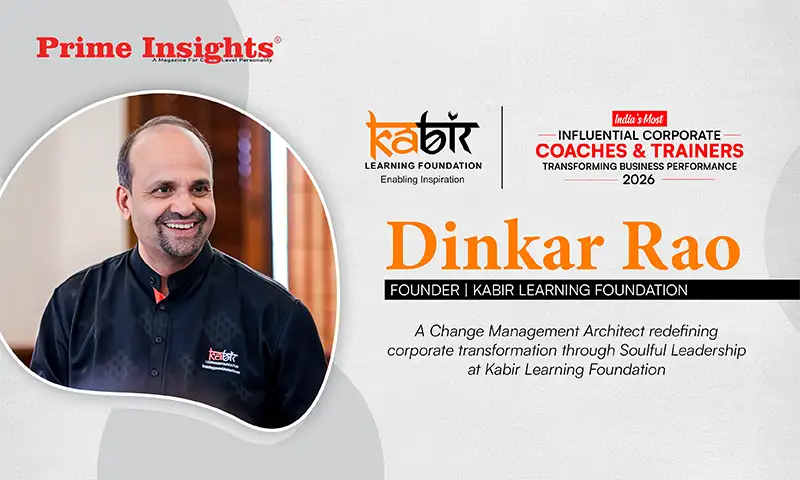
Dinkar Rao | Kabir Learning Foundation
Did you know that the average corporate professional spends nearly one-third of their career in meetings or training sessions, yet a staggering 70% of employees feel they haven’t mastered the skills needed to do their jobs effectively? It’s a classic corporate paradox: we are constantly “learning,” but rarely transforming. In an era where “Zoom fatigue” is a literal medical discussion and generic slide decks go to die in unopened email folders; the coaching industry has reached a breaking point.
Organizations are no longer looking for a teacher with a pointer; they are looking for a “Change Architect” who can perform open-heart surgery on a company’s culture without stopping the clock.
The corporate coaching and training industry has evolved into a high-stakes battlefield where survival depends on more than just “checking boxes.” In an era of rapid digital disruption and shifting workforce dynamics, the competition among consultancy firms is fierce. Organizations no longer seek generic seminars; they demand architectural transformations that bridge the gap between boardroom strategy and basement execution. This environment requires a rare breed of leader who can navigate human egos while maintaining the moral courage to be “politically incorrect” for the sake of institutional health.
Stepping into this void is Dinkar Rao, the visionary founder of Kabir Learning Foundation. With a professional odyssey spanning over two decades, Rao’s journey began in multinational consulting across Europe and the Americas before he ascended to the position of Managing Director and Partner. In 2015, he transitioned from the corporate ladder to entrepreneurship, driven by a philosophy that leadership is only successful when it remains deeply “soulful” and human centric. His background as a postgraduate engineer (MTech -Mineral Engineering) from the prestigious Indian School of Mines- Dhanbad (Now IIT Dhanbad), combined with early exposure to MSME boardrooms, has shaped him into a leader who views business growth as a balance of sales circulation and organizational nervous systems.
Kabir Learning Foundation operates through a specialized ecosystem to address specific organizational needs. Rather than relying on rigid, cookie-cutter templates, the firm functions like a diagnostic clinic. The methodology centers on intense, multi- stakeholder research to identify “catalysts” within a company. By blending the Japanese philosophy of Kaizen with customized KPIs, the team ensures that transformation isn’t just an idea,
But a disciplined execution that has helped clients liquidate inventory years ahead of schedule and scale manufacturing giants tenfold.
In the spotlight is the founder of Kabir Learning Foundation, Dinkar Rao in an interview of our prestigious India’s Most Influential Corporate Coaches & Trainers Transforming Business Performance – 2026 edition. Learn from his insights and valuable lessons as an entrepreneur to excel and make it the best company. Stay tuned and know his tale of success.
Prime Insights: Can you introduce yourself and share your professional journey into executive coaching and leadership development?
I have been in the space of leadership enablement for more than fifteen—rather twenty—years now. My journey started with multinational consulting organizations, mostly based out of the European part of the world, though I was operating from India.
Over the years, my movement happened from sales leadership development and cross-functional leadership development to board-level, CXO-level coaching, and CEO coaching. All this happened in the first ten years of my consulting career.
During this tenure, I worked on both global and Indian projects, which gave me a strong exposure to how leadership development happens across different continents—Europe and the Americas. I also grew in my roles—from consultant to senior consultant to partner to managing director.
This foundation helped me understand how global consulting and coaching practices operate. I have worked with top organizations like Capgemini, Volvo, and Husqvarna, delivering strategic organizational leadership development programs.
Around 2015, I made a major transition and decided to start my own track. I founded three companies—Groval Eulers, Groval Selectia, and Kabir Learning Foundation Foundation.
Groval Euler’s focuses on sales capability development—like the blood circulation of an organization, ensuring business growth.
Groval Selectia focuses on cross-functional capability development—like the nervous system of the organization.
The third company, Kabir learning foundation works on building soulfulness in leadership, because leadership is successful only when people are deeply human and connected.
Today, I position myself as a business transformation coach, also known as a change architect or organizational development architect.
Prime Insights: What inspired you to pursue leadership enablement and organizational transformation?
My career began before consulting, working with MSMEs and small enterprises. Right from the time I was a junior professional, I saw a huge need for transformation.
In my first job, I reported directly to the executive director of a steel plant. As a young postgraduate engineer, that exposure helped me understand how the boardroom thinks. I was given a challenging technical problem and told to focus only on solving it for three months. That level of empowerment shaped my thinking.
Later, I worked with a successful MSME , where at a young age of 25 years, I was entrusted with building the pan-India business for a newly developed product envisioned as a game changer in the Indian market. This role required me to design the roadmap from scratch— shaping the sales culture, defining growth objectives, and driving execution on the ground.
This experience strengthened my confidence and gave me a deeper insight: organizations often need transformation, even if they don’t explicitly call it that.
Over time, I realized I had the ability to navigate human potential, manage egos, and build influence. That is essentially the job of a coach.
At the age of 32, I was at a crossroads—either start my own company or join a multinational. I initially started my own venture but within three months got an opportunity with a multinational consulting firm, which gave me deep exposure to global consulting practices.
That experience eventually led me to start my own companies in 2015.
Prime Insights: How do you define effective corporate training in today’s dynamic business environment?
In today’s environment, unfortunately, coaches think that they need to be politically correct. However, they need to be many a times politically incorrect; As they must do what is good for the organization, not just what is comfortable for the people who have given them the mandate. Coaches need to be thought provoking and capable of challenging status quo.
A coach needs the moral courage to advise and implement changes—even when it is difficult for leadership to accept. Transformation happens when even the board is challenged.
The change must happen across all layers—from the boardroom to the basement. Also, the coach must be agile and should not carry baggage. At the same time, the coach must remain open to change as well.
Prime Insights: What key challenges do organizations face in improving workforce performance and professional skill?
The challenges begin right from defining the problem statement. How accurately the problem is defined and then executed with patience—these are major challenges.
Human resistance is always present. In our country, the biggest challenge is not ideation but execution. Ideas are plenty, but execution requires discipline and consistency.
The second challenge is sustaining intent—ensuring that what is agreed upon gets implemented.
The third challenge is identifying the right people within the organization. Often, people are selected based on how well they perform in interviews, but what really matters is their ability to execute.
So broadly, the three challenges are:
- Agreeing on a common idea
- Executing it with discipline
- Identifying the right people
Prime Insights: What methodologies or frameworks do you use to create impactful training programs?
We have multiple customized frameworks as part of our IP, but we don’t rely heavily on standardized frameworks.
One globally known principle we use is Kaizen—the Japanese philosophy of continuous improvement. It focuses on consistent and precise improvement across processes.
However, our focus is more on what works for the organization rather than applying a fixed framework. Like a doctor, we diagnose first and then decide what is needed.
Prime Insights: How do you customize your coaching for different industries and organizational needs?
It begins with intense research—multi-stakeholder research. We talk to people across levels: senior leaders, employees, and even channel partners.
This helps us build relevance. The quality of the program depends on the depth of research.
It is like a tailor—good tailoring depends on taking the right measurements.
Prime Insights: How do you help organizations build high-performance teams and strong workplace culture?
It is a long process and depends on where the organization currently stands. The key is:
- Understanding the context
- Focusing on the right priorities
- Staying persistent and patient
We also identify the “catalysts” within the organization—people who are deeply committed to change. Working closely with such people helps drive transformation.
Like a cricket coach, you identify players who truly want to win for the team and then work closely with them.
Prime Insights: Can you share a success story where coaching created measurable business transformation?
One example is from a real estate company where the numbers were very low and the team was small.
We focused on one aspect—personalization. We improved how they engaged with customers before, during, and after the sale.
They expected to sell their inventory by 2028, but we helped them liquidate it in nearly half the time.
Another example is from manufacturing, where a company grew 10x in five years. People who were part of the organization earlier are now in senior roles.
In the IT space, we built strong presales, sales, and leadership teams from scratch, and the results are now showing positively.
Prime Insights: How do you integrate technology and AI into training?
Technology is important, but it cannot override human capability.
We use technology as a tool, but we don’t let it dominate human decision-making. The goal is to help people use technology effectively, not become dependent on it.
Prime Insights: What roles do mindset and emotional intelligence play in professional growth?
Mindset is the oxygen of business. Without it, business cannot thrive. Everything in transformation revolves around mindset.
Emotional intelligence gives credibility. Without it, success may be short-term, even if you have knowledge.
In today’s world, both AI and soulfulness are important.
Prime Insights: How do you measure the effectiveness and ROI of your coaching programs?
We design KPIs based on the organization’s needs. These are not standard KPIs—they are created during the research stage.
We then track progress month-on-month.
Prime Insights: What are your future plans for expanding your initiatives?
Our focus is on creating more “catalysts” within organizations—people who can sustain and drive change.
We aim to build a pool of such individuals and ensure that each project has at least two to three strong catalysts.
Prime Insights: What advice would you give to professionals and organizations aiming for continuous learning and excellence?
Be unorthodox. Do not follow a cookie-cutter approach.
Be creative and don’t get carried away by what works for others.
What works for you may be completely different.
Listen to your inner voice and build your own path.
