

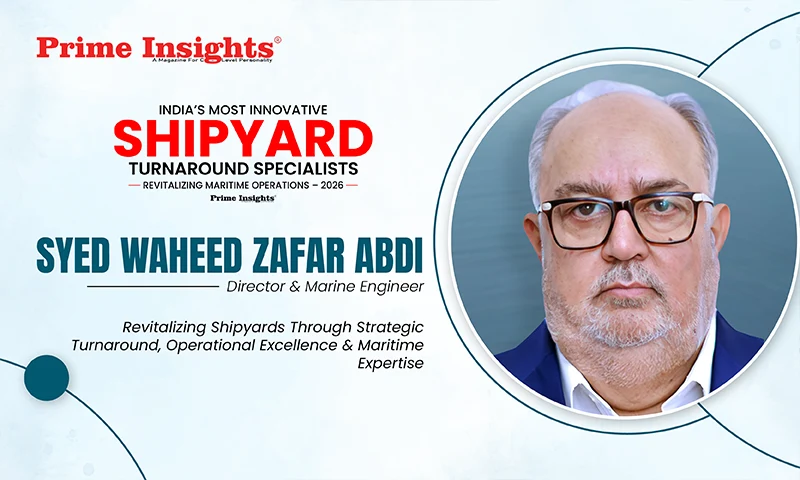
Syed Waheed Zafar Abdi
A single large container ship can carry thousands of containers in one voyage, connecting businesses, industries, and consumers across continents. But behind every such voyage is a highly complex shipyard ecosystem that keeps vessels safe, efficient, and seaworthy. The maritime and shipyard industry is therefore far more than steel, machinery, and massive vessels—it is a high-stakes, capital-intensive sector where engineering precision, skilled manpower, timely execution, cost control, and operational excellence determine success. As global trade expands and India strengthens its maritime ambitions, shipyards are under growing pressure to modernize, optimize resources, overcome financial and operational challenges, and deliver projects safely, on time, and within budget. In this competitive landscape, turnaround specialists have become instrumental in transforming stressed or underperforming shipyards into sustainable, high-performing businesses.
At the forefront of this transformation is Syed Waheed Zafar Abdi, a Marine Engineer from the prestigious Directorate of Marine Engineering Training (DMET), Kolkata, whose remarkable career spans nearly five decades across merchant shipping, ship repair, newbuilding, superyachts, shipyard management, restructuring, and consulting. After sailing in the merchant marine for nearly 15 years, he went on to hold leadership roles with Dubai Drydocks, Drydocks World–Singapore and South East Asia, and ABG Shipyard, gaining first-hand experience in major restructuring and turnaround processes. These experiences ultimately inspired him to establish Raufar Turnaround Specialists Private Limited (Raufar TSPL) in 2019 with his wife, with a vision to create sustainable businesses rather than temporary improvements. His entrepreneurial philosophy emphasizes putting the right people in the right roles, disciplined execution, strong controls, continuous learning, and the courage to take tough and timely decisions.
Raufar TSPL provides end-to-end expertise across the shipyard turnaround and maritime ecosystem, covering shipyard revival and development, restructuring and operational turnaround, greenfield and brownfield development, feasibility studies, strategic advisory, M&A support, capacity enhancement, and drydocking and repair facilitation. Its approach brings together HR, technical, commercial, financial, legal, operational, and HSEQ functions to identify gaps, strengthen processes, optimize resources, and build lasting operational resilience. Backed by Abdi’s extensive exposure across India, the Middle East, and the Far East, the organization combines strategic insight with practical, on-ground maritime expertise.
In the spotlight is Syed Waheed Zafar Abdi in an interview for our prestigious India’s Most Innovative Shipyard Turnaround Specialists Revitalizing Maritime Operations – 2026 edition. Through his insights, entrepreneurial journey, and valuable lessons in leadership and operational excellence, discover what it takes to navigate challenges, transform businesses, and build a company designed for sustainable success. Stay tuned to know his tale of success and the wisdom behind his journey in revitalizing maritime operations.
Prime Insights: Can you introduce your organization and share its core mission in shipyard turnaround and maritime operations?
I am a Marine Engineer from the prestigious Directorate of Marine Engineering Training (DMET), Kolkata, from the 1974–78 batch. I sailed in the merchant marine for nearly 15 years, primarily with a Norwegian-owned shipping company, working on bulk carriers and tankers.
In 1994, I joined Dubai Drydocks, one of the leading ship repair yards in the Middle East and a globally recognised name in ship repair. Starting as a Ship Repair Manager, I later moved into vessel newbuilding, including tugs and service vessels, and subsequently headed the Pipe Department, where I led a significant improvement in efficiency.
Around 2005, Dubai Drydocks came under the Dubai World umbrella, and I moved into the superyacht industry, contributing to the completion of what was then the world’s longest yacht. I subsequently worked in composite boat building in Jebel Ali, UAE.
In 2009, I moved to Singapore to head Drydocks World–Singapore (Tuas), which was engaged in ship repair and newbuilding of offshore support vessels and similar vessels. Following Dubai Drydocks’ acquisition of Pan United and Labroy in Singapore and Batam, Indonesia, I became a Board Director of Drydocks World–South East Asia while simultaneously serving as Director–Project Management.
During the downturn in the shipyard industry, Drydocks World–South East Asia underwent a merger and acquisition process. As a Board Director, I was deeply involved in the M&A process alongside lender banks, legal advisors, and international consulting firms.
In 2013, I returned to Drydocks World–Dubai as Director for Engineering, Project Management, and Technical Divisions. I was subsequently approached to head ABG Shipyard’s Mumbai office. which I joined in early 2014 During my initial tenure, ABG entered Corporate Debt Restructuring (CDR), and I was again involved in the restructuring process alongside financial lenders, international restructuring and operations turnaround consultants, concurrent auditors, and lenders’ independent engineers.
After leaving ABG Shipyard in 2016, I worked with consulting companies primarily serving the shipyard sector. By then, I had developed a strong passion for shipyard restructuring and operational turnaround. This led me to establish Raufar Turnaround Specialists Private Limited (Raufar TSPL) in 2019, with my wife and me serving as the only Directors.
Prime Insights: What inspired the establishment of your company, and how has your journey evolved in the maritime industry?
My inspiration came largely from my experiences at Drydocks World–Singapore and South East Asia and ABG Shipyard, both of which underwent extensive restructuring processes that ultimately involved M&A.
Shortly after establishing Raufar TSPL in May 2019, I was approached by a major Middle Eastern shipyard for an operational excellence assignment. I assembled a team comprising experienced commercial and human resources professionals, and we worked together on-site. The assignment successfully improved cost optimisation and processes, with a positive impact on the organisation’s bottom line.
Since then, our journey has expanded across a wide range of shipyard-related projects, including:
- Shipyard revival and development: Feasibility studies, site selection, master planning, infrastructure development, equipment planning, installation, operational readiness, and handover.
- Restructuring and operational turnaround: Supporting financially stressed shipyards through operational and organisational transformation.
- Greenfield shipyard development: Technical, commercial, and financial feasibility studies, business plans, risk assessment, mitigation strategies, and identification of optimal business verticals.
- Strategic advisory and investment: Market analysis, M&A support, CAPEX and OPEX projections, and ROI assessment.
- Brownfield shipyard restoration: Restoring shipyards with historically low activity and bringing them toward operational readiness.
- Capacity enhancement: Optimising operational, commercial, and financial processes, including commercial controls and monitoring.
- Drydocking and repair facilitation: Providing ship owners with end-to-end support through a global network of associate shipyards, including tender evaluation, techno-commercial assessment, coordination, and negotiations.
The underlying objective across all these assignments remains the same: to create sustainable businesses rather than temporary improvements.
Prime Insights: What are the most common challenges shipyards face today, and how does your organisation help overcome them?
One of the most important lessons I have learned throughout my career is that Human Resources underpins the entire organisation.
An effective organisation structure with the right people in the right positions is critical—essentially, “horses for courses.” This is particularly important at the CEO or Managing Director level, where I have seen significant gaps in several organisations.
Because shipyards are labour-intensive businesses, a clearly defined RACI (Responsible, Accountable, Consulted, Informed) matrix should be embedded into the organisation. It creates ownership, time-bound deliverables, and stronger communication, collaboration, control, command, and cooperation. This should work alongside clearly defined KRAs and KPIs/KPOs.
Shipyards also need an optimal mix of permanent employees and subcontractors because manpower requirements fluctuate by project stage and trade. Manpower histograms can help monitor requirements across steel and hull, piping, mechanical, electrical, instrumentation, and other departments.
Another important area is man-hour control and monitoring aligned with an appropriate Work Breakdown Structure (WBS). This enables better resource planning, execution, and corrective or preventive action.
Timely delivery of repair and newbuilding projects is another major challenge, particularly in India. Winning orders is only the beginning; the real test lies in execution—delivering on time, within budget, safely, and to the required quality and environmental standards.
Cash is king. Effective monitoring of cash flows, including both fund-based and non-fund-based facilities such as bank guarantees and letters of credit, is essential.
Overhead control is equally important, particularly when newbuilding gross margins are limited. Greenfield shipyards must also be designed with flexible, expandable infrastructure and optimal workflows.
Consultants, when engaged, should support management rather than drive the organisation. As Carlos Ghosn noted in Turnaround, “the solution lies within the company.”
A strong legal function with techno-legal expertise is also essential, as legal gaps can create delays across business development, marketing, and operations. Finally, an effective ecosystem of subcontractors, vendors, service providers, logistics partners, and international shipyard collaborators is critical to sustainable performance.
Prime Insights: What differentiates your company from other service providers in the maritime and shipyard sector?
The biggest differentiator is my profile, exposure, and experience across the maritime and shipyard ecosystem.
Having sailed with commercial shipping companies, I understand the language and priorities of ship owners and managers. My shipyard experience spans the Middle East, Far East, and India, supplemented by visits and assignments across shipyards in China, Vietnam, the Middle East, and India.
My experience as both a professional and consultant has also been significant. I have worked alongside prominent international consulting firms such as McKinsey, Alvarez & Marsal, AlixPartners, Deloitte, and Lloyd’s Register Consulting, as well as international legal firms, financial institutions, banks, NBFCs, and organisations involved in TEV studies, pre-feasibility studies, and DPR preparation.
This combination of hands-on operational exposure, consulting experience, and macro- and micro-level understanding gives Raufar TSPL a distinctive perspective. Ultimately, our completed and ongoing project portfolio reflects this experience.
Prime Insights: Can you highlight a major project or milestone that showcases your expertise in revitalising maritime operations?
One of my early assignments was with one of the largest shipyards in the Middle East, covering HR, technical, commercial, finance, legal, operations, and maintenance. It was a particularly gratifying engagement because the results were tangible and included clearly defined improvements that contributed to a more sustainable business.
Another significant assignment involved working with the top management of one of India’s largest shipyards. Beginning with comprehensive business planning, the engagement progressed through restoration and ultimately toward operational readiness. Both assignments provided considerable professional satisfaction.
Prime Insights: How do you leverage technology, automation, and digital tools to improve shipyard productivity and performance?
Compared with several other manufacturing industries, shipyards still lag in the implementation of technology, automation, and digitisation. However, the industry is moving rapidly in this direction.
Key areas include:
- Productivity enhancement and automation
- Effective dashboards for process control and monitoring
- pricing based on workload and market conditions
- Risk assessment and mitigation
- AI-enabled processes to consolidate multiple documents, eliminate duplication, and optimise resources
- Effective and meaningful ERP implementation
The objective should not be technology for its own sake, but technology that delivers measurable operational improvement.
Prime Insights: What role does strategic planning play in reducing downtime and enhancing operational efficiency during turnaround projects?
Strategic planning is important, but dynamic execution is paramount. Planning must be supported by effective controls and continuous monitoring so that corrective action can be taken whenever required.
Prime Insights: How do you ensure quality, safety, and regulatory compliance across complex maritime projects?
A sensible and effective HSEQ culture and strong corporate governance must be woven into the fabric of the shipyard—not merely mentioned in policies, but demonstrated through on-ground compliance.
Simply stating that “safety is our highest priority” has little meaning unless safety becomes part of the day-to-day culture.
Meaningful safety inductions, Tool Box Talks (TBTs), Vessel Safety Coordination Committees (VSCCs), recognition of HSEQ high performers, and a coaching and support culture can significantly strengthen compliance and safety performance.
Prime Insights: Can you share a success story where your solutions significantly improved a client’s shipyard operations or vessel performance?
The operational excellence assignment with the large Middle Eastern shipyard mentioned earlier is a strong example. The project involved multiple functions and supported the shipyard in its journey from “Good to Great.”
The improvements achieved across HR, technical, commercial, financial, legal, operations, and maintenance functions contributed to measurable operational enhancement and a more sustainable business model.
Prime Insights: How do you manage workforce training, technical expertise, and resource optimisation in large-scale projects?
It begins with an effective and meaningful organisation structure, followed by appropriate recruitment, induction, clearly defined responsibilities, RACI matrices, WBS, manpower histograms, strategic planning, and continuous monitoring.
Effective dashboards and purposeful meetings are also essential. Meetings should be conducted to achieve clearly defined outcomes rather than becoming routine exercises.
For large-scale projects, a matrix organisation structure can effectively integrate with functional and hierarchical structures. Resource optimisation can then be strengthened through workforce upskilling, multi-skilling, and effective resource deployment.
Prime Insights: What sustainability initiatives do you incorporate into your turnaround and maintenance services?
Sustainability is closely connected to effective HR, commercial, and financial controls, as well as strong contract awareness among all stakeholders.
I have encountered situations where excellent productivity alone could not deliver the desired result because contractual obligations and implementation were not adequately understood. Therefore, sustainable performance requires all functions to work together rather than treating sustainability as a standalone initiative.
Prime Insights: How do you stay ahead of emerging trends and technological advancements in the maritime industry?
Continuous learning is essential. I spend considerable time reading, interacting with global shipyards, and educating myself about emerging trends and technical and digital developments.
These include developments in alternative fuels, shipyard infrastructure, facilities, machinery, and other technologies.
I also believe in learning beyond the shipyard industry. For example, visiting a large stainless-steel plant and a precision machining and engineering organisation recently broadened my understanding of processes and technologies that could potentially be adapted or improved within shipyard operations.
Prime Insights: What are your future plans for innovation, expansion, and strengthening India’s maritime infrastructure by 2026 and beyond?
The Government of India is providing considerable support and incentives to the shipbuilding and shipyard sector through initiatives such as Maritime India Vision 2030 and Maritime Amrit Kaal Vision 2047.
The development of shipyard clusters is an ambitious initiative and could become an important engine of economic growth. However, there are important lessons to be learned from the financial stress experienced by several major Indian shipyards.
As the saying goes, “History teaches us that we do not learn from history.” We must therefore balance ambition with realism. There is a fine line between being realistic and being overly optimistic. The industry must have the courage to confront reality and take tough, timely decisions when required.
It is also important to recognise that commercial and defence shipyards operate very differently. Their management structures, processes, capabilities, and resources must therefore be aligned with the specific nature of their businesses.
Prime Insights: What advice would you give to shipyard operators and maritime stakeholders seeking to improve efficiency, reliability, and long-term operational excellence?
My first advice is to surgically review the key parameters required to execute the organisation’s vision and ensure alignment across all levels.
Conduct a comprehensive gap analysis, looking both inside-out and outside-in. Do not hesitate to take tough and timely decisions to rebalance resources or implement necessary corrective and preventive actions.
Most importantly, secure the buy-in of people at every level of the organisation toward the business objectives and their sustainable achievement.
If external consultants are required, evaluate each team member carefully before engaging them. The ideal team should combine deep generalists and subject-matter experts, with the right people assigned to the right requirements—again, “horses for courses.”
Finally, define time-bound deliverables, establish strong controls and monitoring mechanisms, and remain willing to change course when circumstances demand it.
Operational excellence is not achieved through a single intervention. It comes from disciplined execution, informed decisions, capable people, and the willingness to continuously improve.
