

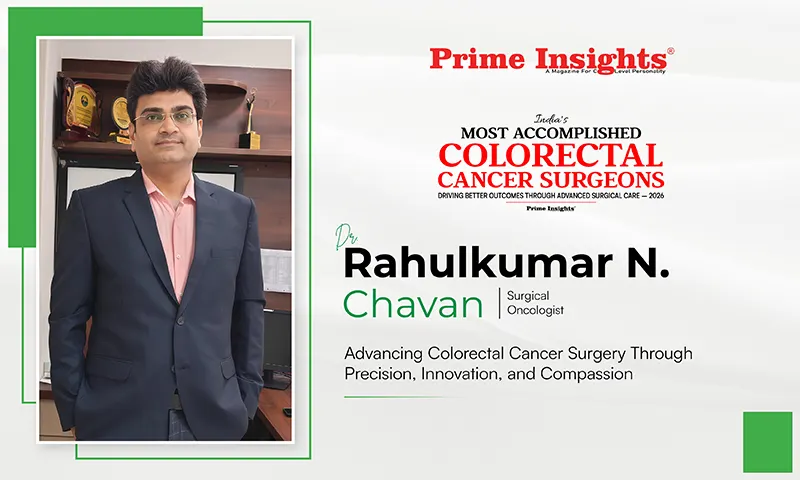
Dr. Rahulkumar N. Chavan
Did you know that colorectal cancer is among the fastest-growing cancers worldwide, with an alarming rise in cases among younger adults?
While medical science has revolutionized cancer treatment through robotic surgery, minimally invasive procedures, and precision medicine, the greatest challenge continues to be delayed diagnosis and a lack of awareness. Today, the field of colorectal oncology is more competitive and technologically advanced than ever, demanding not only exceptional surgical expertise but also continuous innovation, multidisciplinary collaboration, and compassionate patient care. Surgeons who embrace these advancements are transforming treatment outcomes, preserving patients’ quality of life, and redefining the future of cancer care.
Among these distinguished specialists is Dr. Rahulkumar N. Chavan, a renowned surgical oncologist practicing in Mumbai, whose career has been driven by a mission to improve colorectal cancer treatment in India. During his Master of Surgery (M.S.) at the prestigious IPGMER (Institute of Postgraduate Medical Education and Research), he witnessed numerous young patients battling colon and rectal cancers, an experience that inspired him to pursue an M.Ch. in Surgical Oncology from the country’s premier institution, Tata Memorial Hospital, Mumbai. By undergoing advanced training in colorectal surgery under some of India’s most accomplished specialists, Dr. Rahulkumar Chavan has established himself as an expert in personalized, organ-preserving cancer care. His journey reflects perseverance, continuous learning, innovation, and an enduring dedication to putting patients first—qualities that define exceptional leadership in modern healthcare.
Dr. Rahulkumar Chavan focuses on treating colorectal cancers with proven treatment methods, less invasive and robotic surgery, and tailored treatment plans. Every patient receives an individualized treatment plan based on the stage of the disease, age, overall health, and quality-of-life goals. His approach focuses not only on achieving the best possible clinical outcomes but also on raising awareness about early detection, regular screening, and timely intervention, enabling patients to lead healthier and more fulfilling lives after treatment.
In the spotlight is Dr. Rahulkumar N. Chavan in an exclusive interview for our prestigious “India’s Most Accomplished Colorectal Cancer Surgeons Driving Better Outcomes Through Advanced Surgical Care – 2026” edition. Discover his inspiring journey, remarkable achievements, and valuable insights into advanced colorectal cancer care, medical innovation, and patient-centric leadership. His story offers meaningful lessons on dedication, excellence, and lifelong learning for healthcare professionals, aspiring surgeons, and future leaders. Stay tuned and explore the inspiring tale behind his success.
Prime Insights: Could you introduce yourself and share your journey into colorectal cancer surgery?
I am Dr. Rahulkumar N. Chavan, a surgical oncologist practicing in Mumbai. While perusing my Mastery of Surgery (M.S.) from a reputed institute of North-east India, IPGMER (Institute of Post Graduate Medical Education and Research), I saw many young ones dying of colon and rectal cancer. The incidence of this particular cancer among all GI cancers is increasing. It gave me an inward drive to do my super-specialization in cancer surgery, M.Ch. Surgical Oncology, at the country’s premier institute, Tata Memorial Hospital, Mumbai. I worked extra in the colorectal surgery unit to enhance my experience in the treatment of these cancers.
Prime Insights: What inspired you to specialise in colorectal oncology, and what keeps you motivated in this field?
While working in the Tata Memorial Hospital, Mumbai, I noted colorectal cancer is the most common gastrointestinal-related cancer. It can affect people as early as their 20s to as late as 90. Compared to Western countries, a significant number of patients in India are from younger age groups, and not all of them can access facilities for excellent treatment. I worked extra in the colorectal surgery unit and trained under one of the country’s most experienced colorectal cancer surgeons.
Prime Insights: How have advancements in colorectal cancer surgery improved patient outcomes over the years?
Over the years many advancements have happened in the treatment of colorectal cancer in terms of advanced surgical techniques, modern drugs, modern radiation protocols and even investigation modalities. We know the disease far better compared to the last few years, also due to advancements in molecular science. Now, the goal of each patient’s treatment is personalized care. Once upon a time, the choice of treatment involved permanent sacrifice of the organ and colostomy, but now we can preserve the sphincter for the majority of patients and help them lead a normal life.
Prime Insights: What are the most common challenges you encounter while treating colorectal cancer patients?
Ignorance on the part of society is still the biggest problem in dealing with rising colorectal cancer incidence. For example, many people are unaware that if they are over 45 years old and experiencing altered bowel habits such as repeated constipation, diarrhea, black stool, or blood in their stool, these symptoms could indicate colon or rectal cancer. These symptoms do warrant urgent attention. In 15–20% of cases, this cancer can run in families. People still don’t know the importance of family history.
Prime Insights: How do minimally invasive and robotic-assisted procedures contribute to better surgical outcomes?
Minimally invasive surgeries have had a significant positive impact on patient outcomes. These surgeries enhance recovery, reduce blood loss and pain, minimize incisions, and increase precision. Robotic surgery has added extra precision while operating complex cases. Patients’ overall recovery is excellent; they can resume their normal activities far earlier compared to traditional open surgeries.
Prime Insights: What role does early detection play in improving survival rates and treatment success for colorectal cancer?
Early detection improves overall survival; the earlier the stage, the higher the survival overall in all cancers. Early detection also decreases the overall cost, and limited surgery may be feasible with it. Awareness of common clinical features, the role of colonoscopy, and family history will be crucial for early detection.
Prime Insights: How do you personalize treatment strategies for patients with varying stages and complexities of the disease?
In our centre treatment is personalized and individual-based depending upon his stage, age and performance status with the aim of enhancing the quality of life. Now, with the help of modern surgical techniques, surgery can also be customized; no longer is one type of surgery suitable for all patients. In complex cases where multi-visceral resection is needed, robotic surgery gives enhanced precision and improves quality of life.
Prime Insights: Could you share a memorable case or success story that had a significant impact on your career?
One middle-aged patient had a rectovaginal and vesicovaginal fistula. She was abandoned by many national-level standard institutes, but with some innovative techniques, I could cure her. She could void and urinate on her.
Prime Insights: Finally, what message would you like to share with readers about colorectal cancer awareness, prevention, and timely treatment?
I would like to stress that if one is suffering from an altered bowel habit, it needs evaluation. From age 45 onwards, one should undergo regular colonoscopy screening. If we have a family history of colon cancer, one should consult their surgical oncologist presently for further evaluation.
