

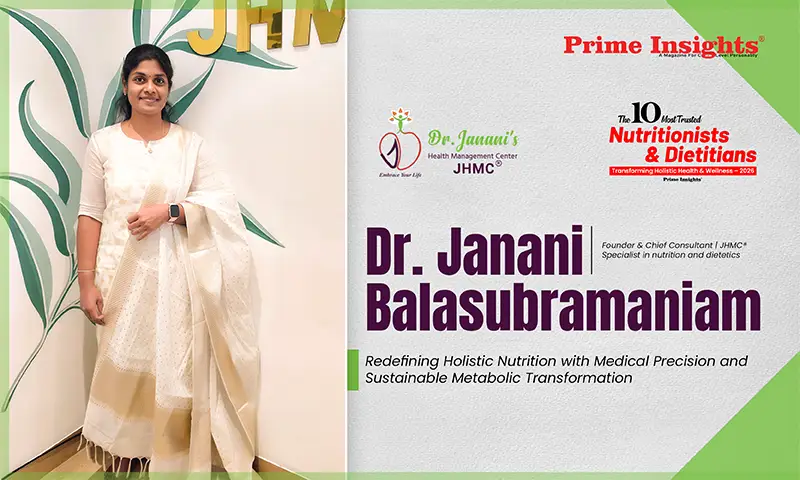
Dr. Janani Balasubramaniam | Dr. Janani’s Health Management Center (JHMC®)
Did you know the average person makes over 200 decisions about food every day, yet is only consciously aware of about 15? In a world of “scrollable” superfoods and 30-second diet hacks, our relationship with nutrition has become a noisy battlefield of misinformation. As the global wellness industry pivots from reactive “sick-care” toward proactive longevity, the competition is no longer just between brands—it is between fleeting fads and sustainable, scientifically-backed health. Today’s consumers are moving past “quick-fix” promises, instead seeking holistic, medical-grade interventions that integrate clinical expertise with advanced nutritional science to achieve permanent metabolic transformations.
At the forefront of this transformation is Dr. Janani Balasubramaniam, a distinguished medical practitioner and the visionary founder of Dr. Janani’s Health Management Center (JHMC®), established in Namakkal and Salem, Tamil Nadu. Holding an MBBS alongside an MS in Nutrition and Dietetics from Central Michigan University, USA, Dr. Janani bridges the gap between clinical medicine and functional nutrition. Her impressive credentials include a Fellowship in Diabetes Mellitus, certification as a Precision Nutrition Coach, and recognition as Healthpreneur of the Year 2022 by MTTV India (Digital Media News Channel) under the 100 India’s Ideal Women Awards. Driven by the philosophy that “Prevention is better than cure,” she pivoted from pediatrics to nutrition after witnessing how the “right diet” could reverse chronic conditions. Her journey is marked by academic excellence, including a published systematic review and a spot in the prestigious “Golden Society” at CMU.
JHMC® operates on a high-touch, people-centered model that treats food as the most potent medical tool. Rather than a traditional, rushed clinical environment, the center offers a private, warm space where patients undergo detailed history mapping and general examinations. By utilizing nutrigenetics, nutrigenomics, and the “Art of Eating by JHMC,” Dr. Janani creates bespoke plans for weight management, PCOD, and diabetes. The process involves clinical nutritional counseling aimed at making patients self-reliant “self-managers” of their own health, using medical drugs only as a last resort to ensure that the body heals from within.
In the spotlight is founder Dr. Janani Balasubramaniam in an interview for our prestigious The 10 Most Trusted Nutritionists & Dietitians Transforming Holistic Health & Wellness – 2026 edition. Learn from her insights and valuable lessons as an entrepreneur to excel and make your health the best it can be. Stay tuned and know her tale of success.
Prime Insights: Can you introduce yourself and share your core philosophy toward nutrition and holistic wellness?
I am Dr. Janani Balasubramaniam, MBBS, MS (USA), FDM, Pn1, and the founder of “Dr. Janani’s Health Management Center- JHMC ®” located in Namakkal and Salem, Tamil Nadu. I am a registered medical practitioner with an MBBS degree from Pondicherry Institute of Medical Sciences and a specialization in Nutrition and Dietetics, holding a Master of Science degree from Central Michigan University, USA. I am also certified in Fellowship in Diabetes Mellitus and have an expertise in nutrigenetics and nutrigenomics, clinical and nutritional counseling, and precision nutrition.
My practice involves incorporating diet and nutrition knowledge in managing patients’ medical conditions, targeting lifestyle-related issues like diabetes, hypertension, PCOD, and metabolic syndrome with the right diet. I believe in the philosophy “PREVENTION IS BETTER THAN CURE,” and realised food is the most potent tool to help people striving for disease prevention that improves the quality of life, thereby saving a lot of money. I am passionate about working with my people to embrace their lives for a healthy future and a disease-free life.
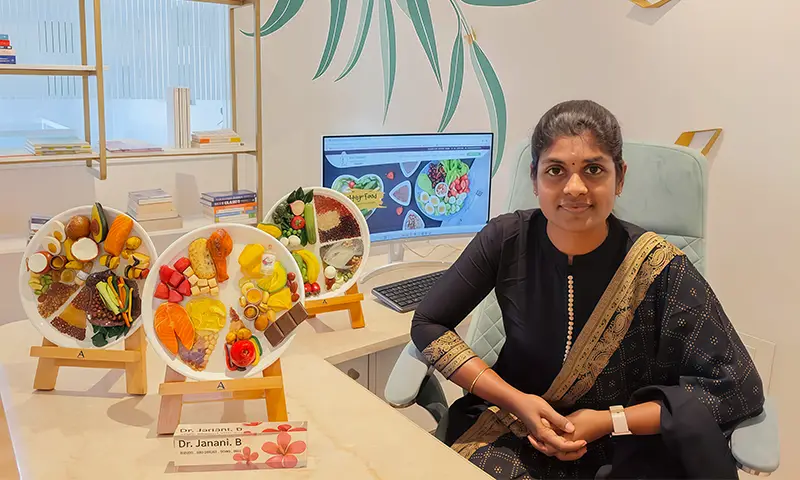 Prime Insights: What inspired you to pursue a career as a nutritionist/dietitian, and how has your journey evolved over the years?
Having started my career as a general physician and treating people of all ages and socioeconomic statuses, I felt that health management was never complete without correcting a person’s diet and lifestyle. I could see that lifestyle or metabolic issues couldn’t be cured by just prescribing medications. The severity of these diseases and their symptoms could only be controlled, and could never be reversed.
This realization made me dive into the field of nutrition, and therefore, I, who primarily wanted to become a pediatrician, dropped that idea and pursued a master’s in nutrition and dietetics. This immense and invaluable knowledge helped me incorporate planning diets, giving nutritional advice, and clinical nutritional counseling in my regular medical practice. Correcting a person’s diet and lifestyle spontaneously reverses their already existing metabolic issues that indeed mandated me to either reduce the dosage or even stop the medications.
This proved to me that the right diet has the power to maintain one’s health for life, prevent disease if it is in the pre-disease phase or sub-clinical stage, or even reverse the disease if it is already present, and helps in definitely reducing the medication and dosage requirements for those who have crossed the stage of managing everything by “right diet” phase. All these have led my practice in a way in which dietary prescriptions/advice are given prime importance, and prescription of medical drugs is only a last resort.
Prime Insights: How do you define “holistic health,” and how is this philosophy reflected in your nutrition practice?
My definition of holistic health is a disease-free body that enables you to do anything and everything that you wish to, e.g., for some it might be climbing Mt. Everest, and for some, it could be the daily chores that they can do with no tiredness and challenge, with a peaceful mind that is free of chaos and confusion, and a heavenly sleep routine that is rejuvenating. I think enjoying your own mind, body, and soul when it is at its fullest health is a bliss and a boon in this birth. You literally have control over everything when all of these are super healthy.
A healthy body and a healthy life are an experience, and I want everyone to feel it at least once in their lifetime. My vision is to prevent diseases, as disease prevention improves the quality of life and saves a lot of money. Everything should be made as simple as possible for a person to understand both the internal and external factors that could influence their health and well-being. My clinical practice does not follow the traditional protocol, be it the Center’s ambience or its name. I do not want my people to get that sick feeling that they are meeting a Doctor to fix their problems, but rather a good guide who is helping them to transform from within and make them and their lives efficient in all ways.
And that is why we named our place JHMC®, which is Dr. Janani’s Health Management Center, and not as any regular titles like clinic/dispensary/nursing home. Our place gives them a warm feeling that alleviates anxiety, and everyone is treated as an important person. A prebooked appointment which avoids the crowd and gives a more private space and time with the Doctor, a non-rushed, elaborate discussion, and a personalised approach makes our Center stand out. Every person who steps into our Center becomes a self-manager of their body and health. I do not want my people to become dependent on me forever to manage their health. Their efforts and drive should become internalised over the course. So, I focus on how to take care of yourself, be it a 20 min consultation or a 2 hours discussion.
Prime Insights: What are the key health areas or conditions you specialize in (such as weight management, metabolic health, gut health, or lifestyle disorders)?
Initially, I started with the aim to manage all medical conditions that are within my scope, and that could be effectively managed with diet and lifestyle changes for all age groups. I render my expertise in weight management with/without any medical issues, MetS, diabetes, PCOD/PCOS, thyroid disorders, hypertension, anemia, other nutritional deficiencies, eating disorders, and so on.
However, the prevalence of diabetes has been increasing in the last couple of years, especially, and almost 90% of people coming to JHMC are getting my service for weight loss and diabetes management, followed by PCOD and thyroid disorders. Never to miss though!!..
The way a person’s blood reports are explained at JHMC by the doctor myself is something unique and special. A lot of people just come to discuss their reports, get educated, and get clarity about their health status. They are given general guidance by clinical nutritional counseling about how early they should start taking actions to preserve their health or reverse the disturbances if they are at the pre-disease or sub-clinical stage.
Prime Insights: How do you create personalized nutrition plans that align with individual health goals, lifestyles, and medical needs?
We have a systematic approach to deliver our service. The first time a person visits, we take a detailed history that literally covers almost everything, along with a comprehensive general examination. Also, we have questionnaires available on our website, and the patients can complete and submit them to us if they are interested.
We have a crisp list of JHMC service plans that the patient can choose themselves, considering the factors like how deeply they want to get into actions, and how long they want to receive our service. Based on the plan chosen, each person receives what and how they want the guidance delivered to them.
For instance, some might not want to go deep, and for these people, I give a one-time dietary prescription, whereas some want a detailed diet plan, which involves following the individualised diet plan and filling the JHMC Food Diary, and for those with diabetes, even filling the JHMC Glucose Log is needed. Actions within a chosen JHMC service plan are also individualised. All of these services are done both physically and online. We follow a people-centered approach!!.
Prime Insights: How do you balance traditional medical practice with modern nutritional science & dietary wisdom in your practice?
As a doctor, my contribution to managing my patients’ (people); health conditions through dietary and lifestyle changes has given me the confidence and evidence that diseases are reversible, prevention is possible, and maintaining one’s health condition is feasible through a proper diet. This keeps me focused, motivated, and on track all the time because offering a health service to a person should make them liberated from suffering and not rely on a medical service forever.
Diagnosing a disease is no longer a challenge because people have already become aware of the health issues that are common in their houses, in a locality, and regions worldwide. What is challenging is how to halt the issues, how to reverse the issues, how to prevent the issues, and how to live a disease-free life. When one knows how to manage their health conditions through proper diet and lifestyle, and is aware of actions and consequences, how would these lifestyle or food-related diseases emerge?!
Educating my patients and transforming them to be self-reliant and self-dependent individuals, as far as their health management is concerned, is what I consider success in my practice. Doctors should not just command or order in rendering their medical service. Try to transfer your knowledge in simple terms that the patient can understand, and help them become a master of their body and health.
Prime Insights: Can you share a success story where your nutritional guidance significantly improved a client’s health or quality of life?
Many such success stories exist, but I will share a short one. A young working woman in her mid-20s presented with c/o constipation on and off, and feeling uneasy because of it. This was in the year 2020. She had no other complaints at all. Before coming to JHMC, she was getting homeopathic treatment for constipation, and the problem did not resolve. Upon reviewing her, I diagnosed her to have Subclinical thyroid deficiency, which was due to multiple nutritional deficiencies, especially vitamin D and vitamin B12. Making the right changes in her daily diet and correcting the deficiencies with the support of the right supplements completely cleared the constipation in just a couple of weeks. She also lost some weight along with a totally normal TSH level in about 3-4 months, and the supplemental correction of deficiencies was closed by 6 months. Thereafter, the regular yearly follow-up to date shows she is perfectly well and feels good overall. She has been maintaining the benefits only with the dietary changes, and comes to me to just get reassured if she is making the right dietary choices.
Prime Insights: How do you address common nutrition myths and misinformation while educating your clients?
As far as misinformation is concerned, it is very easy to dispel it when you give a clear explanation and show the evidence. But myth is like a strong belief that is a task to deal with. Everyone chooses a myth that is comfortable to them and uses it as an excuse to say that, because of that, they did not change a certain thing and so on. Also, some myths are being passed on from time to time, from generation to generation, and people follow them religiously. For eg, Fats will make you fat, eat frequent smaller meals to control sugar, if you do not eat on time you will get an ulcer, and so on.
So, these kinds of beliefs should be dealt with only by repeatedly saying they are not true and making the patient follow the advice open-mindedly, and feel the changes happening to them, and slowly making them realise that what they believed was not true at all. Also, if you can prove with a blood test the improvements that have happened by comparing them with the previous blood tests, it is self-convincing for the patients.
This is how the trust is built in the doctor, and over time, the doctor becomes the first source to seek to find the right solution or advice for the doubts and questions.
Prime Insights: How do you build trust and long-term relationships with your clients throughout their wellness journey?
Being available to the patients when they need you and giving sufficient time, the right space, being modest, treating them with respect, coaching professionally, and most of all listening to them with utmost patience despite seeing them for the 100th time, is all it takes to build a long-term relationship with unshakable trust.
Prime Insights: What role does mental well-being and mindful eating play in your approach to nutrition counseling?
When people are not clear about what and how they want a change, they are easily influenced, manipulated, or carried away by others’ opinions. I encourage everyone to express their opinion with no hesitation and fear, and ask them to choose how they want to be managed. I tell them frankly that my approach is going to be non-judgmental, and they need not try to give answers to convince me or their family members who accompany them. In my practice, I find this peculiar phenomenon.
A lot of eating patterns are linked to moods, and if I find that someone is deeply disturbed, I help them to get proper clinical psychological counseling before starting clinical nutritional counseling, and take some therapy for some time, and come back with clear thinking about what should be done. Sometimes, the patient would be clear, but the people who accompany them would be manipulators. The situations will be handled accordingly.
I assess my patients based on SDT & CBT, and do my coaching depending on how well they understand a concept and start adopting it in their routine. I would always act only as a guide and help them to make the right decisions, and prioritise their needs. I want my patients to be self-thinkers and self-decision makers. Without these qualities, they cannot be consistent in what they want to do or are doing.
Prime Insights: Can you highlight a key milestone, certification, or recognition that reflects your credibility and impact in the field?
The very first moment related to my career would always be my graduation as a doctor. Next, I was awarded as an outstanding student in my MS program and received a complimentary membership as an honor to join the “Golden Society” at Central Michigan University. I got my systematic review published in a reputed journal, which upgraded my position to become a peer reviewer now. Also, being a foreigner and getting your testimonial published on the college (CMU) website by a special request and recommendation from the professors can never be forgotten.
Being a doctor and a specialist in this field has yielded huge respect, global connections, and unbiased service to my people. I feel proud to call myself a Dr. who is a “Specialist in Nutrition and Dietetics.” The most satisfying moments are when my patients thank me from their hearts for the great transformations and immense benefits happening not just to them but also to their families by following my guidance. I am always grateful to my people for trusting me and believing in my efforts.
Prime Insights: How do you stay updated with emerging nutrition research and evolving wellness trends?
I love to read a lot of books- especially the books written by the health experts who need not be doctors or scientists only, but also those who have experienced the changes, be it good or bad, for real, and have written their own stories and experiences of the people known to them. I take the lead for the next set of books from the references given in the books I read currently, and created a big list of books to read, which is just growing bigger day by day. Also, to convince myself of a conclusion or the truth, I research the web databases myself, as we were trained well to write the research papers on our own, which is an exciting activity for me.
I have some papers written already and got one published successfully about 6 years ago. Now you also have social media, you can follow your favourite expert, and follow them for current trends and updates. I follow only the genuine ones, like doctors, researchers, some of my professors, and never the fads and the fakes. Also, a lot of global webinars and seminars are happening online, which, if they interest me, I register and attend. And that is how I keep myself updated.
Prime Insights: What advice would you give individuals seeking sustainable, long-term health transformation through nutrition and lifestyle changes?
As mentioned in the question, it is undoubtedly a long-term process if you want a sustainable health transformation. Right from the first time I take up a person for dietary/ lifestyle changes, I would stress the point that JHMC focuses more on maintenance rather than the immediate outcome of weight management or health management per se. Because if it is about losing weight, it is, in fact, easy and achievable when the diet plan & lifestyle changes are individualised & personalised.
But maintaining the weight is quite tough. I always tell my people that procuring food is possible and convenient through various sources. But choosing what, when, and how to eat is a big task. We at JHMC give guidance about “Art of Eating by JHMC,” which focuses more on bringing consciousness, mindfulness, awareness, and decision-making about one’s choices in diet and lifestyle, as most of our discussion revolves around psychology, and at least 60-70% of the time spent on consultation (discussion) is on clinical nutritional counseling. Even though the motivation and driving factors for a transformation are initiated externally, over time these should internalise, and people should become self-sufficient, self-reliant, and self-motivating to sustain the benefits achieved.
These are my words to my people: “Focus on the 3 main things if you are taking up a transformation program.
First of all, it should be realistic, next it should be practical, and the last thing is sustainability. You cannot sustain if the first 2 points are not met or satisfied. So think before you decide, be consistent, be slow & steady, be gritty, and be selfish.”
