

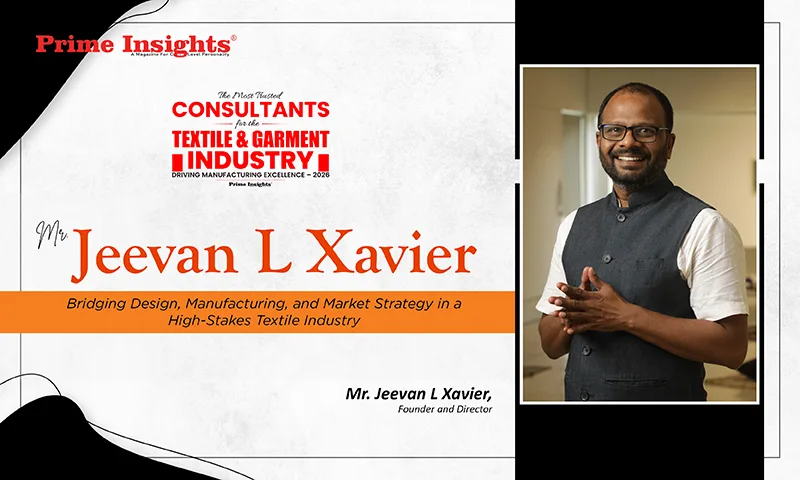
Mr. Jeevan L Xavier | M/s Explorinno Private Limited
Did you know that the average garment travels nearly 20,000 miles—enough to wrap around three-quarters of the Earth—before it ever touches a retail shelf? In an industry where a single loose thread in the supply chain can unravel millions in profit, the distance between a designer’s sketchpad and a factory’s sewing line can often feel even further.
In 2026, the global textile and garment industry stands at a critical inflection point, grappling with razor-sharp competition and a rapid shift in consumer behavior. While traditional manufacturing hubs face mounting margin pressures and supply-chain volatility, the market has transitioned into a “survival of the agile.” Success is no longer determined solely by scale, but by the ability to go through complex ESG mandates and digital transformations. In this high-stakes environment, manufacturers are moving away from reactive production toward system-led growth, seeking strategic clarity to bridge the widening gap between creative design and the hard realities of the factory floor.
Meet JLX Studio, a design-first consulting powerhouse founded to redefine these industrial intersections. At its helm is Mr. Jeevan L Xavier, Founder and Director of M/s Explorinno Private Limited. With a career built on bridging the gap between artistic innovation and corporate leadership, Mr. Jeevan has turned JLX Studio into a beacon for businesses striving for excellence. His journey is one of profound achievements, moving from firsthand experience in manufacturing ecosystems to leading a firm that impacts over USD 50 million in annual business outcomes.
JLX Studio operates at the heart of the value chain, serving everyone from cluster-based SMEs to vertically integrated global export units. The firm’s methodology centers on “embedding design thinking” directly into manufacturing processes to eliminate inefficiencies before they are locked into production. By aligning material behavior and machine capability with market strategy, they help businesses move from fragmented decision-making to a unified, scalable architecture. Whether through SKU rationalization or responsible sourcing, the studio’s interventions make sure that products are both commercially viable and future ready.
In the spotlight is Mr. Jeevan L Xavier – Founder and Director M/s Explorinno Private Limited in an interview for our prestigious The Most Trusted Consultants for the Textile & Garment Industry Driving Manufacturing Excellence – 2026 edition. Learn from his insights and valuable lessons as an entrepreneur to excel and make it the best company. Stay tuned and know his tale of success.
Prime Insights: Can you introduce your consulting firm and explain its core mission within the textile and garment industry?
JLX Studio is a design-first consulting practice working at the intersection of textiles, apparel manufacturing, and market strategy. Our core mission is to help textile and garment businesses build resilient, efficient, and future-ready systems—where design, manufacturing, costing, and market realities work together rather than in silos.
Design is not a surface layer but a strategic business tool. Our role is to translate intent—whether from a manufacturer or a brand—into products and systems that are commercially viable, responsibly made, and scalable over time.
Prime Insights: What inspired you to specialize in consulting for textile and apparel manufacturing, and what industry gaps do you want to address?
JLX Studio emerged from firsthand experience within textile and garment manufacturing ecosystems. We saw a recurring gap between design intent, factory capability, and market expectations. Often, good ideas failed not because of a lack of creativity, but because they were disconnected from production realities, cost structures, or operational constraints.
Our work solves this gap by embedding design thinking directly into manufacturing and business decision-making, helping companies move from reactive execution to planned, system-led growth.
Prime Insights: Which segments of the textile and garment value chain do you primarily serve?
We work across multiple segments of the textile and garment value chain, such as:
- Home textile, apparel, knitwear, and hard goods manufacturing
- Textile, wood, metal, and glass-based lifestyle product development
- Vertically integrated units
- Cluster-based SME manufacturers
- Sourcing and vendor development
- Brand-facing export units
- Retailers and brands across global markets
- NGOs and maker communities
Our strength lies in connecting these segments rather than treating them independently.
Prime Insights: What key consulting services or solutions do you offer to help manufacturers improve efficiency and competitiveness?
Our consulting services include:
- Design and product strategy aligned to market positioning.
- Material and process optimization
- Costing and SKU architecture rationalization
- Line planning and range development systems
- Vendor and sourcing strategy
- Market-facing design and sales enablement support
- Design-led process restructuring
- Rather than offering templates, we build context-specific systems that work within existing factory realities.
Prime Insights: How do your consulting interventions help optimize production processes, quality, and cost management?
We intervene upstream—before inefficiencies are locked into production. By aligning design decisions with machine capability, material behavior, and process flow, we reduce rework, sampling waste, and last-minute cost escalations.
Quality improves when products are designed for the process, not adjusted after production starts. Cost control becomes proactive rather than corrective.
Prime Insights: What role does technology adoption and digital transformation play in your consulting approach?
Technology is an enabler, not a solution by itself. We help clients adopt digital tools where they add clarity—whether in design development, sampling workflows, data tracking, or communication across teams.
Our focus is on appropriate technology—tools that integrate seamlessly with people and processes, rather than creating parallel systems that increase complexity.
Prime Insights: How do you support textile and garment manufacturers in meeting global compliance, sustainability, and ESG standards?
We approach compliance and sustainability as design and process questions, not audit checklists. This includes:
- Responsible material selection
- Process transparency
- Documentation clarity
- Supplier capability alignment
By embedding these considerations early, manufacturers avoid retrofitting compliance later, making sustainability practical, measurable, and economically viable.
Prime Insights: Can you share a success story where your consulting services hugely improved a client’s manufacturing performance or profitability?
In several engagements, our interventions have helped manufacturers achieve measurable improvements, including:
- Clear product mix design across categories
- Reduced sampling and development cycles
- Improved sell-through through sharper product positioning
- SKU-level profitability and increased revenue
- Greater buyer confidence, resulting in repeat orders
While client confidentiality prevents naming specifics, the common thread has been system clarity—once the system improves, performance follows.
Prime Insights: How do you customize your consulting strategies for SMEs versus large export-oriented units?
For SMEs, the focus is on clarity, prioritization, and resource optimization, helping them do fewer things better.
For large export units, we work on system alignment, inter-departmental coordination, and scalability. The principles remain the same; complexity and pace differ.
Prime Insights: What are the most common challenges textile and garment manufacturers face today, and how do you help overcome them?
Common challenges include:
- Margin pressure
- Inconsistent demand
- Rising compliance expectations
- Talent and skill gaps
- Fragmented decision-making
We help overcome these by introducing design-led thinking, aligning departments around shared goals, and building adaptable systems rather than rigid ones.
Prime Insights: How do you measure the impact and effectiveness of your consulting engagements?
Impact is measured through:
- Reduction in development time
- Improved costing accuracy
- Better production stability
- Increase in revenue
- Repeat business and long-term engagement
- Internal team confidence and clarity
If the system improves, the numbers follow.
Prime Insights: What steps do you take to build trust and long-term partnerships with your clients?
Trust is built through:
- Transparency
- Consistency
- Respect for factory knowledge
- Clear communication
We work as partners, not external advisors. Over time, relationships turn into shared ownership of outcomes.
Prime Insights: Have you achieved any notable milestones, certifications, or industry recognition?
Being recognized as Consultancy of the Year is a big milestone for us. More importantly, sustained relationships with clients across markets, repeat engagements, and word-of-mouth credibility show the trust placed in our work. Across our engagements, our work contributes to business outcomes amounting to USD 50 million and above annually, depending on the client mix.
Prime Insights: How do you stay updated with changing global textile trends, regulations, and market demands?
We stay current by working with global buyers, manufacturers, sourcing teams, and design communities. Continuous engagement with factories, markets, and material innovation keeps our insights grounded and relevant. Our teams travel across the globe, attend cutting-edge cultural and art events, closely study the markets and emerging trends online, and network with a small group of the international creative community.
Prime Insights: What advice would you give to textile and garment manufacturers aiming for manufacturing excellence and sustainable growth?
Focus on building clear systems, not chasing short-term wins. Invest in design thinking, process discipline, and people. Sustainable growth comes from understanding your strengths, respecting constraints, and making informed, consistent decisions.
Optional addition
What sets JLX Studio apart is not a single service, but the ability to connect design, manufacturing, and market intelligence into one coherent system—helping textile and garment businesses remain competitive in an increasingly complex global landscape.
