

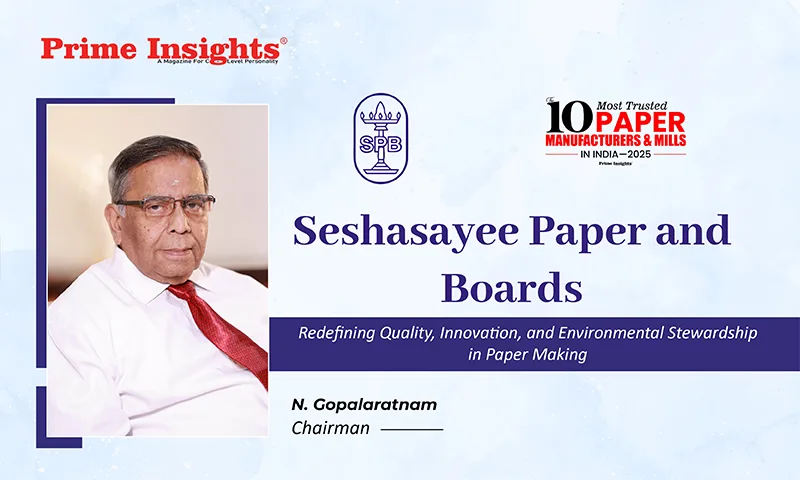
Seshasayee Paper and Boards
Have you ever considered how much paper is in your life right now? From the essential delivery box waiting on your porch to the notes on your desk and the packaging for your favorite snack, the average Indian is now consuming about 15 kg of paper annually—a number that’s rapidly growing. Driven by strict environmental regulations and surging demand for eco-friendly products (e-commerce, packaging), the Indian paper sector is shifting towards sustainability and circular economy principles.
At the forefront of this sustainable pivot is Seshasayee Paper and Boards Limited (SPB), a flagship integrated Pulp, Paper, and Paperboard Mill established in 1960. Guiding the company’s trajectory is N. Gopalaratnam, Chairman. A Mechanical Engineer by background, he joined the company in 1969 and assumed the role of Managing Director in 1988 at a time when SPB’s financial health was challenged. His able leadership, commitment, and vision not only restored the company to its good health but also pioneered securing critical certifications like ISO 9001, ISO 14001, and FSC (Forest Stewardship Council) accreditation. As a business leader, his message centers on global competitiveness, which he advises encompasses quality, cost-pricing, and environmental compatibility. His story is one of transforming challenges into opportunities, leading to the company becoming a prime player in the Indian paper industry.
SPB’s competitive advantage lies in its integrated operations (Pulp to Paper) which provide cost and raw material control, and its broad product portfolio, including specialty and niche grades. The company is actively integrating its Environmental, Social, and Governance (ESG) roadmap with its growth strategy. This includes a strategic collaboration for setting up a 62 MW Hybrid-Solar and Wind Power facility to address over 65% of the company’s energy needs from green sources. Furthermore, its unique, innovative Lift Irrigation Scheme—a tripartite arrangement with a sugar mill and local farmers that uses treated wastewater to irrigate sugarcane for raw material—has been recognized internationally as a Role Model for sustainable resource use. This commitment to operational excellence and sustainability is why SPB is one of the most compliant and trusted sources for demanding buyers.
In the spotlight is N. Gopalaratnam, Chairman, in an interview for our prestigious “The 10 Most Trusted Paper Manufacturers & Mills in India – 2025” edition. Learn from his insights and valuable lessons as an entrepreneur to excel and build a best-in-class company. Stay tuned and know his tale of success.
Prime Insights: The Paper Mill sector is evolving with a rising environmental regulation along with demand for more sustainable, eco-friendly products. How do we see its growth?
India’s paper sector is being reshaped by stricter environmental regulations from the central and state pollution control boards. Requirements on effluent treatment, water usage reduction, and air emission control are compelling mills to adopt cleaner, more energy-efficient technologies.
While compliance increases operational costs in the short term, it also positions compliant mills as long-term winners, as regulatory enforcement becomes more uniform across the industry.
Consumer demand, both domestic and international, is rapidly moving toward eco-friendly products such as:
- Recycled paper & packaging board (driven by e-commerce and FMCG).
- Biodegradable and compostable packaging as alternatives to single-use plastics.
- FSC-certified and chlorine-free paper for export markets.
This shift is pushing Indian paper mills to integrate recycled fiber, reduce plastic coating, and adopt closed-loop water systems, opening up new revenue streams.
The sector is projected to grow at 6–8% CAGR in the coming years, fueled by:
- Rising literacy and education sector growth (printing and writing paper).
- Boom in packaging due to e-commerce, online food delivery, and retail.
- Government’s ban on single-use plastics, which has created strong substitution demand for paper-based packaging.
Notably, packaging board and tissue paper are expected to outpace traditional printing and writing paper.
The Indian paper industry is at an inflection point. As global buyers demand sustainable sourcing, Indian mills adopting circular economy principles (fiber recovery, renewable energy, waste-to-energy initiatives) will gain a competitive edge.
With the government supporting extended producer responsibility (EPR) and recycling infrastructure, the sector could emerge as a global hub for sustainable paper and packaging products.
Prime Insights: How is Seshasayee Paper and Boards Limited positioned in this market? What is the key market gap being filled by the company?
Integrated operations
Being integrated from pulp → paper gives SPB more control over raw material flows, cost structure, and flexibility (versus standalone recycled paper based paper mills or pure converters). This helps when raw materials or waste constraints are tight.
Product-grade breadth & niche grades
SPB’s ability to make a variety of grades (MF, MG, coated, boards, colored papers) helps it serve both commoditized segments and value-added ones. Commoditized plain grades have stiff competition; SPB’s ability to produce specialty grades (e.g. colored, coated, maplitho, boards) helps it serve niche demands where differentiation matters. As demand shifts away from plain printing/writing paper, SPB’s board & paperboard capabilities can help it pivot to packaging, especially for e-commerce, FMCG, and food industries.
Environmental credentials and certifications
Having ISO 14001, and recognition / awards for environmental management help in meeting stricter regulations and appealing to “green” buyers (domestic & export). This is especially relevant as industry norms tighten. Many mills, especially smaller or legacy ones, struggle to meet new pollution / environmental norms — SPB, with its certifications and environmental investments, can be one of the more compliant / trusted sources for buyers demanding higher environmental standards.
The Company’s ESG roadmap, Green initiatives and targets have been integrated with the Growth Strategy of the business.
The Company has also recently collaborated with a Spanish company for setting up and commissioning of about 62 MW of Hybrid-Solar and Wind Power facilities, for exclusive use by SPB. This facility, to be housed as a separate SPV, will have Equity Participation from our Company under Group Captive Model and this facility will have 9 MW of Wind Power Facilities and 52.8 MW of Solar PV facilities.
This strategic tie-up to foster Energy from Renewable sources, along with the company’s proposed investment in Erode in project MDP-IV and in bio-fuel based boilers in Tirunelveli unit, can ensure that more than 65% of energy needs of all the 3 units of the company be addressed by Green Sources.
SPB has a structured, innovative Lift Irrigation Scheme by which our treated waste water is used to irrigate nearly 1500 acres of land in which local farmers grow sugar cane. The sugar cane produced is procured by our associate Company viz. Ponni Sugars(Erode) Limited which in turn gives bagasse, a residue left after extraction of sugar from sugar cane. Bagasse is used by our Company to produce paper, and in turn, our Company gives treated waste water to the farmers to grow sugar cane. This tripartite arrangement between our Company, Ponni Sugars (Erode) Limited and the nearby Farmers has been in operation for over 35 years. This innovative Lift Irrigation Scheme is a unique and innovative irrigation scheme and has caught the attention of Overseas Experts and UNDP as a Role Model.
Export capabilities & reach
The export component, particularly to demanding US markets, gives access to markets with more stringent standards (and perhaps higher willingness to pay for certified / eco-friendly grades). This helps SPB benchmark against global players, and maintain higher product standards. For export buyers who demand traceability, environmental credentials, and certified supply chains, SPB’s integrated, certified operations help fill a reliable gap in the Indian supply base for such buyers.
Legacy and reputation in southern India
With decades of presence and being a known brand in the printing & writing space, it has channel relationships, brand trust, and market reach.
As demand shifts away from plain printing/writing paper, SPB’s board & paperboard capabilities can help it pivot to packaging, especially for e-commerce, FMCG, and food industries.
Prime Insights: What methods does Seshasayee Paper and Boards Limited implement in its manufacturing operations to maintain a level of consistency in the quality of the paper it produces to satisfy the emerging demands of customers in industries?
Seshasayee Paper & Boards (SPB) has adopted multiple technical, process-control, and organizational measures to maintain consistency of paper quality, especially in a context where customer expectations are rising (for tighter tolerances, specialty grades, “green” credentials etc.).
Automation, real-time sensors & control systems
- SPB has integrated programmable logic controllers (PLCs), distributed control systems (DCS), and sensors to continuously monitor critical variables (temperature, pressure, chemical concentrations, flows) in pulp, bleaching, chemical dosing, etc.
- These systems help detect deviations early and allow automatic or tight manual interventions, reducing human error or drift.
- Particularly in the bleaching stage, SPB has recently partnered with BTG’s Bleaching Advanced Process Control to optimize bleach plant operations (monitoring metrics like total Kappa, fiber Kappa, brightness) and maintain pulp quality stability against feed variability.
Laboratory & pilot trials / R&D-backed furnish optimization
- In its history, SPB has experimented (in lab trials) with mixing raw fibers of different types (bamboo, eucalyptus, hardwoods) to find furnishes that yield stable and acceptable paper performance.
- Such trials help define tolerances and operating “recipes” so that when raw fiber inputs change, the adjustment margins are known and controlled.
Maintenance & equipment reliability programs
- One of SPB’s published strategies is its maintenance regime geared for cost reduction and quality improvement. They monitor equipment deterioration daily and take corrective action before issues escalate.
- Ensuring that rollers, blades, screens, headboxes, and other mechanical parts remain within tolerance is a key enabler of repeatable sheet properties (basis weight, moisture, caliper, formation).
Synergies between units & captive pulp balancing
- SPB’s Erode and Tirunelveli units are mutually supportive: Erode has excess pulp capacity, which it supplies to Tirunelveli, reducing dependence on imported or external pulp sources. This helps maintain more consistent raw pulp quality in both plants.
- Having integrated pulp & paper operations afford more control over upstream variability (versus purely converting operations that depend wholly on external pulp suppliers).
Certifications, traceability & chain-of-custody systems
- SPB holds certifications (e.g. for environmental & process systems) and claims traceability in wood, wood fibre, and pulp procurement, enabling them to supply FSC-100% and FSC Mix products. This implies they maintain audit trails and controls over raw material quality and origin.
- Having such systems helps ensure that variations due to raw material quality (wood fiber mix, moisture, contamination) are tracked and managed, rather than introducing unpredictability.
Process benchmarking, energy & quality improvement projects
- SPB regularly engages in energy-efficiency, process retrofit, and benchmarking studies to reduce variation. For example, in their Erode unit, they have worked on paper machines, digesters, evaporators to improve both quality and quantity.
- They also track key performance metrics (e.g. specific energy consumption, specific steam consumption) and use them as part of feedback loops to identify process drifts.
- Also, in their “Forest to Paper Machine” presentation, SPB discusses “best practices” and the use of “6R” (reduce, reuse, recycle, redesign, recover, remove) and continuous improvement frameworks to tighten control over waste, deviations, and non-conformances.
In FY 2022-23, the Company has installed a PCC (Precipitated Calcium Carbonate) Plant capturing the CO2 from the Stack of the Lime Kiln, reducing thereby the overall emission of GHG from the unit.
By deploying the above methods, SPB reduces sources of variability across the production chain — fiber quality, chemical dosing, temperature/pressure fluctuations, mechanical wear, equipment drift. That in turn helps ensure that key paper attributes (basis weight, moisture content, brightness, smoothness, caliper, strength) stay within tighter tolerances, which is essential for demanding customers (printers, converters, specialty packaging etc.).
Also, having integrated operations, certification systems, and internal synergies helps SPB reduce its dependence on external suppliers or spot inputs — a major source of quality unpredictability in many paper mills.
Prime Insights: What solutions does Seshasayee Paper and Boards Limited use to establish a competitive advantage over other paper mills in both domestic and international markets?
SPB is certified under multiple internationally recognized standards: ISO 9001 (quality), ISO 14001 (environment), ISO 45001 (OH&S), ISO 50001 (energy). Crucially, SPB has FSC (Forest Stewardship Council) certification (for its Erode and Tirunelveli mills) allowing it to produce FSC 100% and FSC Mix products. Having FSC and chain-of-custody traceability enables SPB to access “environmentally sensitive” or premium export markets (where buyers demand certified, socially and environmentally responsible supply chains). In a market shifting toward greener procurement, such certification is a strong differentiator — many mills lack the systems, traceability, documentation, or forest sourcing discipline. That gives SPB an edge in both premium domestic contracts and export markets.
SPB is not limited to commodity grades: it produces printing & writing paper, chromo / coated paper, colored varieties, white & colored MG boards, multilayer packaging, etc. Approximately 20% of production is exported to around 35 countries, giving exposure to global demand and benchmarks. It holds the status of “Golden Export House” in recognition of its export performance. This breadth lets SPB hedge cyclicality in any one segment (e.g. printing & writing vs packaging) and capture higher-margin opportunities. Its export presence also helps it understand global quality expectations and adopt them in domestic operations. Its brand presence (SPB, Colorsprint, etc.) in key regional markets gives more immediacy and responsiveness versus distant mills. In paper & board, logistics, delivery time, responsiveness, and local service matter a lot. SPB can leverage lower freight cost / delivery time in its core geography as a competitive advantage versus mills located far away.
SPB treats its wastewater and reuses it in irrigation; it has a tripartite arrangement (mill, sugar mill, farmers) wherein treated effluent is used to irrigate land, and in turn the sugar mill supplies bagasse for SPB’s raw material. The company often highlights its green balance and sustainability narrative as part of its brand identity. Also, SPB actively promotes plantation: distributing seedlings to farmers to build a sustainable wood / fiber supply base. This integrates SPB more deeply into the local ecosystem, helping with raw material security, social license to operate, and brand goodwill in communities. In the future, this could feed into sourcing security and lower fiber costs.
SPB has commenced its upgradation/expansion program via Project Mill Development Plan-IV (MDP-IV) to raise pulp and paper capacity in its Erode unit. It has also acquired the defunct Servalakshmi Paper Limited (adjacent to its Tirunelveli unit) to revive ~75,000 tpa of fine paper capacity, leveraging proximity and shared infrastructure. These moves aim to consolidate scale, expand capacity, and reduce fixed-cost per unit, improving margin resilience. Scale matters in paper/board (for cost absorption, R&D, capital turnover). Strategic acquisitions that can be integrated (economies of scale, shared synergies) can accelerate growth while limiting green-field risk.
SPB has a relatively healthy capital structure and liquidity buffers. SPB’s Balance Sheet position gives it flexibility to invest and absorb cyclical shocks. Capital-intensive industries like paper need strong balance sheets to invest in upgrades, absorb raw material cost fluctuations, and maintain continuous operations. SPB’s relatively prudent leverage gives it optionality.
Prime Insights: Going forward, what is the future road map for the company?
SPB is now in the process of implementing Mill Development Plan IV (MDP-IV), in 2 phases to augment pulp capacity (wood & bagasse) and increase paper capacity. In particular, a 20% expansion of pulp + paper capacity at its Erode plant has been cleared via environmental clearance (EC) from MoEF&CC (in August 2025) for Phase-I.
SPB has acquired the Servalakshmi Paper Mill (currently non-operational) and expects to refurbish / revive ~75,000 TPA capacity. When this is brought online, the aggregate capacity could rise materially (to ~330,000 TPA, given existing ~255,000 TPA base).
SPB continues to emphasize sustainability / ESG integration with “High share of renewable energy use”, “Wood-positive operations” with distributing seedlings, planting contracts, “farm / contract forestry” and working to augment wood sourcing from nearby states and “Integration of ESG goals into growth strategy” (i.e. future expansions will need to meet environmental, social, and governance ambitions).
These announced moves already suggest that SPB is betting heavily on scaling up its pulp self-sufficiency, augmenting power generation, and reactivating idle capacity to boost its scale and reduce dependence on purchased pulp or external power.
Prime Insights: SPB’s commitment to sustainability and operational excellence has earned it several industry awards. Can you walk us through some of the major recognitions the company has achieved recently?
SPB has bagged several awards for excellent Environment performance, safety, energy efficiency, etc. Notable Awards received by the Company in recent years are:
- CII GreenCo Gold Rating Award during GreenCo Summit held at Pune in the year 2017.
- Green Award 2017 by Tamil Nadu Pollution Control Board for Environment Protection.
- CII – National Award for Excellence in Energy Management:
- Excellence in Energy Management – for the past 8 consecutive years
- National Energy Leader – 6th time in row
- Paper Mill of the year award for FY 2019-20, awarded by Indian Paper Manufacturers Association.
- IPMA Energy Conservation Award for FY 2021-22.
- CII EHS (Environmental, Health and Safety) Excellence – Bronze Award for the year 2022.
- AEE award – Regional Corporate Energy award 2021 by Association of Energy Engineers, US
- CAPEXIL Export Excellence Award for FY 2018-2022
- CII SR EHS Excellence – Silver Award for the year 2023
- CII EHS Excellence – Special award in Energy / Carbon footprint for the year 2023
