

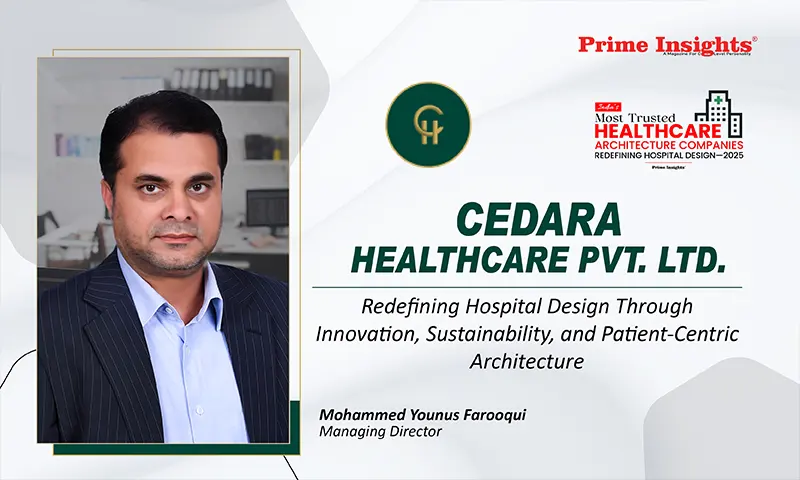
Cedara Healthcare Pvt. Ltd.
Did you know that operating a hospital can cost up to three times more in maintenance than it did to build? This single, startling fact reveals the high-stakes reality of the Indian healthcare industry. It’s a field where architecture is not just aesthetic but a critical investment—or a crushing operational burden. In healthcare’s competitive, high-stakes market, modern design must balance patient outcomes, efficiency, and sustainability, demanding end-to-end, cost-effective solutions to bridge the access gap.
Stepping into this demanding arena is CEDARA HEALTHCARE PVT. LTD., a full-service project delivery consultancy established in 2003. At the helm is Mohammed Younus Farooqui, Managing Director, a visionary entrepreneur with over three decades of robust experience in hospital design, management, and engineering, including a background at institutions like Apollo Hospitals and an MSc in Bioengineering from the University of Strathclyde. He founded Cedara with the core mission to be a “one-stop shop” for technically challenging healthcare projects, providing comprehensive solutions from planning to commissioning.
Cedara excels by integrating multiple domains—architecture, engineering, nursing, medicine, and hospital management—to create bespoke services that redefine healthcare facilities. Their unique approach begins with designing patient-centric process flows to make sure of maximum convenience, then deploying value engineering and lean principles to deliver space-wise and cost-wise economical designs. They address a fundamental challenge by ensuring facilities are flexible, economical to maintain, and properly commissioned for the long run, often incorporating technology like BIM for clash resolution. This holistic model is proven by flagship achievements, including developing a first-of-its-kind portable CBRNE decontamination unit in the UAE and swiftly completing a 70-bed multi-specialty hospital in just ten months.
In this spotlight, we feature Mohammed Younus Farooqui, managing director, in an exclusive interview for our prestigious “India’s Most Trusted Healthcare Architecture Companies Redefining Hospital Design—2025” edition. Learn from his insights and valuable lessons as an entrepreneur and business leader committed to creating the best healthcare architecture.
Prime Insights: Can you introduce your company and its core mission in healthcare architecture and hospital design?
Cedara is a full-service project delivery consultancy company that operates in the domains of design, engineering, and managing healthcare services. We undertake integrated planning, architectural, engineering, project management, and commissioning services for healthcare facility infrastructure. Beyond this, we manage hospitals, assist in implementing quality accreditation systems, optimize operational processes, help clients in designing efficient operational systems, etc.
CEDARA’s wide range of resources and expertise offer comprehensive, one-stop-shop solutions (incorporating architectural, building, and infrastructure engineering, mechanical, electrical, and HVAC services) for technically challenging projects and services, from planning and construction to commissioning and managing hospital projects.
CEDARA’s value proposition is defined through its non-negotiable commitment to sustainable earnings growth and value creation. We aspire to world-class fulfillment in everything we do, through our core competence in hospital design, delivering major projects and services primarily for the development of the healthcare industry.
At Cedara, various experts in the fields of architecture, engineering, nursing, medicine and surgery, hospital management, biomedical engineering, materials management, finance, strategy, marketing, operations, infection control, quality, and customer care come together to create bespoke services in hospital design and management.
Prime Insights: What inspired your firm to focus on healthcare infrastructure, and what unique challenges do you address?
We have been working in the healthcare domain all our careers; we understood early on that healthcare facilities continue to evolve as they mature during their use. Thus, facilities need to be flexible enough to allow these changes. Further on, healthcare facilities cost much more to maintain than build (1:3) during their useful life. Hence, it is extremely important to commission the facilities to render them economical for maintenance and remodeling. We also address issues of commissioning that arise while transitioning from the project phase to the operational phase.
Prime Insights: What are the flagship services or solutions your company provides in hospital design and healthcare facilities planning?
We undertake planning and design for all formats of healthcare facilities, from large super multi-specialty hospitals to relocatable and mobile healthcare facilities. Beyond the scope of planning and design services, we keep involved with our client, handholding during operations. This also gives us an opportunity to learn how the design worked. During the process of planning and design, we deploy value engineering & lean principles that enable us to develop space-wise and cost-wise economical design solutions.
Prime Insights: How do you integrate patient-centric design principles to enhance healthcare experiences?
Our planning process commences with the design of process flows. These flows are designed with the aim of providing the most convenience to the patients. This enables us to develop truly patient-centric designs.
Prime Insights: How do you balance aesthetics, functionality, and safety in healthcare architecture?
Our inspiration for developing balanced designed functionality, aesthetics, and safety comes from nature itself. Natural systems are flawlessly functional, aesthetically appealing, and safe. Having said that, health facilities have a personality that reflects the aspirations and values of their owners; we ensure that this personality is reflected in the aesthetic and functional aspects of the designs that we develop.
Prime Insights: What role does technology (BIM, smart systems, IoT) play in your hospital design projects?
We use BIM for clash resolution and routing service lines and utilities for large hospital projects. We also incorporate IoT and automation systems as per the feasibility of the project and budgets available for it. However, we make all the systems compliant to be upgraded for IoT and automation at a later date if the budgets prove to be a limiting factor in the construction phase.
Prime Insights: Can you share a milestone project or achievement that highlights your expertise in healthcare architecture?
We developed the first portable CBRNE decontamination unit in a container with requisite climate control in the UAE. More recently we have developed a hybrid OT facility for vascular surgery in Hyderabad. Our fastest design-build assignment was 70-bed multi-specialty hospital facilities in 10 months from site handover to inauguration.
Prime Insights: How do you ensure compliance with healthcare regulations, safety standards, and accessibility norms?
This is the very fundamental of our design; we incorporate NABH/JCI and local healthcare guidelines in the planning stage itself. Safety is also fundamental and non-negotiable. We ensure our designs are fully compliant with all the relevant codes and regulations.
Prime Insights: How do you incorporate sustainability and eco-friendly practices in your healthcare projects?
Our design principles incorporate and use locally available material as much as possible. We also keep our designs economical for systems that economize power consumption. Our designs use glass judiciously to ensure daylight in every room while ensuring that it does not increase requirements of HVAC and climate control.
Prime Insights: Can you provide an example of a project that significantly improved operational efficiency and patient care?
We had designed Olive Hospital Hyderabad 15 years ago, which prides itself on one of the most cost-efficient operations, mainly because of optimized design. We invite those interested to study the design and how it contributes to operational efficiency and patient care.
Prime Insights: How do you collaborate with healthcare providers, engineers, and other stakeholders during the design process?
Early on in the planning process we bring together all stakeholders in a workshop to understand every stakeholder’s wish list. This is followed by closely studying the operational processes. Especially nurses provide vital clues on operational aspects. This is followed by developing process flows and concept design, presented to stakeholders in a second workshop where we freeze design specifications. Important stakeholders in this workshop are nurses, doctors, and maintenance personnel.
Prime Insights: How do you adapt designs to meet the specific needs of different medical specialties or hospital types?
As I mentioned earlier, it all starts with getting all the stakeholders in a workshop very early on in the planning process. Oftentimes there are competing interests, and each specialization portrays an amplified significance of their part. It is during the second design workshop that reality checks are done and interests balanced with available space and budgets. These trade-offs are not a matter of negotiation but a well-structured process that takes into account various factors such as incidence of disease, prevalence of disease, the vision of the owners, the significance of the process, economic feasibility, etc.
Prime Insights: What innovative design trends do you see shaping the future of healthcare architecture in India?
The cost of healthcare infrastructure is exponentially increasing, especially in urban areas. There is an increasing need for optimal use of space. Another trend is fast-changing needs; designs need to be adaptable and modifiable with minimal disruption to the operations. Typically, we plan for a long-lasting outer core structure and more flexible internal use of space.
Prime Insights: What are your company’s future plans for expanding services and impact in healthcare infrastructure?
Our company would focus on economizing the cost of healthcare infrastructure, as it directly impacts the cost of services to patients. With improving transport infrastructure in the country, we would also explore developing more portable (relocatable) healthcare facilities that could service rural populations in their respective habitats. Portable health facilities also make health screening programs more effective and practicable.
Prime Insights: What advice would you give to hospitals or healthcare organizations seeking the best architectural solutions?
I would request them to discuss their projects with us, ha ha ha! On a more serious note, I would like to alert prospective clients to be mindful of the operational costs of running a hospital facility beyond the aesthetic and other considerations. It is much more economical to build a healthcare facility than to operate it. About 75% of the cost of a healthcare facility is incurred in its maintenance.
