

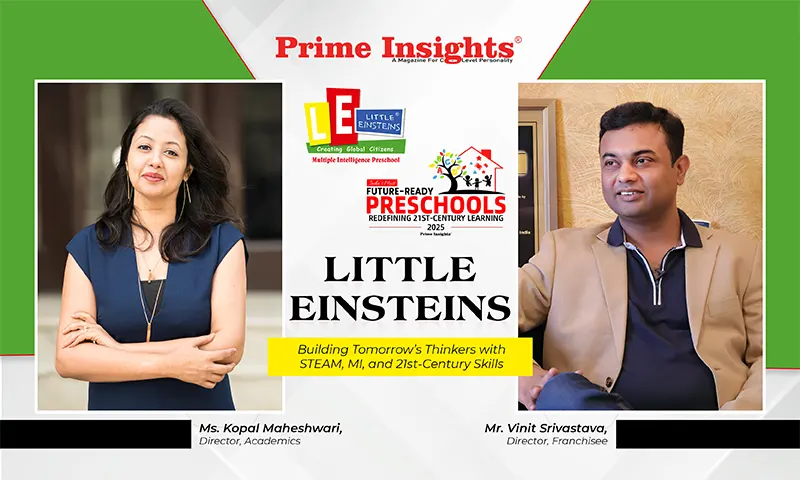
Little Einsteins
Did you know that 85% of the jobs that today’s preschoolers will hold haven’t even been invented yet? This staggering fact underscores the intense challenge facing the early childhood education (ECE) industry today. The sector is highly competitive and rapidly evolving, shifting away from rote learning toward preparing children for static subjects, as well as for a future of rapid change.Success in ECE now requires care, as well as genuinely future-ready learning models focused on critical thinking, creativity, and digital literacy. Amidst this imperative to innovate, a few networks are pioneering truly effective, scalable, and child-centric approaches.
One such pioneer is Little Einsteins, the preschool network established in 2008 by Sebille Educations Pvt Ltd, guided by the vision of Mr. Vinit Srivastava, Director, Franchisee and Ms. Kopal Maheshwari, Director, Academics. The core mission that inspired the founders is to “nurture curious, resilient lifelong learners and responsible global citizens.” Both leaders, with proven track records in educational innovation and entrepreneurial success, recognized the crucial need to integrate global best practices with scalable implementation. Little Einsteins quickly evolved by delivering child-centred early learning through innovative STEAM (Science, Technology, Engineering, Arts, Math) and Multiple Intelligence (MI) frameworks. Their message as business leaders and education experts emphasizes providing children with personalized, inquiry-based experiences that foster curiosity, creativity, and foundational cognitive skills. Little Einsteins’ pedagogical success lies in what and how they teach.
Their approach is driven by a unique philosophy that merges the Multiple Intelligences framework with inquiry-based, play-led STEAM learning.The curriculum intentionally weaves essential 21st-century skills—critical thinking, collaboration, creativity—through project work, maker activities, and classroom coding labs. The methodology utilizes innovative techniques like project-based learning, guided discovery, and integrated STEAM labs. To make sure of holistic development, the classrooms are designed as bright, accessible, zoned spaces for exploration, and the teachers undergo rigorous onboarding and ongoing STEAM/MI professional development to maintain high standards and pedagogical fidelity across the entire franchise network.
In the spotlight this month is Ms. Kopal Maheshwari in an exclusive interview for our prestigious “India’s Most Future-Ready Preschools Redefining 21st-Century Learning – 2025” edition. Learn from her and Mr. Vinit Srivastava’s insights and valuable lessons as entrepreneurs to excel in this transformative industry and make Little Einsteins the best company in early childhood education. Stay tuned and know their tale of success.
Prime Insights: To begin with, could you share a brief overview of Little Einsteins and its core vision in early childhood education?
Little Einsteins is a future-ready preschool network (est.2008) delivering child-centred early learning through STEAM, Multiple Intelligence and 21st-century skills. Our vision: nurture curious, resilient lifelong learners and responsible global citizens.
Prime Insights: What is the educational philosophy that drives Little Einsteins’ approach to preschool learning?
We combine a Multiple Intelligences framework with inquiry-based, play-led STEAM learning. Every child receives personalised experiences that respect developmental readiness, fostering curiosity, creativity and foundational cognitive and social skills for lifelong learning.
Prime Insights: How does Little Einsteins prepare children with essential 21st-century skills?
The curriculum intentionally weaves critical thinking, collaboration, creativity, communication and digital literacy through project work, maker activities and classroom coding labs — making sure that children practise transferable skills in authentic contexts.
Prime Insights: Can you explain the innovative teaching methodologies used across your centres?
We use project-based learning, guided discovery, learning stations and integrated STEAM labs.Lessons include hands-on experiments, storytelling, role-play and scaffolded teacher prompts to make learning engaging, iterative and meaningful.
Prime Insights: How do you integrate age-appropriate technology into the learning environment?
Technology is used deliberately — tablet-based story platforms, unplugged coding, micro:bit/simple robotics and digital portfolios — always paired with hands-on activities and adult mediation to preserve sensory, social and motor development.
Prime Insights: What systems and practices ensure safety, hygiene, and security at Little Einsteins centres?
We maintain secure entry/exit systems, CCTV, first-aid trained staff, strict hygiene schedules, safe furniture/materials and routine emergency drills. Policies are audited periodically and shared transparently with parents. (Child safety is a non-negotiable priority.)
Prime Insights: How are your classrooms and overall infrastructure designed to support child-centred learning?
Classrooms are bright, accessible and zoned for exploration: makerspace, reading nook, sensory area and outdoor play.Furniture is child-sized, modular and encourages autonomy, mixed-age interaction and multi-sensory learning.
Prime Insights: What training and professional development do teachers undergo to maintain high-quality teaching standards?
Educators undergo onboarding, ongoing STEAM/MI workshops, classroom coaching, assessment literacy training and online micro-credentials.We emphasize reflective practice, developmental observation and parental communication skills to make sure of teaching excellence.
Prime Insights: How do you cultivate emotional intelligence and wellbeing among young learners?
SEEDed social-emotional lessons, circle time, role play and mindful routines teach self-awareness, empathy and conflict resolution. Teachers scaffold peer interactions and partner with parents for consistent emotional learning at home and school.
Prime Insights: What extracurricular and enrichment programs does Little Einsteins offer to enhance holistic development?
Einstein Labs, music, movement, early coding, language enrichment and nature clubs extend learning. Enrichment is optional, differentiated and designed to deepen curiosity, fine motor skills and creative expression.
Prime Insights: How do you support inclusion and cater to children with diverse learning needs?
We use differentiated instruction, small-group scaffolding, sensory supports and specialist referrals. Individual Learning Plans and strong parent-teacher collaboration ensure access and progress for children with diverse needs.
Prime Insights: What does parent partnership and communication look like at Little Einsteins?
Regular digital portfolios, monthly progress summaries, parent workshops and open classrooms keep families engaged. We use scheduled meetups and real-time messaging to build transparent, collaborative relationships around each child.
Prime Insights: What future-ready innovations or unique practices set Little Einsteins apart from other preschool networks?
Our blend of STEAM, MI, early coding, SDG awareness and franchise-driven teacher support creates scalable, future-focused programming that readies children for a rapidly changing world. Continuous curriculum auditing keeps us future-ready.
Prime Insights: Could you highlight some of the awards, recognitions, or achievements Little Einsteins has received?
Little Einsteins has been recognised among top preschool innovations and featured by education platforms for its future-ready model and international presence — highlighting curriculum innovation and scalable impact across regions.
Prime Insights: What is your 3–5 year vision and expansion roadmap for the Little Einsteins network?
Scale responsibly: deepen curriculum impact, expand teacher-training academies, grow franchise quality assurance, add adaptive digital assessments and pilot blended learning partnerships to reach broader communities while maintaining pedagogical fidelity
