

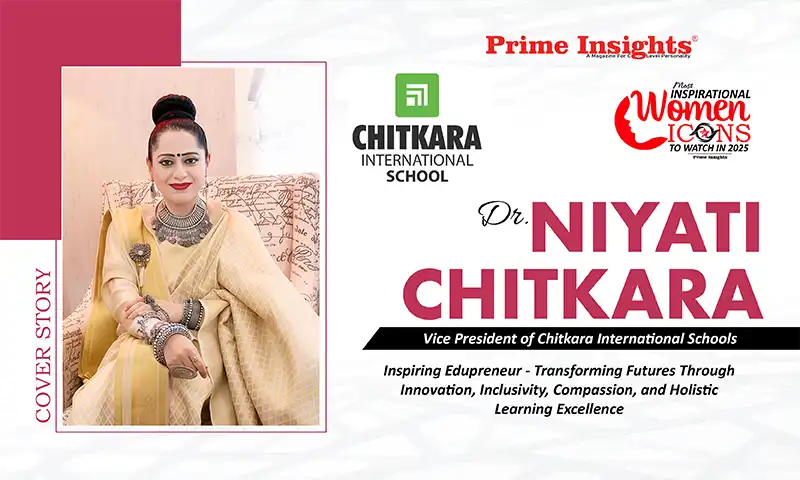
Dr. Niyati Chitkara | Chitkara International Schools
Ever wonder what it takes to get a seat at one of the world’s most prestigious universities or how a child learns to become a confident leader? The journey begins long before college applications or corporate boardrooms, in the very foundation of learning: the education sector. It shapes character, inspires curiosity, and builds the leaders of tomorrow. In this competitive environment, institutions must innovate to provide education that goes beyond the classroom, preparing students not just for exams but for life. Chitkara International School (CIS), founded in 2005, leads this charge under the guidance of Dr. Niyati Chitkara, the Vice President and a visionary edupreneur. With over two decades of experience, a doctorate in school-based assessment, gold medals in her Master’s degrees, and recognition by Forbes India as “India’s Visionary Entrepreneur”, she has grown CIS from 7 students to over 2,700 learners across two campuses.
She authored Assessment Quotient and has been honoured at the Viksit Bharat 2047 – Google Education Summit, Leader Series 2025 – Leading in the AI Era, and by Google Cloud for her contributions to education.
Under her leadership, CIS has attained No. 1 rankings in India and Chandigarh, top positions for Happiness Quotient, recognition for outstanding infrastructure, and its RIDS accreditation from the British Council confirms that the school meets global standards of excellence. She has forged over 250 international collaborations and signed MoUs with WDC, UNESCO MGIEP, Toastmasters International, The College Board, The Climate Reality Project, Cinevidya, IDP, Microsoft, Adobe, Canva, ETS India, ISBF, and Access USA, establishing CIS as a Scholastic Assessment Test (SAT) Centre and a hub for global learning. She has facilitated Edureform and CLIL (Erasmus+ EU – co-funded) projects and overseen 18+ patents, cultivating innovation, creativity, and intellectual property development among students. Her leadership has also positioned CIS in prominent media, including JioHotstar’s “Leading Educational Institutes of India”.
Dr. Chitkara has embedded sustainability and technology into CIS, aligning initiatives with the UN SDGs through solar power, herbal gardens, vermicomposting, rainwater harvesting, eco-plantations, and the student-patented Agronic Culture model. She has integrated AI, Design Thinking, ERP, LMS, SEO strategies, and SchoolPad, enhancing learning, operations, and alumni engagement. Her global exposure includes visits to Apple Park, San Diego State University, and Shenandoah University, and dialogues with luminaries like Boman Irani, Masaba Gupta, Shobhaa De, Lisa Ray, Javed Akhtar, and Usha Uthup. She also helped CIS host a TEDx Talk, providing a platform to share ideas and inspire change.
CIS leverages global partnerships with tech leaders and implements a distinctive “PhD to Playway” curriculum, bridging early childhood learning with advanced studies, in collaboration with Chitkara University. Its “5 Qs” framework encapsulates the institution’s philosophy, emphasising the development of students’ Intelligence, Emotional, Skill, Happiness, and Technology Quotients, balancing academic excellence with well-being, creativity, career readiness and Industry 5.0 readiness.
Furthermore, CIS demonstrates a strong commitment to social responsibility through initiatives supporting underprivileged students and the adoption of local villages, ensuring that education nurtures not only intellect and skills but also empathy, leadership, and societal impact.
In this special feature on our “Most Inspirational Women Icons to Watch in 2025” edition, we turn the spotlight on Dr. Niyati Chitkara. Read on to gain valuable insights and lessons from her journey as a business leader and discover her tale of success.
Prime Insights: Please introduce yourself and share your journey in the field of education.
I have always believed in the transformative power of education—not merely as a profession, but as a profound way to touch lives and shape futures. As Vice President of Chitkara International Schools (Chandigarh and Panchkula), I have the privilege of working with an exceptional team to cultivate a learning environment that fosters integrity, dignity, resilience, and a lifelong passion for learning. My journey spans two decades, enriched by a doctorate in school-based assessment, gold medals in Master of Commerce and Business Administration, and top ranks in M.Ed. and B.Ed. programmes. Inspired by this belief in the power of education, I have contributed to the curriculum framework for the B.Ed. programme and the Chitkara School of Psychology and Counselling, driving innovative educational practices aimed at enhancing both teaching and learning outcomes.
I am the author of the book titled Assessment Quotient, published by Lambert Academic Publishing in Germany and a certified IB trainer for the Primary Years Programme. Steering initiatives such as Inlingua International School of Languages, implementing the Happiness Curriculum inspired by the teachings of His Holiness the Dalai Lama, weaving together SCERT, the Triad of Happiness, and PERMA, and designing assessment rubrics recognised by the Centre for Assessment, Evaluation and Research (CAER), Pearson, has been profoundly fulfilling. These initiatives, complemented by 18+ patents, 250+ international collaborations, and Erasmus+ projects funded by the European Union, have significantly enhanced the school’s stature and enriched our students’ learning experience. I have also helped Chitkara International School gain publication in CBSE & CAER and facilitated its participation in Cambridge-conducted case studies.
Honours such as the Bill & Melinda Gates Foundation Scholarship and recognition for inclusive education celebrate the collective dedication of our educators and students. Guided by the belief that education should nurture compassionate, capable, and globally conscious citizens, I remain committed to empowering learners, inspiring innovation, and crafting transformative educational experiences across all levels at Chitkara International Schools.
Prime Insights: What motivated you to choose education as your life’s mission and leadership path?
I was born on 5th September, and perhaps it’s no coincidence that I have always felt a teacher at heart—a love for learning and sharing knowledge has been part of me for as long as I can remember.
My journey in education has been profoundly inspired by my mother, and my mother-in-law, Dr Madhu Chitkara, Pro-Chancellor, Chitkara University, Punjab and Himachal Pradesh, and Chairperson, Chitkara International Schools, and my daughter. These women created a continuum of support, nurturing and empowering each other. Dr Madhu Chitkara’s visionary leadership inspired me to lead with integrity, cultivate creativity, and empower others. Support from the men in my life—my father, father-in-law, Dr Ashok K Chitkara, husband, Mr Mohit Chitkara, brother, and son—have been equally invaluable.
Mentors, especially the late Dr V. Natarajan, guided my PhD and co-authorship of Assessment Quotient, shaping my commitment to education. This blend of family and mentorship fuels my mission to cultivate spaces where students thrive as empathetic, imaginative, and socially conscious individuals, creating capable and compassionate changemakers.
I am grateful that the synergy of my “entire family and friends at home” and the “entire family at work” continues to inspire and sustain my journey in education.
Prime Insights: How do you define the role of women leaders in shaping the future of education?
Women, by their very nature, are nurturers endowed with an innate capacity for empathy and visionary leadership.
In my capacity, I have meticulously designed a school structure where the majority of leadership roles are entrusted to exceptional women, each acting as a principal of their office and making pivotal decisions that exemplify their remarkable capabilities. Through signature initiatives like Change the Game 2.0 and Frolic Fridays, students engage with inspiring women industry leaders and trailblazers, gaining firsthand insights, professional exposure, and the acumen to lead with vision, resilience, and integrity.
At our Centre of Research, Innovation, and Teaching Excellence, women leaders drive mentorship, innovation, and empowerment, guiding faculty and students to pursue ideas, file patents—resulting in over 18 successful patents—and cultivate entrepreneurial skills through initiatives such as the Diamond Challenge, CBSE Skill Expo, Career Fest, Deakin Career Studios etc. fostering creativity, critical thinking, and confidence for a rapidly evolving educational landscape.
Prime Insights: What challenges did you face as a woman in educational leadership, and how did you overcome them?
Navigating educational leadership as a young woman has been a challenging yet incredibly rewarding journey. Early on, I had to prove my credibility and work hard to build creative, empowered teams. My vision of integrating a “PhD to Playway” curriculum and seamlessly blending school with higher education was ambitious, and it needed frequent discussions with parents and stakeholders to bring it to life.
I also faced the challenge of embedding industry exposure, AI, and sustainability into our learning framework to make students future-ready. However, the steadfast support of Chitkara University has made my journey smoother, guiding and empowering me. I’ve always wanted to make this path easier for the women around me, which is why I created initiatives like “We Talk” and “Heart to Heart” to build open conversations and mutual support.
Prime Insights: What is the core vision or philosophy that drives your institution’s learning approach?
At Chitkara International School, our vision and mission guide every step: We will take a Hand, Open A Mind, Touch A Heart & Shape the Future. Our mission is to deliver high-quality, skill-based education by 2030 through innovative assessment frameworks, cutting-edge infrastructure, and opportunities for holistic growth. We prioritise a hygienic, happy learning environment, effective online communication, and strong collaborations with universities, industries, and global entities. Technology and AI are integrated into teaching, learning, and administration, while faculty are equipped with the latest knowledge to enhance student outcomes and well-being.
Our approach goes beyond academics, empowering learners with knowledge, practical skills, values, and resilience. Frameworks like the Reverse Integrated Model (University to K) link early learning with advanced studies and real-world applications. Aligned with NEP 2020 and UN SDGs, our curriculum ensures inclusive, future-ready education.
Holistic development is central, emphasising happiness, sustainability, global readiness, and Industry 5.0 preparedness. The Happiness Curriculum, inspired by His Holiness the Dalai Lama and the PERMA Model, nurtures emotional resilience alongside intellectual growth. With over 250 international collaborations, 18+ patents, and partnerships with ISBF, The College Board, ETS India, IDP India, Access USA, UNESCO, and the Climate Reality Project Foundation, we prepare students to become future-ready innovators, leaders, and compassionate global citizens, equipped for purposeful, balanced, and successful lives.
Prime Insights: How do you balance academic excellence with values, creativity, and holistic student growth?
Balancing academic excellence with values, creativity, and holistic growth requires a purposeful and structured approach. At Chitkara International School, we cultivate the 5 Qs—Intelligence (IQ), Emotional (EQ), Skill (SQ), Happiness (HQ), and Technology (TQ)—using readiness meters for global, higher education, and employability preparedness. Digital Portfolios help students map Career Trajectories aligned with their strengths, ensuring professional readiness.
Our 12-point charter, where every aspiration begins with “Let’s”, promotes collaboration, leadership, civic engagement, creativity, and global competitiveness. Students develop strong communication skills, integrity, discipline, and entrepreneurial spirit, while embracing social responsibility and pride in their heritage.
Creativity and innovation are nurtured through experiential learning, formative assessments, project-based evaluations, and academic planners, alongside platforms like JoyHub, Chitkara Happiness Centre, Psytoon, Netiquette, and ChitKool Mental Health Kit, enabling critical reflection, problem-solving, responsible digital creativity, and mental wellness. Co-curricular activities, community initiatives, and sustainability projects provide real-world engagement, fostering empathy, collaboration, adaptability, and civic consciousness.
Leadership is reinforced through roles such as CEO, VP, Head Boy/Girl, and participation in clubs like Health Brigade, Gavel Club, and Happiness Ambassadors, giving practical experience and accountability.
By integrating values, creativity, and holistic growth with rigorous academics and structured guidance, we ensure that our students emerge as confident, compassionate, innovative, and socially conscious global citizens, fully equipped to thrive and make meaningful contributions to society.
Prime Insights: Can you share a milestone or initiative that you are most proud of in your educational journey?
I started the school with just 7 students, and today we have grown into a thriving community of over 2,700 learners across two campuses in Chandigarh and Panchkula. The journey has been both challenging and deeply rewarding, with every day teaching perseverance, creativity, and collaboration as we built a nurturing and happy learning environment for all stakeholders.
Through the shared vision of our team and strong university-school cohesion, this humble beginning has evolved into an institution with state-of-the-art classrooms, ATL labs, libraries, sports facilities, creative arts studios, and sustainable spaces including herbal gardens and eco-friendly learning zones. Robust online communication, industry and university collaborations, and AI integration further strengthen our educational approach. A culture of research and innovation has enabled teachers and students to file over 18 patents, reflecting our commitment to excellence, integrity, and continuous improvement.
What makes this milestone truly meaningful is seeing students flourish—curious, confident, and creative—demonstrating that our Vision—to take a hand, open a mind, touch a heart, and shape the future—and Mission of high-quality, skill-based education, holistic happiness, and global readiness are being realised every day.
Prime Insights: How do you integrate technology, innovation, or new teaching methodologies in your institution?
At Chitkara International School, technology and innovation form the backbone of a modern, future-ready education. Memorandums of Understanding (MOUs) with global partners like UNESCO Mahatma Gandhi Institute of Education for Peace and Sustainable Development, ETS India, IDP, Adobe, Canva, and Microsoft ensure students gain hands-on experience with industry-standard tools. Technology is seamlessly integrated across both campuses through smart classrooms, Augmented Reality/Virtual Reality-enabled libraries, the i-Class Lab, #FootageSquare, and the Atal Tinkering Lab “Tinkering Talkies”, as well as tech-driven spaces such as the 4 Ws (Value Window, Green Window, Career Window, Fact Window), flexible learning zones, and immersive tech walkways. I undertook a transformative Leadership Learning Visit across the United States, where I explored innovation and technology at institutions like San Diego State University, Apple Park, and Shenandoah University. During this journey, I witnessed the fusion of mentorship, cross-disciplinary collaboration, and immersive tools like Apple Vision Pro in shaping future-ready learners. I visited Viksit Bharat 2047 and was honoured with a certificate of participation in Leader Series 2025 – Leading in the AI Era, and by Google Cloud. Sustainability is also embedded via initiatives like the Agronic Culture, Sustainable Centre, and Herbal Garden. Platforms such as SchoolPad, the 24/7 Redressal System, Enterprise Resource Planning (ERP) systems, and a dedicated mobile app strengthen communication, personalise learning, and provide continuous feedback. CIS fosters entrepreneurship and research through the Centre for Entrepreneurship and Education Development (CEED) and the Chitkara University Research and Innovation Network (CURIN). Innovative pedagogy, including TEK-8 Curriculum, flipped learning, Brainwork, and Multiperspective Teaching, along with advanced assessments from Assessment Quotient, ensures personalised, collaborative, and engaging learning experiences.
Prime Insights: What role do inclusivity and diversity play in your educational leadership?
At Chitkara International School, inclusivity and diversity are central to my educational leadership. Our community is highly diverse, with 25% of students from the Economically Weaker Section (EWS), ensuring that every child benefits from an equitable and enriching learning environment.
We cultivate international perspectives through initiatives such as “India-Italy Connect”, US East Coast Exploratory Programme, Teach in India, Global Week, and “Socialising Across Cultures”, enabling students to engage with global peers, develop empathy, and appreciate different cultures. Our infrastructure and learning environment are fully inclusive, featuring ramps, lifts, special washrooms, adaptive teaching aids, libraries, and dedicated special educators and counsellors.
We also prioritise the needs of specially-abled students by providing accessible infrastructure, personalised learning aids, and professional support systems that empower them to thrive academically, socially, and emotionally.
We celebrate festivals, conduct Break-Free Days and Squad sessions, and integrate sessions on gender sensitivity and inclusive practices, ensuring every student feels valued and respected. Through service initiatives like donation drives, plantation drives, greeting cards for soldiers, and community volunteering, students develop empathy, resilience, and social responsibility.
By combining global exposure, inclusive practices, and community engagement,CIS ensures students emerge as confident, compassionate, socially responsible, and globally aware leaders, living the principles of inclusivity and diversity every day.
Prime Insights: How do you empower teachers and staff to remain motivated and innovative in their teaching?
At Chitkara International School, I firmly believe that empowered and inspired educators are the cornerstone of transformative education. As Vice President, my mission is to nurture a culture where every teacher feels valued, motivated, and equipped to innovate. Comprehensive Faculty Development Programmes (FDPs) provide a 360-degree growth journey, immersing teachers in cutting-edge pedagogical strategies, digital tools, mentoring techniques, curriculum innovation, feedback integration, and multi-perspective teaching for differentiated learning. Support is provided for completing 50 hours of mandatory CBSE training, while Gurudakshita – Teacher Induction introduces new educators to the institutional vision. Teachers participate in Erasmus+ initiatives like EDUREFORM and Content and Language Integrated Learning (CLIL), gaining skills for Industry 4.0, critical thinking, and innovative teaching. Collaboration with the Chitkara School of Psychology and Counselling, Chitkara University ensures hands-on learning. We place a strong emphasis on both teacher and counsellor education, equipping them with the knowledge, sensitivity, and skills required to address diverse learner needs and foster holistic well-being. Recognition through the Green Card system, CBSE workshops, and mentoring platforms like “We Talk” and “Tea Talk” foster growth. Ultimately, CIS cultivates skilled, compassionate, and innovative educators who inspire generations and transform lives.
Prime Insights: In your opinion, how should education evolve to prepare students for a rapidly changing world?
In my view, Generation Z, Generation Alpha, and the emerging Beta learners are growing up in a rapidly evolving, digitally driven, and globally connected world. Education must move beyond traditional methods, emphasising creativity, critical thinking, adaptability, empathy, and digital literacy. I believe this can be achieved by guiding students through career pathways, digital portfolios, and employability planning while nurturing emotional well-being, integrating innovation, sustainability, and global awareness to develop socially conscious, adaptable, and future-ready citizens.
Prime Insights: What initiatives have you taken to make education more accessible, especially for underprivileged students?
At Chitkara International School, we believe education is a right for all, and true leadership lies in extending opportunities beyond our walls into communities that need them most. CIS integrates equity, empowerment, and compassion into every initiative. Students and staff conduct sessions like “Words to Make a Difference”, covering First Aid, Nutrition, Adolescence Challenges, Menstrual Hygiene, and Child Safety for government school students, collaborating with institutions like Government Senior Secondary School, Dhanas, and initiatives such as Swachh Bharat Mission.
We provide underprivileged students with fee waivers, a Book Bank, and free remedial classes, while programs like Twinning and “Bachpan Gali” foster the inclusivity and equal opportunity. Our transformative work includes adopting five villages and a school in Rajpura, offering education, sustainable practices, essential resources, and employment for women. During the pandemic, we donated food, clothes, and water purifiers. Grain drives, nutritional sessions, and sanitation campaigns empower families, reflecting our philosophy that education must create dignity, hope, and opportunity, shaping resilient, inclusive, and empowered communities. As a CBSE hub lead school, Chitkara International School also collaborates with other government schools, providing support through infrastructure, resources, and guidance to enhance learning environments.
Prime Insights: Who or what has been your biggest source of inspiration as an education leader?
My greatest inspiration as an education leader comes from Dr. Ashok K. Chitkara, Dr. Madhu Chitkara, and Mr. Mohit Chitkara, whose vision and leadership have driven the growth of Chitkara institutions. Dr. Madhu Chitkara’s visionary guidance inspires me to pursue excellence, embrace innovation, and lead with dedication, while Dr. Ashok K. Chitkara and Mr. Mohit Chitkara exemplify commitment, vision, and transformative leadership. Starting humbly as educators, their passion for teaching and perseverance built one of India’s most respected and innovative educational empires. What inspires me most is their philosophy: preparing students for the future by fostering creativity, critical thinking, global awareness, empathy, and responsibility. Their journey embodies humility, innovation, and dedication, guiding my own path in holistic education.
Prime Insights: What advice would you offer to young women aspiring to take leadership roles in education?
My advice to young women aspiring to lead in education is to seek balance and invest in self-awareness—understand your values, strengths, and purpose while building clarity, resilience, and confidence. Cultivate networks, embrace continuous learning, and step beyond your comfort zone. True leaders combine adaptability, foresight, and curiosity with empathy, grace, and humility. By nurturing themselves and empowering others, women can inspire, transform, and shape the future of education with vision, collaboration, and purposeful impact.
Prime Insights: Finally, what message would you like to share with our readers about resilience, leadership, and transforming education in 2025 and beyond?
As we move into 2025 and beyond, resilience, leadership, and education will define our future. Resilience turns uncertainty into opportunity; leadership is visionary, compassionate, and fearless; and education must cultivate intellect, creativity, and integrity. Tomorrow’s leaders will not just respond to change—they will shape a world that is inclusive, sustainable, and full of possibility, where knowledge, values, and innovation drive meaningful impact.
