

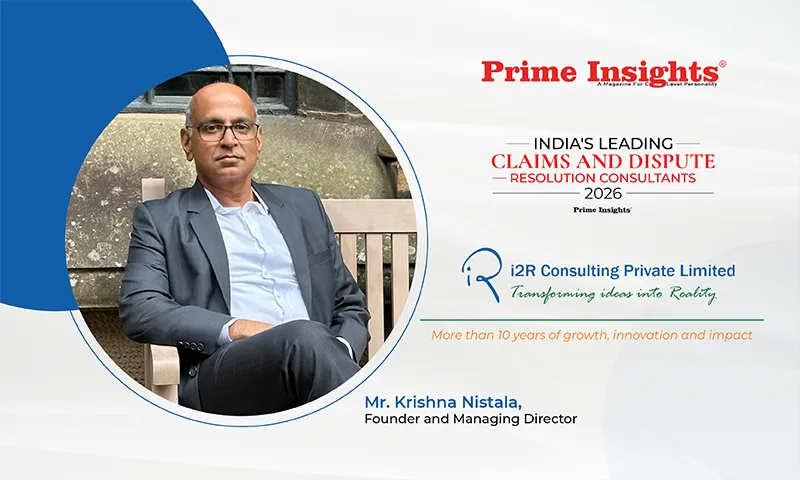
i2R Consulting Private Limited
A construction project can be completed on the ground and still remain unfinished on paper for years. Behind every road, bridge, metro, or airport project lies a complex web of contracts, approvals, payments, deadlines, and obligations—and when even one link breaks, the resulting dispute can keep millions or even crores tied up for years. This reality reflects the growing complexity of the construction and infrastructure industry, where tight margins, prolonged project timelines, multiple stakeholders, and increasingly competitive bidding leave little room for commercial inefficiencies. As projects become larger and more sophisticated, businesses need more than technical expertise; they need strong contract administration, evidence-based claims management, commercial foresight, and effective dispute resolution strategies to protect their interests and sustain profitability.
Against this challenging backdrop, i2R Consulting Private Limited, founded in Hyderabad in 2015 by Mr. Krishna Nistala, Founder and Managing Director, has established itself as a specialist in claims and dispute resolution consulting for the construction and infrastructure industry. Today, the firm advises projects across India and South Asia, supported by a workforce of more than 80 professionals and experience spanning over 300 projects. Group i2R comprises i2R Consulting Pvt. Ltd. (Parent Company) and its subsidiaries, Druta Designs Pvt. Ltd., i2R Rail Infra Systems Pvt. Ltd., and the innovation lab, i2R Infra IQ Lab™. The leadership team includes Ms. Sailaja Nistala, Director; Mr. Ramlal Chunduri, CEO of i2R Consulting Private Limited; Dr. Pattabhiram Yegulla, CEO of Druta Designs Pvt. Ltd.; Mr. Srinivasa Sarma Bhallamudi, CEO of i2R Rail Infra Systems Pvt. Ltd.; and Dr. Hareesh Boinepelli, Chief Technology Officer of i2R Infra IQ Lab™. Built from the founders’ first-hand experience as contractors and site engineers, i2R was created with a clear purpose: to help resolve the problems that construction businesses face every day while preventing capital and project value from becoming trapped in prolonged disputes.
What sets i2R apart is its practical, end-to-end approach. The firm works across the project lifecycle, from contract review, early risk identification, documentation, and claims prevention to entitlement and quantum assessment, delay and disruption analysis, claim preparation and defence, negotiation, conciliation, arbitration, and expert support. Its work also extends beyond disputes, helping contractors protect margins through buildability and value-engineering reviews, resource-linked planning, disciplined contract administration, and timely management reporting. Technology further strengthens this approach through solutions such as TractusIQ™, PlanisIQ™, and SentinelIQ™, developed through i2R Infra IQ Lab™ to bring greater structure, traceability, and intelligence to contractual and project information.
In the spotlight is Mr. Krishna Nistala, Founder & Managing Director, i2R Consulting Pvt. Ltd., in an insightful interview featured in our prestigious India’s Leading Claims and Dispute Resolution Consultants – 2026 edition. Through his experiences, achievements, entrepreneurial journey, and leadership insights, discover the thinking behind i2R’s growth and the valuable lessons that can inspire businesses to build stronger, more resilient, and future-ready organizations.
Prime Insights: Can you introduce your firm and share its core mission in claims and dispute resolution consulting?
I founded i2R Consulting Private Limited in Hyderabad in 2015. Today, we advise on highways, expressways, bridges, rail, metro, urban infrastructure, and airport projects across India and South Asia, including Nepal and Bangladesh. Over the past decade, we have grown to a workforce of more than 80 people and supported over 300 projects, contributing to more than 1,800 km of roads and 4,000 bridge structures.
Group i2R has also expanded to include Druta Designs, which we formed in 2016 for feasibility studies, DPRs, detailed design, and construction-stage support; i2R Rail Infra Systems, which has been operational since 2022 for rail, metro, and transit systems; and i2R InfraIQ Lab™, our internal innovation lab established in 2025 to combine our domain knowledge with digital capability.
My mission has always been to solve the problems the construction industry deals with every day, using engineering knowledge, practical experience, and technology where technology genuinely helps. In claims and dispute resolution, we work across the entire lifecycle, covering entitlement and quantum, delay and disruption analysis, claim preparation and defence, negotiation, conciliation, and arbitration support. A large share of our effort goes further upstream, into making a client’s position defensible long before a claim is contemplated.
Prime Insights: What inspired the establishment of your firm, and how has your journey evolved?
Our founding team spent much of our careers working as contractors and supervising contractors, both in India and overseas. From this vantage point, we repeatedly witnessed the same challenge: a contractor completes the work, the work is duly executed, the payment is legitimately due, yet even seven years later, the contractor may still be waiting to receive it.
Subcontractors go unpaid. Equipment stands idle. Banks reclassify the exposure. The company loses the capacity to bid for its next project. In national highway arbitration alone, claims of roughly `88,100 crore were raised over a five-year period, against counterclaims of more than `39,000 crore. Capital of that scale, sitting still, does nothing for anyone. Released, it pays wages, clears debt, and funds the next project, with a multiplier that runs through the wider economy and employment. I founded i2R in 2015 to release that capital and, wherever possible, to keep it from getting stuck at all.
The same experience also showed us where margins disappear. Very little is lost at the bidding stage; the erosion happens during execution, through value-engineering opportunities identified too late to be adopted, programmes disconnected from resources, fronts and cash, contract administration handled as routine correspondence rather than as the protection of entitlement, and management reporting that describes what has already gone wrong instead of warning what is about to.
Competition has thinned construction margins to a level where none of this is survivable. Closing these leaks became the other half of what we do.
Prime Insights: What does your team look like, and how do you retain expertise in a specialist field?
Only ten people have left i2R in eleven years. Most went for higher studies or family reasons, and they remain some of our best ambassadors in the wider industry. Against a workforce of more than 80, that represents very low attrition.
The commercial value of this is easy to underestimate. Disputes run for years. The engineer who drafted a notice in year two is usually still with us when the matter is argued in year six, carrying the context, the correspondence, and the memory of the site.
For me, continuity of people means continuity of evidence. It gives our clients confidence that the people handling their matters understand not only the documents but also the circumstances behind them, and that continuity shows in the quality of the record we are able to place before a tribunal.
Prime Insights: How did the firm navigate difficult periods such as COVID-19?
Through the pandemic and every month since, no salary at i2R has missed its due date. We made that commitment when project sites were shut and receivables were uncertain, and we have held to it.
The reasoning was straightforward. We spend our working lives advising clients to be disciplined about contractual commitments, to honour obligations on time, and to put things in writing. A firm making that argument has to be visibly disciplined about its own commitments.
That decision also helped us keep our team together and ensured that the expertise our clients depend on was still in place when work resumed.
Prime Insights: What differentiates your approach in providing effective, commercially focused and timely dispute resolution?
Our founding team came up through the ranks, starting as site engineers. We have set out works, chased fronts, argued designs and measurements, prepared bills, run projects, and later supervised them from the employer’s side.
That progression shapes how we examine a delay or disruption. We have personally stood in the situations we are analysing, and that experience helps us quickly understand which explanations will hold and which ones may fall apart under cross-examination.
We also place unusual weight on contract administration during execution. I consider it the most effective form of dispute avoidance available, and it is far cheaper than reconstructing a case two years after the event.
A claim resting on a sound contemporaneous record is credible, proportionate, and capable of settlement.
Prime Insights: Beyond disputes, how do you help contractors protect the margins they are losing during execution?
Half of our work involves no dispute at all. We focus on protecting margins during execution, particularly in the four areas where money most commonly leaks: value-engineering opportunities that surface too late to be adopted, planning that is not tied to resources, fronts and cash flow, contract administration handled as correspondence rather than as protection of entitlement, and management information that reports history instead of providing early warning.
We work alongside the client’s own team on all four areas. We review design and methodology for buildability and cost, build programmes that can be defended, establish notice and record discipline from the first month, and structure reporting so management can see exposure while there is still time to act on it.
When contractors get this right, they raise fewer claims and win a higher proportion of the claims they do raise.
Prime Insights: What types of claims and disputes do you primarily handle and which industries do you serve?
Our work covers construction and infrastructure claims, including extension of time, prolongation, disruption, change of scope and variations, additional cost, payment and financing impacts, approval, land and utility delays, and contractual interpretation.
We work across highways, expressways, bridges, railways, metros, airports, urban infrastructure, power, and industrial projects under EPC, HAM, BOT/DBFOT, item-rate, and FIDIC-based frameworks. Our involvement can range from claim formulation and defence through negotiation and conciliation to arbitration and expert support.
Prime Insights: How do you help clients identify, assess and manage potential claims and disputes at an early stage?
We push our clients to confront emerging issues during execution, while positions are still flexible and the record is fresh. Our teams review contracts, programmes, instructions, correspondence, site constraints, payment events, and design changes to identify exposure early and ensure entitlement is notified within the time the contract allows.
We then insist on structure: notices issued on time, an event register maintained, schedules updated, and cause linked to effect as it happens.
On many projects, that discipline alone prevents a dispute from forming. Where a claim does become necessary, it ensures that the claim can be properly proved.
Prime Insights: What role do contract review, claims analysis, documentation and risk assessment play in your process?
These form the backbone of every engagement we undertake. We first establish how the contract allocates responsibility, risk, relief, and notice obligations. We then test actual project events against those requirements using schedules, instructions, correspondence, drawings, site records, and financial data.
A genuine commercial grievance still has to be carried through entitlement, causation, evidence, and quantum before it becomes a claim worth pursuing.
For us, risk assessment is about exposing gaps and likely counterarguments early, while there is still time to strengthen the position—or to conclude that a pragmatic settlement is the better commercial answer.
Prime Insights: How do you leverage technology, data analytics and digital tools to strengthen claims evaluation and dispute management?
We use technology to improve the quality, speed, and traceability of project information, while professional judgment remains at the centre of every decision.
TractusIQ™ brings structure to contractual correspondence by classifying communications, mapping them to clauses, linking related threads, and tracking obligations and deadlines. This helps ensure that a project’s contractual history remains traceable instead of being scattered across inboxes.
PlanisIQ™ maintains the delivery record, covering physical and financial progress, target against achieved performance, constraints, and the actual reasons for slippage captured as they occur.
Together, these tools preserve, contemporaneously, the two things every claim eventually rests on: what was said and what actually happened.
We are developing all these products through our innovation lab, i2R InfraIQ Lab™.
Prime Insights: Concession disputes do not end at completion. How do you address handing over and asset-condition risk?
Handing over is one of the least-prepared-for dispute events in Indian infrastructure. In BOT, DBFOT, and HAM projects, divestment obligations are tested near the end of the concession, and the outcome decides retention amounts, rectification liability, and the release of guarantees.
The argument usually turns on a single condition assessment carried out shortly before expiry, with no reliable historical baseline to measure it against. That reduces a very large financial question to a contest of opinions.
We built SentinelIQ™ to address this challenge. Continuous instrumentation of bridges and major structures, covering natural frequency and damping for stiffness, strain for overload and fatigue exposure, deflection and pier tilt for settlement and bearing behaviour, scour depth, corrosion indicators, and environmental variation, builds a documented behavioural record across the life of the asset.
Condition at handing over can then rest on a demonstrable trend. The same record can help establish whether deterioration resulted from maintenance practices or from factors outside the concessionaire’s control, such as sustained overloading, which carries its own compensation consequences.
Prime Insights: Can you share a case where your expertise achieved a favourable or commercially valuable outcome?
One National Highway DBFOT project valued at over `2,000 crore had stalled under prolonged delays, authority-side constraints, and severe financial stress. We were engaged to reconstruct the project chronology from first principles, establish where contractual obligations had not been met, assess the commercial consequences, and support the client through negotiation.
Our work consolidated roughly `700 crore of claims across several heads into a single coherent, evidence-backed position. As reported in the published case study, this supported a settlement of approximately `400 crore together with a restructuring of milestones. This helped restore liquidity, allowed works to recommence, and protected the long-term value of the asset.
The matter was resolved through negotiation rather than by award. In my experience, this is precisely the kind of outcome that a well-evidenced case can make possible.
Prime Insights: How do you approach complex disputes on high-value construction and infrastructure projects?
We begin by rebuilding the factual sequence, identifying the contractual responsibilities attaching to it, and then evaluating entitlement, time impact, and financial consequence as distinct but connected workstreams.
Complex matters usually involve overlapping causes, including design development, approvals, access, interfaces, financing effects, productivity loss, and resequencing.
Our task is to turn fragmented project information into a case that is technically sound, commercially coherent, and capable of withstanding scrutiny.
Prime Insights: What challenges do businesses commonly face in claims management, and how does i2R’s role sit alongside that of legal counsel?
Most clients arrive with a real entitlement but no reliable way of proving it. The recurring causes are late notices, fragmented correspondence, incomplete site records, weak schedule updates, missing links between event and consequence, and poor coordination between engineering, contracts, finance, and legal teams.
We rebuild timelines, connect cause to effect, apply appropriate delay methodologies, quantify impact, and align every issue to the governing contract.
However, I believe our more valuable service is helping clients build the record contemporaneously, so they do not have to pay later for expensive retrospective reconstruction.
Our founding team is precise about where our role sits alongside legal services. Counsel frame the pleadings, argue the law, and carry the case before the tribunal. We supply the ammunition they argue with: the engineering analysis, programme evidence, causation chain, and quantum, drawn from project records and assembled in a form that can withstand examination.
Construction tribunals decide technical and factual questions as often as legal ones, and counsel armed with evidence of that quality are better positioned to present a strong case.
Where required, our specialists also appear as expert witnesses and support counsel in preparing for cross-examination. The two roles are complementary, and clients see the best outcomes when both are engaged early and working from the same body of evidence.
Prime Insights: How do you ensure objectivity, confidentiality, professional integrity and transparency?
Credibility is our principal asset. Our responsibility is to establish what can be demonstrated from the contract, the factual record, and the evidence.
That means assessing vulnerabilities as rigorously as strengths, stating assumptions openly, preserving traceability to source documents, distinguishing established fact from professional opinion, and handling all information under controlled access.
Clients rarely enjoy hearing where a case is weak, but I believe they are far better served by learning it from us before the other side does.
Prime Insights: What strategies do you use for negotiation, mediation, arbitration and other ADR mechanisms?
We work towards a sound commercial resolution as early as circumstances allow, without diluting legitimate rights.
Before any negotiation, we establish the factual basis, contractual position, time consequences, financial exposure, and an acceptable range of outcomes.
In mediation, conciliation, DRB or DAB proceedings, and arbitration, we build our submissions around the strongest evidence and the most defensible arguments.
We also consider settlement in terms of cash flow, probability of recovery, legal cost, management time, and continuing relationships. This allows our clients to make a commercial decision rather than simply pursuing a matter of principle.
Prime Insights: How do you stay updated with evolving laws, contractual practice and dispute resolution standards?
We continuously track policy changes, authority circulars, contractual frameworks, judicial and arbitral developments, and recognised delay and disruption methodologies.
One of the most consequential current shifts is the move away from arbitration in public procurement towards conciliation, mediation, and structured settlement.
As the available forum narrows, the contemporaneous record carries far more weight in deciding outcomes. Parties who have maintained a strong record are the ones who are better positioned to settle early.
Prime Insights: What are your future plans for expertise, technology and market presence by 2026 and beyond?
Our next phase is about strengthening both depth and breadth.
By depth, I mean continuing to improve our core capabilities in engineering, manufacturing, installation, project management, and after-sales service. By breadth, I mean developing i2R as a more comprehensive architectural building-solutions organisation.
We will continue strengthening our capabilities in forensic delay and disruption, claims strategy, and expert support while extending further into rail, metro, airports, and large capital programmes.
Alongside our growing pan-India presence, I see clear opportunities to take our model across South Asia and into selected international markets.
We will continue investing in technology, people, processes, and structured project data because I believe the future of our industry lies in bringing engineering knowledge, contract intelligence, and digital capability together.
Prime Insights: What advice would you give businesses when selecting a claims and dispute resolution consultant?
My advice is to look beyond a firm’s ability to produce a claim document.
A dependable adviser should understand how projects are designed, planned, executed, administered, and financed, and should be able to connect engineering reality to contractual and commercial consequences.
I would recommend testing for relevant sector experience, genuine senior involvement, familiarity with the specific contract model, forensic capability, evidence discipline, and independence of judgment.
Most importantly, look for an adviser who is willing to build a defensible position and protect cash flow rather than simply being eager to enlarge the claim.
Prime Insights: Is there anything you would like to add?
The purpose of i2R is to solve the problems the construction industry deals with every day, using engineering knowledge, practical experience, and technology where technology genuinely helps.
For me, success looks like healthier margins on projects, records that are good enough for most disagreements to be settled before they harden, settlements reached in months rather than years, capital returned to the economy, and concession assets handed back at the end of term without argument.
Claims work becomes necessary when a project reaches these things late. Our objective is to help clients reach them earlier.
