

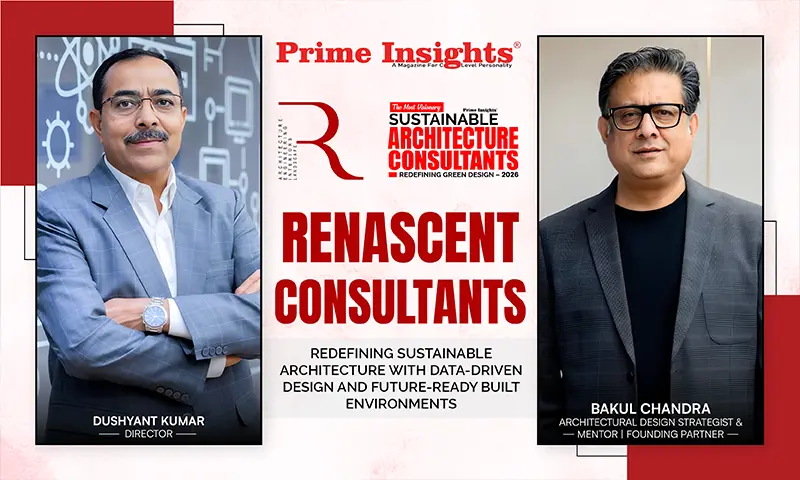
Renascent Consultants
Did you know that the average person spends nearly 90% of their life indoors? It’s a staggering statistic that transforms architecture from a matter of “pretty buildings” into the single most important factor in our daily health, mood, and productivity. In an era where our skyscrapers and hospitals are essentially the “ecosystems” we inhabit, the architecture and design industry is facing a high-stakes challenge: how do we build for a future that demands both luxury and survival? The competition has shifted from merely designing sleek glass facades to creating “living” buildings that breathe, conserve water, and effectively lower our heart rates. For the modern firm, the blueprint is no longer just a map of walls—it’s a strategy for long-term human and environmental resilience.
Leading this architectural evolution is Renascent Consultants, a firm that treats sustainability not as a “premium add-on” but as a fundamental responsibility. Leading this vision are Bakul Chandra (Architectural Design Strategist & Mentor | Founding Partner) and Dushyant Kumar (Director). With a background built in the belief that buildings should optimize urban systems, their story is one of transforming complex requirements into “visually calm” environments. From their founding, they have moved beyond simple green features to embrace integrated design thinking—a philosophy that has powered landmark projects like the Graphic Era Hospital at Dehradun.
The firm’s success lies in its technical DNA. By using energy simulations, daylight analysis, and environmental modeling, Renascent Consultants makes sure that every massing and orientation decision is backed by data. Their work optimizes resource use through passive design, high-performance envelopes, and intelligent building controls, effectively reducing carbon footprints while enhancing the recovery of patients in healthcare settings and the focus of professionals in the workplace.
In the spotlight are Bakul Chandra and Dushyant Kumar in an interview for our prestigious “The Most Visionary Sustainable Architecture Consultants Redefining Green Design – 2026” edition. Learn from their insights and valuable lessons as an entrepreneur to excel and make it the best company. Stay tuned and know their tale of success.
Prime Insights: Can you introduce your firm and share the core philosophy behind your sustainable architecture and green design practices?
Renascent Consultants is an architecture and design consultancy focused on healthcare, institutional, and workplace environments. Our philosophy views sustainability as responsible planning — optimizing resources, improving building performance, and designing environments that remain efficient, adaptable, and relevant over long operational lifecycles.
Prime Insights: What inspired your journey into sustainable architecture, and how has your vision evolved over the years?
Our journey began with recognizing how buildings influence energy use, human well-being, and urban systems. Over time, our vision expanded from isolated green features to integrated design thinking—where sustainability, performance, and operational efficiency shape decisions from planning to long-term facility management.
Prime Insights: How do you integrate sustainability, functionality, and aesthetics into your architectural designs?
We approach design as a balance of performance and experience. Planning decisions consider climate responsiveness, efficient circulation, and operational needs, while materials, light, and spatial proportions create environments that remain functional, durable, and visually calm across decades of use.
Prime Insights: What innovative materials, technologies, or construction methods do you use to reduce environmental impact?
We emphasize passive design strategies, high-performance envelopes, energy-efficient systems, and durable materials suited to local climates. Modular planning, prefabrication where appropriate, and lifecycle-focused material selection help reduce waste, construction time, and long-term environmental impact.
Prime Insights: How do your projects add to energy efficiency, water conservation, and reduced carbon footprints?
Our projects prioritize daylight optimization, natural ventilation where feasible, energy-efficient mechanical systems, and intelligent building controls. Water conservation strategies include rainwater harvesting, low-flow fixtures, and efficient landscape planning, collectively reducing operational energy demand and environmental footprint.
Prime Insights: Can you highlight a landmark project that best represents your commitment to sustainable design excellence?
Our healthcare projects often best demonstrate this commitment. In several hospital developments, integrated planning improved daylight access, reduced travel distances, optimized HVAC performance, and supported efficient clinical operations—delivering environments that perform sustainably while supporting patient care and staff efficiency. Graphic Era Hospital at Dehradun is a case in point.
Prime Insights: How do you ensure compliance with green building standards, certifications, and environmental regulations?
We add regulatory requirements and green certification frameworks early in the design process. Through close coordination with consultants, simulation studies, and systematic documentation, we make sure that projects align with environmental guidelines while remaining practical, cost-effective, and operationally efficient.
Prime Insights: What challenges do you commonly face while implementing sustainable solutions, and how do you overcome them?
Common challenges include budget constraints, regulatory complexity, and limited awareness of lifecycle benefits. We address these through data-driven design decisions, phased strategies, and clear communication that demonstrates how sustainable planning improves long-term operational efficiency and asset value.
Prime Insights: How do you educate clients and stakeholders about the long-term value and benefits of green architecture?
We communicate sustainability through performance metrics rather than abstract concepts. Energy modeling, lifecycle cost analysis, and operational benchmarks help clients understand how thoughtful design reduces running costs, improves occupant experience, and protects long-term asset value.
Prime Insights: What role do digital technology, simulation, and data analytics play in optimizing your sustainable designs?
Digital tools allow us to evaluate building performance early. Energy simulations, daylight analysis, and environmental modeling help refine orientation, massing, and systems before construction, ensuring design decisions are informed by measurable performance outcomes.
Prime Insights: How do you build innovation, research, and continuous learning within your architectural team?
We encourage a culture of inquiry where team members study evolving technologies, environmental strategies, and global design practices. Internal reviews, research discussions, and exposure to diverse project typologies help continuously refine both technical capability and design thinking.
Prime Insights: What collaborations or partnerships have helped improve your sustainable design capabilities?
Collaboration with engineers, environmental consultants, and technology specialists strengthens our approach. These multidisciplinary partnerships allow sustainability to be embedded across structural systems, building services, planning strategies, and operational workflows.
Prime Insights: How do you measure project success beyond aesthetics and cost—particularly in terms of environmental and social impact?
Success is measured through building performance, operational efficiency, user comfort, and adaptability over time. We evaluate how spaces support human well-being, reduce resource consumption, and remain resilient as organizational and environmental needs evolve.
Prime Insights: What are your future goals for expanding your sustainable architecture practice and driving industry-wide change?
Our goal is to deepen integration between architecture, infrastructure, and operational performance. We aim to advance design strategies that reduce resource demand, improve healthcare environments, and encourage more strategic collaboration between architects, engineers, and urban systems planners.
Prime Insights: What advice would you give to young architects and designers wanting to build careers in sustainable and green architecture?
Understand that sustainability begins with planning, not technology. Study climate, infrastructure, and building performance deeply. The most effective architects combine design sensitivity with technical understanding, allowing them to create spaces that remain responsible, resilient, and enduring.
