

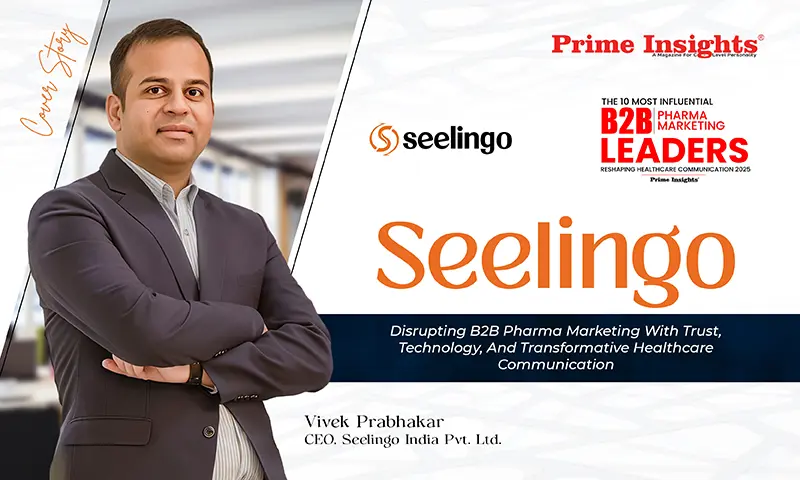
Seelingo
“In pharma marketing, credibility is the real currency. Technology is just the bridge.”
— Vivek Prabhakar
Did you know that for a B2B pharma marketer, the regulatory approval process for a single marketing campaign can sometimes be as rigorous as an actual clinical trial? This fact underscores the high-stakes, highly regulated, and quickly evolving nature of the B2B pharmaceutical marketing industry. Unlike consumer tech, competition here is not just about gaining market share but establishing trust and scientific credibility with a small, highly educated audience of healthcare professionals, researchers, and institutions. The landscape needs a delicate balance, where storytelling must be accurate and ethical, and innovation must be carefully integrated with stringent regulatory compliance. The global market is quickly transitioning from traditional sales-rep models to digital-first, data-driven communication, creating a new frontier where the ability to simplify complex science and deliver personalized, timely insights determines success.
In this challenging environment, SEELINGO INDIA has come up as a key disruptor. Founded in 2021, the company is an active private limited entity focused on trading and revolutionizing the medical consumables and equipment supply chain, serving as a transparent B2B marketplace. Leading this entrepreneurial venture is Vivek Prabhakar, a serial entrepreneur who has previously founded and scaled two unicorns. Having built my career across the USA, China, India, and other global markets, Vivek brings a tech-based innovation mindset to healthcare. His journey, sparked by the struggles in the healthcare supply chain witnessed during the Covid-19 pandemic, is rooted in the mission to simplify science, build trust, and get better health outcomes through tech-enabled solutions. His entrepreneurial message is about finding opportunity in crisis and balancing speed, compliance, and trust to make a lasting impact.
SEELINGO INDIA works by building a transparent B2B marketplace for the medical consumables and equipment supply chain. By directly connecting healthcare institutions with quality-assured products, the company cuts procurement costs, sometimes by up to 30%. Beyond this supply chain efficiency, Vivek Prabhakar and his team are known for innovative communication strategies in pharma marketing, blending AI-powered personalization with narrative design. This involves creating adaptive content platforms that deliver complex insights in simplified formats—like infographics and micro-learning videos—tailored to the user, redefining communication as a dynamic, two-way knowledge exchange.
In the spotlight this month is Vivek Prabhakar in an exclusive feature for our prestigious “The 10 Most Influential B2B Pharma Marketing Leaders Reshaping Healthcare Communication – 2025” edition. Learn from his insights and valuable lessons as an entrepreneur to excel and make it the best company. Stay tuned and know his tale of success!
Prime Insights: Can you introduce yourself and share your core mission in the B2B pharma marketing space?
I am a serial entrepreneur who has founded and scaled two unicorns at the intersection of technology and healthcare. Having built my career between USA , China , India and other Global Markets, my mission in B2B pharma marketing is to bring a tech-based innovation mindset into healthcare communication. I believe pharma marketing should not just promote products, but also simplify science, build trust, and drive better health outcomes. My focus is on creating scalable, tech-enabled solutions that allow healthcare professionals and institutions to collaborate more effectively, making sure that access to knowledge translates directly into improved patient care worldwide.
Prime Insights: What inspired you to have a leadership role in healthcare marketing, and how has your journey evolved?
The idea of Seelingo came when I was not able to travel back to India during COVID, and seeing the struggles the healthcare supply chain was facing, due to which millions of patients were affected. My journey began in technology, but I quickly realized that healthcare, despite its importance, lagged in terms of communication, transparency, and adoption of digital tools. The spark came while working with the health industry, which often struggled to access timely, simplified information to guide decisions. Over the years, I evolved from building pure tech platforms to integrating AI-driven communication models for pharma clients across India and the USA. The evolution has been about scaling impact and from solving niche tech problems to shaping how entire healthcare ecosystems communicate, with an entrepreneurial mindset that balances speed, compliance, and trust.
Prime Insights: How is B2B marketing in pharma different from other industries, and what unique challenges have you faced?
Pharma marketing differs fundamentally because it requires balancing innovation with a duty of care. Unlike consumer tech, where storytelling can be bold and disruptive, pharma needs accuracy, regulatory compliance, and scientific credibility. The challenge I’ve faced most often is going through this fine line: making sure that campaigns are both engaging and ethical. Additionally, B2B pharma audiences are highly educated and skeptical—doctors, researchers, policymakers—so persuasion must come from value, not flash. As an entrepreneur, I’ve tackled this by borrowing from my tech background: using data, AI, and behavioral insights to craft messages that resonate authentically without diluting science.
Prime Insights: What innovative strategies have you used to strengthen healthcare communication?
One of my key contributions has been blending AI-powered personalization with narrative design. Instead of sending generic medical product updates, we build systems that curate the right information for the right healthcare professional at the right time. For instance, we developed adaptive content platforms that deliver insights in simplified formats, such as infographics, podcasts, micro-learning videos that are tailored to each user. Another innovation has been using community driven learning models, inspired by Silicon Valley’s startup culture, where clinicians and pharma clients co-create knowledge hubs. These strategies have redefined communication as a dynamic, two-way exchange rather than one-way marketing.
Prime Insights: How do you make sure that your marketing approach balances compliance with creativity in a highly regulated sector?
I approach this balance the same way I built my unicorns: by creating frameworks that allow innovation to flourish without breaching trust. In pharma marketing, that means embedding compliance as a design principle, not an afterthought. We work with medical and legal advisors to validate every message, while encouraging creative teams to experiment with format, design, and digital channels. For example, instead of limiting storytelling, we reimagine how data is visioned or how content is localized across markets. This makes sure that campaigns remain imaginative, human, and engaging, while meeting the highest ethical and regulatory standards globally.
Prime Insights: Can you tell us a milestone campaign that redefined communication for your clients?
One milestone was a multi-country campaign for a global pharma client, focused on accelerating awareness around breakthrough dental research. We built an AI-driven knowledge hub that personalized research summaries for physicians across India. Instead of overwhelming professionals with lengthy journal articles, our system distilled key findings into structured, bite-sized insights accessible via mobile and web. The campaign increased adoption of clinical updates as well as redefined the client’s positioning as a trusted knowledge partner. It demonstrated that when technology and storytelling converge, even the most complex medical science can be made actionable.
Prime Insights: What role do digital platforms, AI, and data-driven insights play in your pharma marketing strategies?
They from the backbone of everything we do. Coming from the Silicon Valley ecosystem, I’ve seen how AI and data-driven models transform industries. In pharma marketing, they help us personalize communication, predict engagement patterns, and measure impact beyond vanity metrics. Digital platforms extend our reach, while AI makes sure of precision—delivering the right content to the right healthcare professional, at the right time. By leveraging behavioural analytics, we understand how clinicians consume knowledge and adjust accordingly. For me, it’s about shifting pharma marketing from being broad and static to being targeted, adaptive, and deeply impactful.
Prime Insights: How do you build long-term trust and credibility with healthcare professionals and institutions?
Trust is built through consistency, transparency, and respect. I’ve learned that healthcare professionals value clarity and honesty over flashy campaigns. Our approach is to deliver science-backed communication that respects their intelligence and time. By providing resources that genuinely support decision-making—rather than pushing promotional agendas—we build credibility over time. Partnerships with institutions are rooted in co-creation; we involve them early in designing communication tools, making sure of alignment with their goals. My entrepreneurial philosophy is that trust compounds like capital: when you invest in it consistently, it pays back multifold in relationships, reputation, and long-term impact.
Prime Insights: In your opinion, how is B2B pharma marketing evolving in India and globally?
In India, B2B pharma marketing is transitioning rapidly from traditional rep-driven engagement to digital-first, education-focused communication. Global trends are moving toward AI-driven personalization, omnichannel platforms, and storytelling that humanizes science. From my global vantage point working across the US and Asia, I see India leapfrogging by adopting mobile-first and cost-effective digital tools, while Western markets push the frontier with AI, AR/VR, and advanced data analytics. The convergence of these models is creating a new global standard: communication that is personalized, real-time, and measurable, helping pharma companies to serve as knowledge partners rather than product sellers.
Prime Insights: What strategies have you found most effective in simplifying complex medical information for better engagement?
I believe simplification is an art. We use layered storytelling—starting with high-level, easily digestible visuals, then allowing deeper dives for those who want detail. Infographics, podcasts, micro-learning videos, and even gamification tools are part of our toolkit. AI helps us translate scientific jargon into personalized insights while maintaining accuracy. During one campaign, we converted dental product trial results into regional-language video explainers, significantly boosting awareness. The strategy is simple: respect the complexity of science, but never let complexity block understanding. This human-centred approach ensures better engagement across diverse healthcare audiences.
Prime Insights: How do you measure the success of your marketing campaigns in terms of impact and ROI?
Traditional ROI is necessary but not sufficient. In pharma, success must also be measured in knowledge transfer, trust, and behaviour change. We track engagement quality, time spent on content, feedback loops from physicians, and ultimately, whether the communication influenced better decision-making. For instance, a campaign may not yield immediate financial returns but may strengthen long-term trust and adoption. We also use AI-driven analytics to measure how communication affects awareness, intent, and prescribing patterns.
Prime Insights: Can you share an example where your work significantly improved healthcare awareness or accessibility?
With Seelingo.in, we’ve reimagined how the medical consumables and equipment supply chain works in India and beyond. Traditionally, fragmented distribution and high markups inflated costs for hospitals, clinics, and ultimately patients. By building a transparent B2B marketplace, we enabled direct access to quality-assured products, cutting procurement costs by up to 30%. This brought financial relief to patients through reduced treatment expenses as well as empowered healthcare institutions to optimize budgets and invest more in patient care. The ripple effect has been powerful—Seelingo.in has lowered barriers to affordability, while making sure that stakeholders across the ecosystem benefit from sustainable cost efficiencies.
Prime Insights: How do you nurture teams and build a culture of innovation in healthcare communication?
At heart, I believe people drive innovation. My approach is to empower teams with autonomy while building cross-disciplinary collaboration and bringing together medical experts, technologists, and creative storytellers. Drawing from my experiences at Harvard and in Silicon Valley, I learned that innovation thrives when failure is seen as learning. We encourage experimentation, pilot bold ideas quickly, and celebrate curiosity. Our culture is built around three values: impact, integrity, and imagination. By aligning purpose with entrepreneurial freedom, we make sure that every team member feels like a co-creator of change in healthcare communication, not just an executor of tasks.
Prime Insights: What future trends in pharma marketing do you believe will dominate the next 5 years?
The next five years will see AI-driven personalization and immersive AR/VR for medical education becoming mainstream. Another key trend will be patient-centric storytelling in B2B communication—acknowledging that every pharma innovation ultimately impacts lives. Globally, we’ll see greater integration of predictive analytics and conversational AI to provide real-time, context-aware communication. In India, mobile-first models will dominate, while developed markets push the boundaries with advanced immersive tools. What excites me most is that pharma marketing will evolve from being transaction-driven to becoming a knowledge economy, where pharma companies act as enablers of better healthcare.
Prime Insights: What advice would you give to emerging B2B pharma marketing professionals aiming to make a lasting impact?
My advice is threefold: stay curious, stay ethical, and stay global. Learn continuously, because healthcare evolves daily with changes. Put ethics at the core, credibility is your greatest asset in pharma. Finally, adopt a global mindset. My own career, shaped between India, USA, China, and global markets, taught me that solutions must scale beyond borders. Don’t chase trends blindly—focus on solving real problems that impact both professionals and patients. Embrace AI, data, and digital platforms, but never forget that healthcare communication is about people. If you keep empathy and trust at the center, your impact will be both lasting and transformative.
“At Seelingo, we’re not just building a marketplace—we’re building the future of connected, ethical healthcare communication.”
